Mapping pedestrian/cyclist road casualties by age

12 Nov

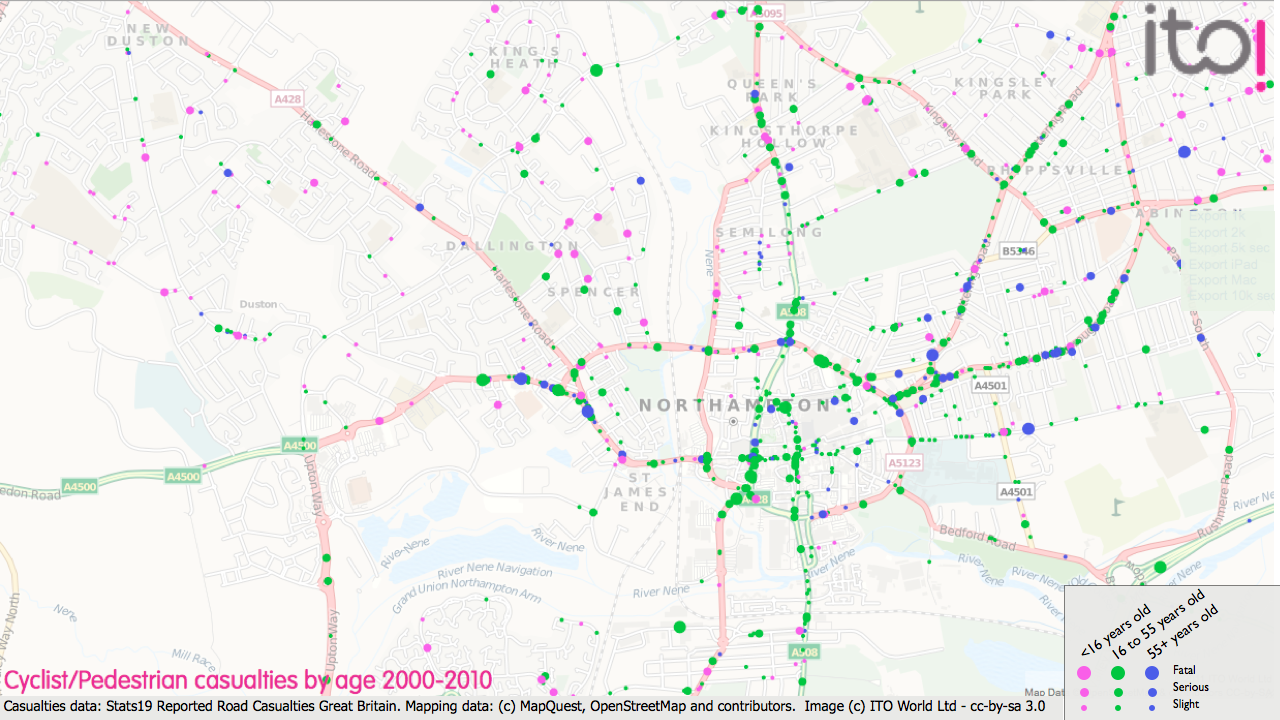
The Stats19 casualty data that the police have been patiently collecting for many years now is a mine of information. Here are some maps looking at where pedestrians and cyclists are injured and killed depending on their ages. I have taken three places which show up some patterns which deserve more analysis (London, Edinburgh and Northampton). There are some obvious patterns, in that children are hurt in the residential areas, 16-55 year olds tend to be injured in the commercial centres and along the main arterial roads whereas 55+ year olds have their own distinct patterns. However, it is also possible to see tell-tail clusters which deserve more investigation, including the apparent rat-runs along ‘residential’ roads that have much higher levels of injury than surrounding roads, and also the junctions and sections roads where higher numbers of casualties that surrounding ones. Click on the maps to make them bigger and see what you can find.

South London pedestrian and cyclist casualties by age 2000-2010

Edinburgh pedestrian and cyclist casualties by age 2000-2010

Northampton pedestrian and cyclist casualties by age 2000-2010

Lots more mapping coming up on the lead up to World Remembrance Day for Road Traffic Victims on the 20th Nov.

Rembering the dead on London’s roads

12 Nov

Thank you to the hundreds of cyclists who took part in the Tour du danger today to highlight a number of London’s most dangerous junctions and put pressure on the Mayor and on TfL to do some serious work on them.

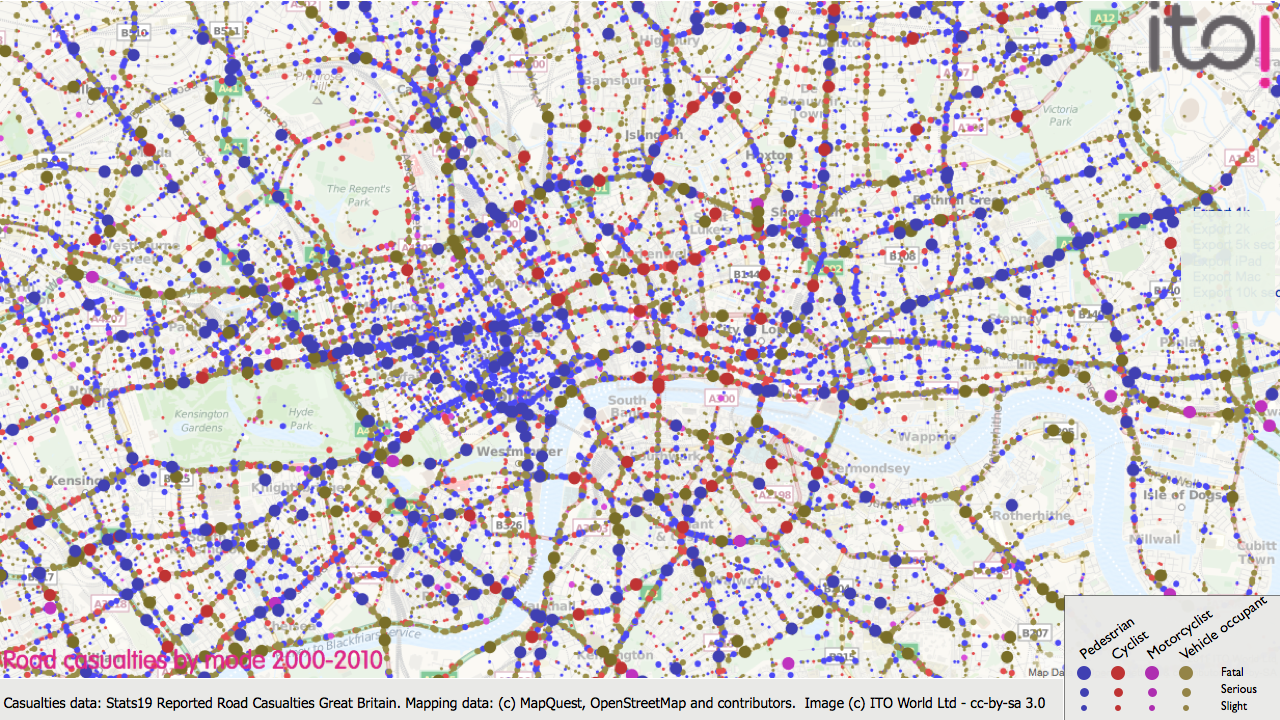
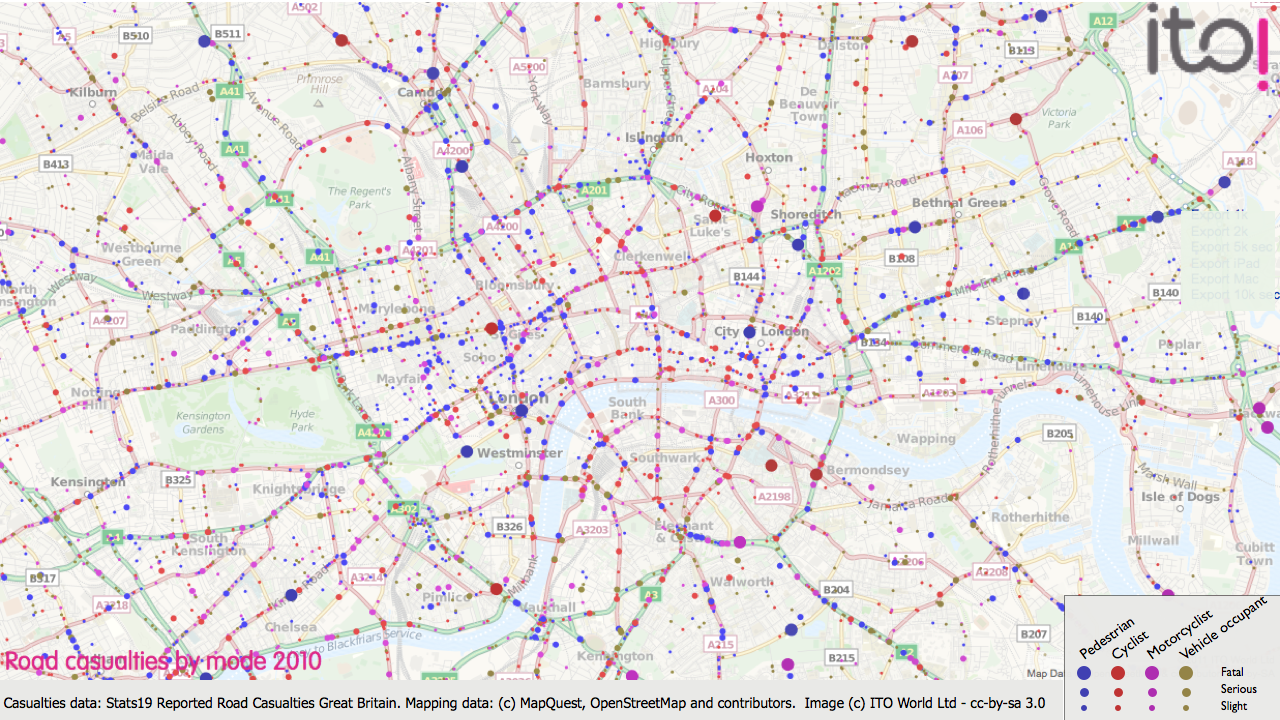
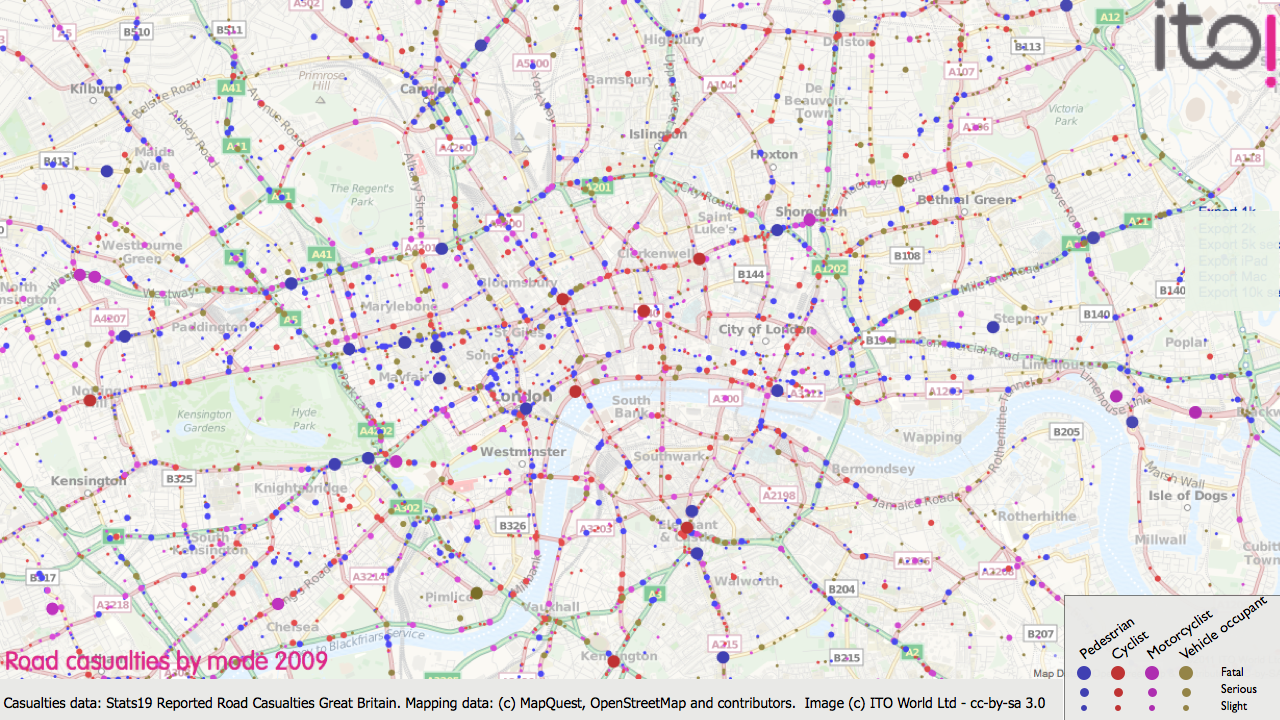
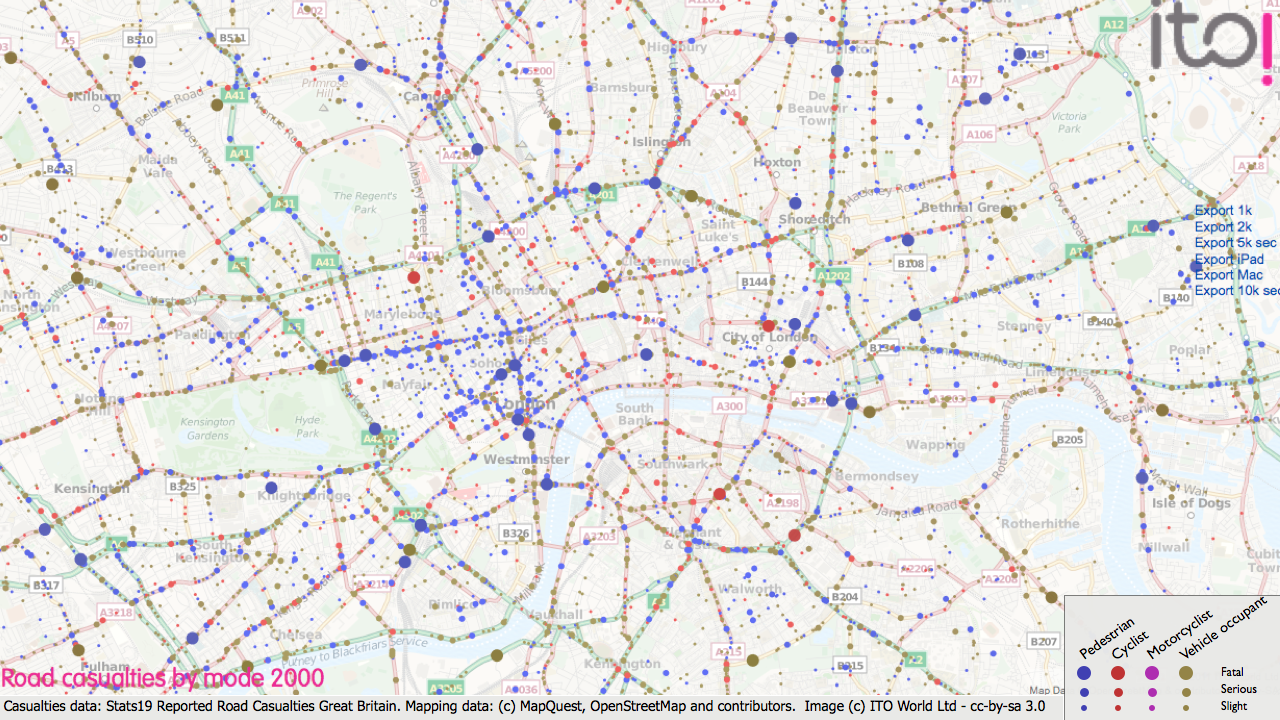
Here are some maps showing where people are have been getting killed and injured in recent years. The first one shows deaths and injuries from traffic crashes between 2000 and 2010, the second for 2010 only and the next one for 2009 and the final one for 2000. Areas of blue indicate were pedestrians are getting injured and killed, red shows the high risk areas for cyclists. Purple is for motorcyclists and tan/green for vehicle occupants. Click on the images to see them full size.

Road casualties in Central London 2000-2010

Road casualties in Central London 2010

Road casualties in Central London 2009

Road Casualties in Central London 2000

These maps appear to show that fatalities amongst vehicle occupants has fallen from 17 in 2000 to one in 2009 and then zero in 2010. For cyclists the trend is apparently going the other way (up from four in 2000 to eight in 2009 and also in 2010). Motorcyclist fatalities are up from 0 in 2000 to 6 in 2010, pedestrians falling significantly. Do however be aware that this map only shows one fatality blob for crashes with multiple fatalities (which may include multiple modes). I will do some more work on this in the coming week and the figures may then need to be adjusted upwards.

Based on Stats19 road casualty data. See ‘Reported Road Casualties Great Britain‘ for more details.

Dropped kerbs and ‘Special enforcement areas’

9 Nov

It appears to be a requirement that all rules relating to parking and pavements should be confusing and ineffective and slow to come into force. By way of example, lets look at the relatively introduced legislation which bans parking across dropped kerbs.

This legislation received Royal Assent back in 2004 with the Traffic Management Act of that year. Royal Assent was followed by five years of consultation on these new rules during which time the AA, needless to say, objected saying that it would be entirely unreasonable to expect motorists to know that it was illegal to park on dropped kerbs unless the council installed white lines on every single one at their own cost. I am glad to say that the government ignored them and the legislation was finally ‘enabled’ in June 2009. We should of course be grateful that the legislation was enabled at all, given that legislation which would have banned pavement parking entirely which received Royal Assent in 1974 was never enabled at all!

Now comes the ‘confusing’ bit. As I have said, legislation needs to be confusing. Part of the small print of the 2004 Act says that these new powers will only be available in places that adopt new ‘Special Enforcement Area’ status. Every Council wishing to use these powers then had to apply for this  Special Enforcement Area status (as distinct from ‘Civil Enforcement Areas’ which many had already been granted). To make it more complex Special Enforcement Areas can be applied for covering either an entire area of, or only part of a Civil Enforcement Area.

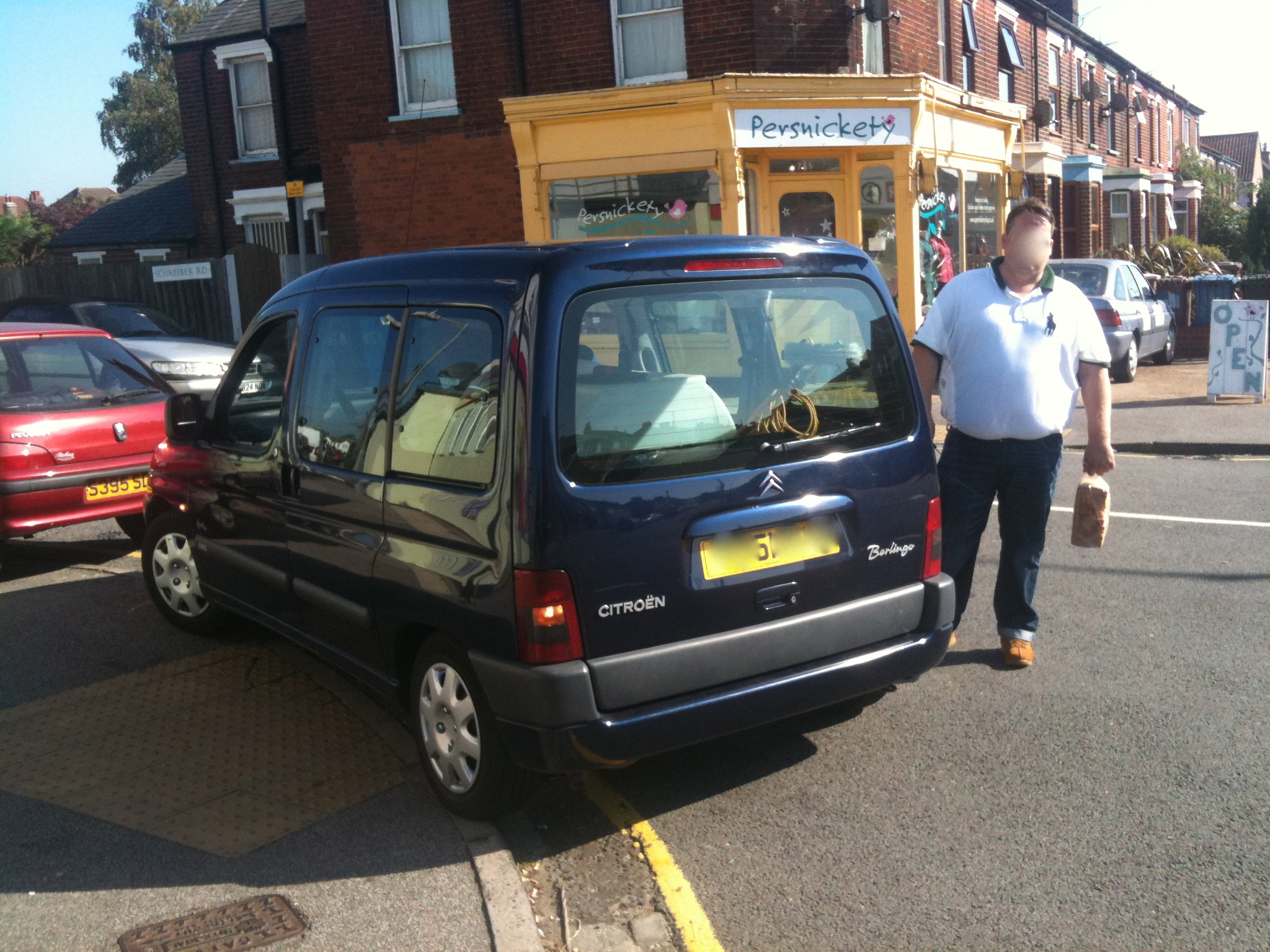
So.. the next question of course is to find out if my town and which other places have been granted ‘special enforcement area’ status. Is there a national map of these areas? err… no; is there a published list of such areas? err… no. Is it clear from my local authorities website if my town has been granted these powers? err.. no. The only way I found out that they had was to email them. The good news is that it has been enabled in my areas and people do get fined from time to time I understand. The bad news (for pedestrians) is that my local police didn’t even know that it parking across dropped kerbs was actually illegal and apparently refuse to enforce it in some cases. Here is a local driver explaining to be that he finds that this particular dropped-kerb is a very convenient (and often available) parking spot when doing his local shopping.

Blocking a dropped kerb, no problem

Beware, lobbying ahead

7 Nov

A new lobbying group “The Road Ahead Group” is apparently being set up by various business with interests in freight, and in building and operating roads. They will be lobbying Whitehall but according to the press aim to maintain a low public PR profile. True to their word, they appear to currently have no web presence but we do know that it has been set up by Brian Wadsworth who moved to a lobbying firm after a stint as Director of Strategic Roads, Planning and National Networks’ at the Department for Transport. Other supporters include Midland Expressways (who operate the M6 Toll road), my friends May Gurney and other infrastructure companies. Rather quaintly, one of their lobbying aims is to protect part of the Vehicle Excise Duty revenue for road building. (err, didn’t Winston Churchill get rid of that in 1937?)

In an apparently unconnected announcement in the past 24 hours the RAC Foundation and ARUP have claimed that the UK needs to spend £12.8bn building new roads; they talk about an infrastructure ‘shortfall’, outline 100 ‘urgently needed’ projects and say that current situation is ‘worrying’ and ‘concerning’. One thing they are not concerned about it carbon emission and climate change – the word carbon does not appear and the word ‘climate’ only gets mention in relation to the financial climate. They do however like toll rolls and Public Private Partnerships and by way of good examples they draw attention to the fact that Canada, Spain and the USA have built a lot of roads recently.

Curiously, given that neither Arup nor the RAC Foundation are publicly connected with ‘The Road Ahead Group’, but their report does happen to recommend that road building should be supported by “giving the sector a dedicated revenue stream, based on retained user charges and/or hypothecation of some motoring taxes (e.g. VED).” Incidentally, the RAC Foundation/Arup report is written by a former civil servant at the DfT, where ‘he sponsored the Department’s roles in major projects and transactions’. The doors are clearly still revolving – you can read about bit about revolving doors and lobbying in the UK on Wikipedia.

To sign off, here is an image from the RAC Foundation/Arup report. They don’t mention it by name, but it is this monsterous interchange in Los Angeles – an impressive bit of engineering for sure, but possibly not something any of us will want in our back yard, and indeed LA is going off roads and getting pretty excited about public transit.

Judge Harry Pregerson Interchange (Los Angeles)

Car park this way!

7 Nov

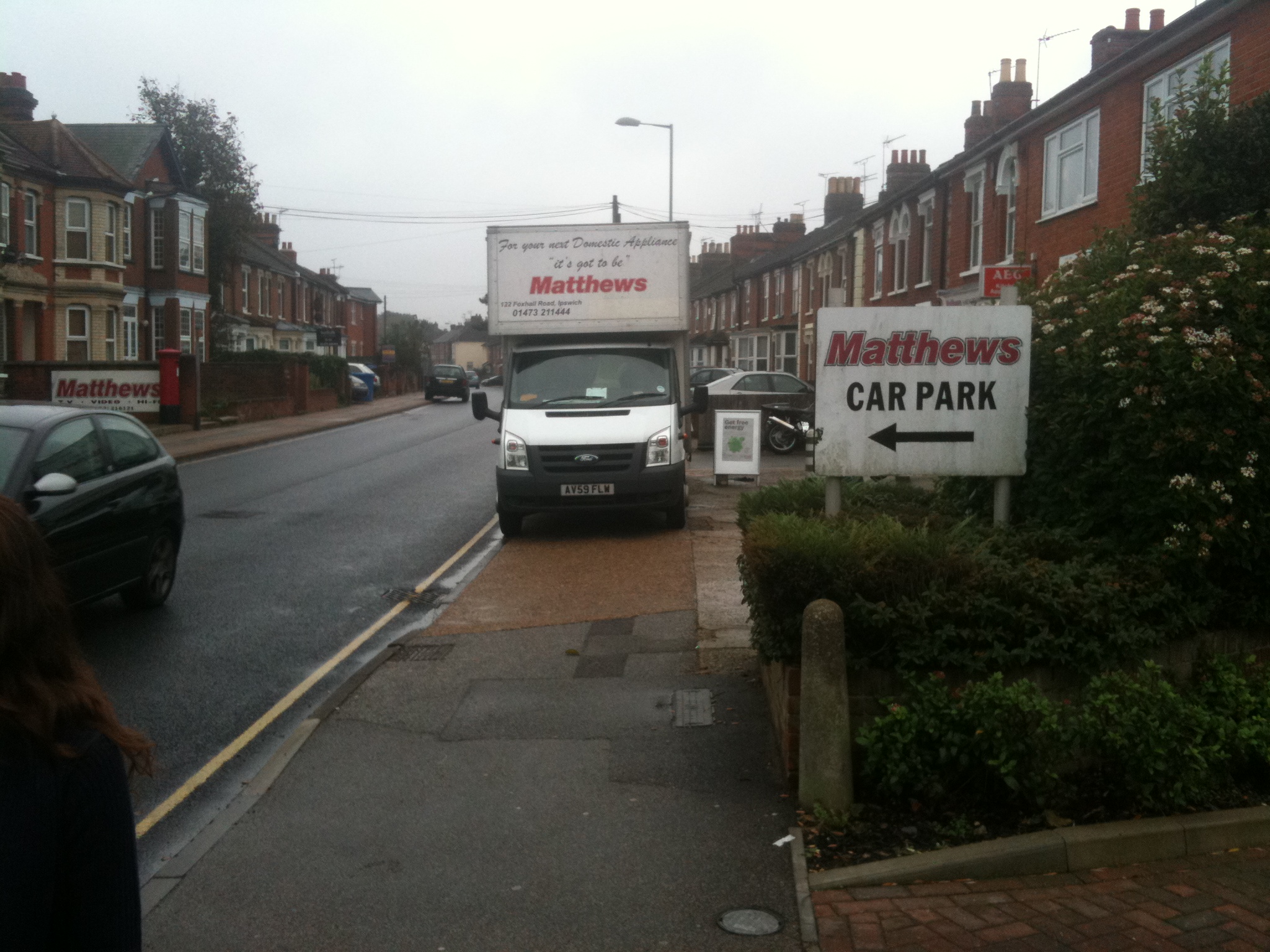
Matthews parked their van fully across the pavement right next to their own (empty) off-street parking bay and by a sign pointing to their car park a few days ago. As a results pedestrians have to navigate through their parking bay avoiding both the ‘pavement sign’ and the bollards to get past or to take their chances in the road. To their credit the company did immediately move the vehicle but the driver did say ‘it has never been a problem before’. Possibly not for the company, but for blind people it is one of the reasons why most blind people never go out. This is not a new concern however, back in 2002 the issues for blind people were the same.

Car park this way!

Another view of the same vehicle.

Update

The van was back in exactly the same location today. The staff see absolutely no problem what they are doing, and believe that blind and disabled people and everyone else would be able to find their way around the vehicle with no problems at all.

They repeat that no one has ever complained. Odd when the police must go up that road every day. Not only are then 100% obstructing the pavement, they are also on a single yellow line during its period of operation (which of course covers the pavement as well as the road). However… the police have never been very keen about enforcing these regulations.


Royal mail – An attitude problem?

7 Nov

Why on earth is this driver parking on the pavement? Normally the excuse is ‘I had to park on the pavement’, but in this case there are virtually no over vehicles in view. A different royal mail vehicle parked in exactly the same position the previous week – when I asked why he didn’t park across the road 20 meters away on the carriageway the driver explained that it was ‘too far’. This it not an isolated case unfortunately. There are more below and a few weeks back I blogged about this royal mail vehicle that obstructed two double decker buses in the centre of Ipswich. The driver explained that he could park exactly where he felt like because he was working for the crown!

Why park on the pavement when the road is empty!

Proper pavement parking

Not getting out, just sitting there on a double yellow with the door open while having a chat

Personally I think it is for the Royal Mail to do something about this. They need to do more ‘pedestrian awareness’ training or whatever and prove that they take the issue seriously. If they continue to park like this they will continue doing serious damage to their reputation.

Strange goings on at Halloween

31 Oct

Scary stuff was going on at Halloween in Oxford in 2002. This year there are road closures for events in Los Angeles, in Washington and also in in New York.

Road Witch trial 2002

A bit of honesty from the government??

24 Oct

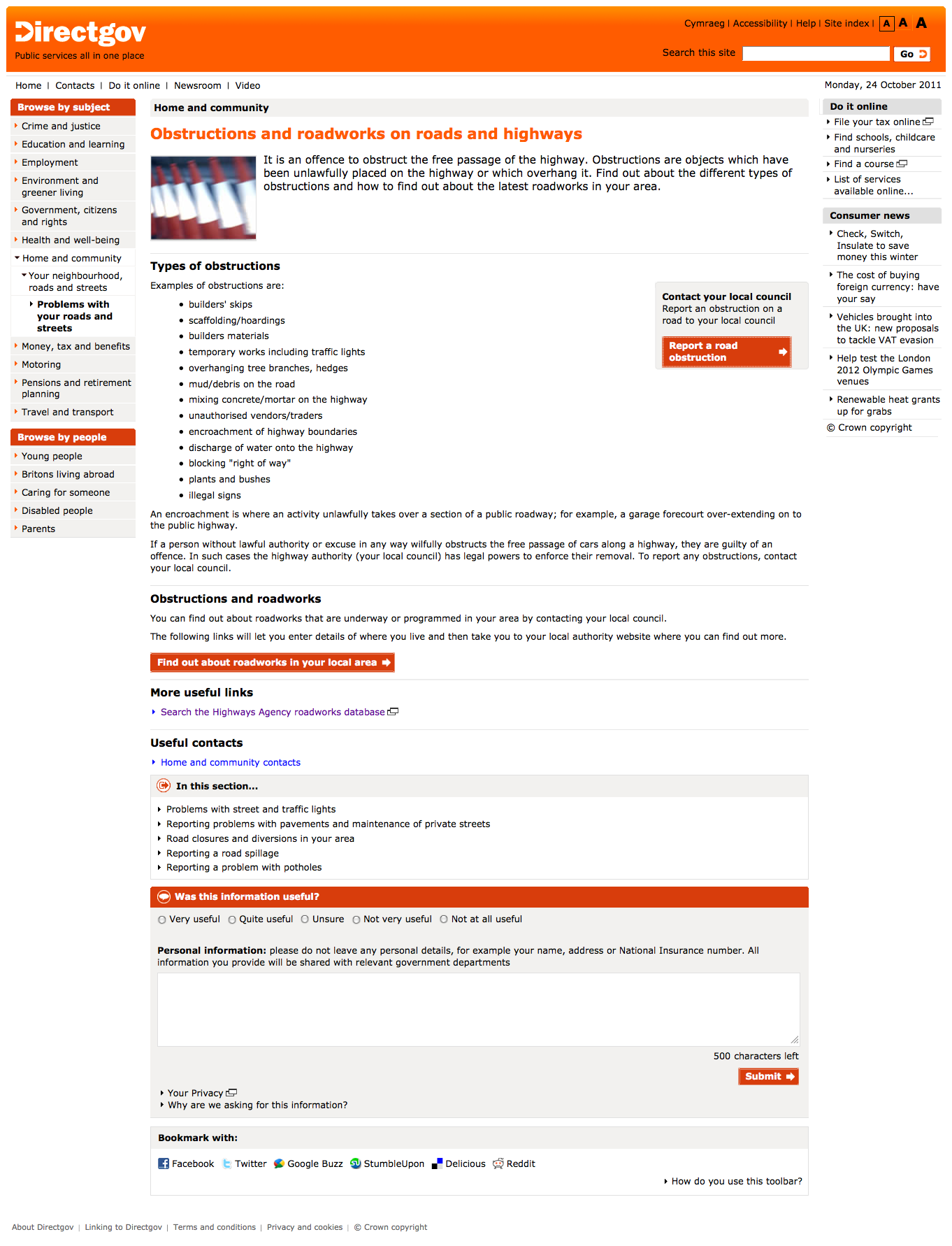
I was poking around some government websites over the weekend relating to ‘encroachment’ when I came across this delightful example of how discrimination against pedestrians (and indeed cyclists, motorcyclists and lorry drivers in this case) works. It comes from the ‘Homes and Communities’ section of DirectGov and expresses clearly attitudes which are common but normally unspoken:

An encroachment is where an activity unlawfully takes over a section of a public roadway; for example, a garage forecourt over-extending on to the public highway. If a person without lawful authority or excuse in any way wilfully obstructs the free passage of cars along a highway, they are guilty of an offence. In such cases the highway authority (your local council) has legal powers to enforce their removal. To report any obstructions, contact your local council.

OK, so that means that it is OK to willfully obstruct the free passage of pedestrians, wheelchair users, people with buggies and cyclists! Nice! Here is a screengrab of the webpage taken this morning.

DirectGov guidance on obstruction (screen grab from 24 October 2011)

I have already used the feedback box to suggest that they change this page and make it more inclusive. Others may wish to do the same.

Ipswich Borough Council blocking pavements with roadworks signage

17 Oct

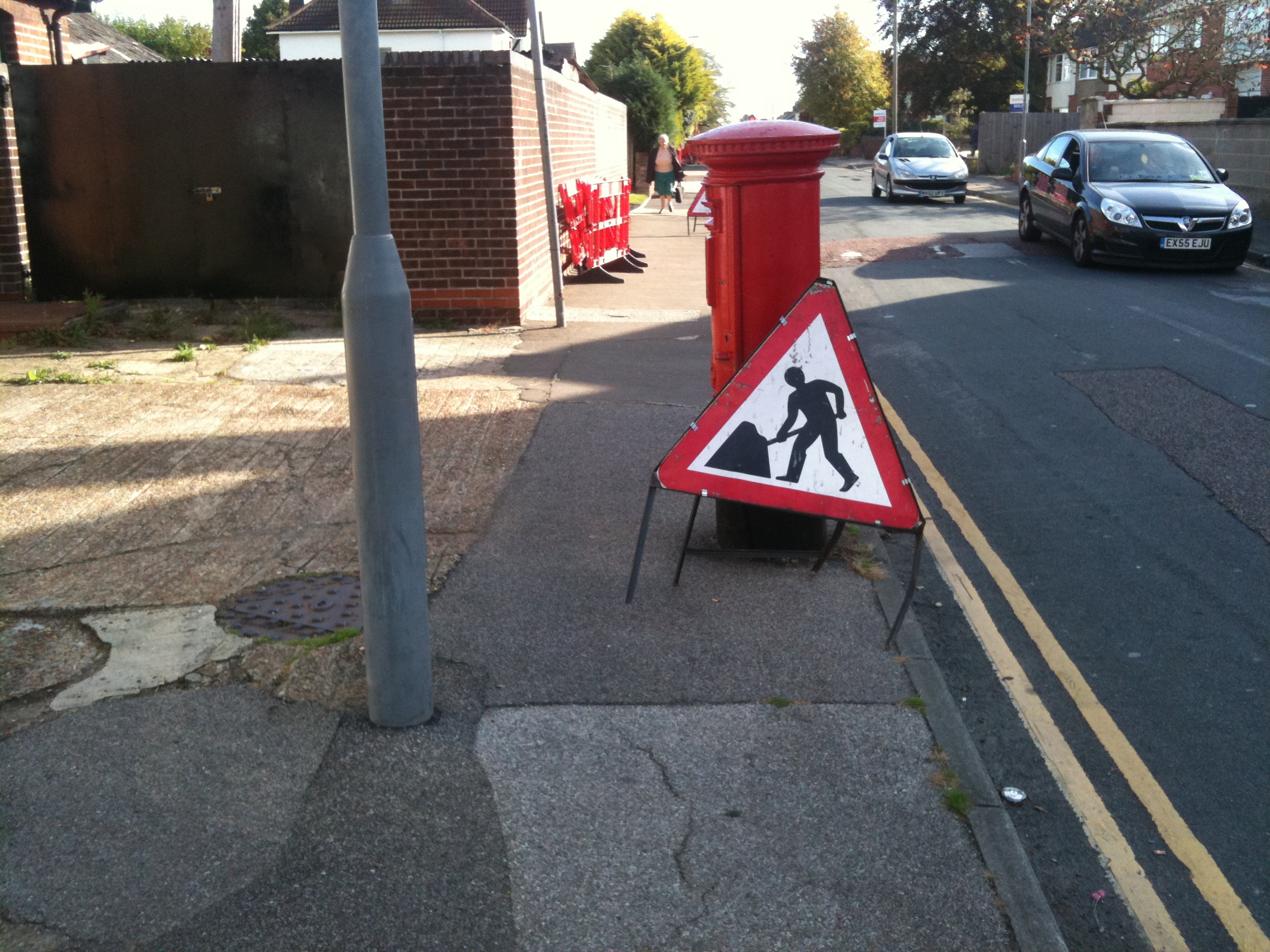
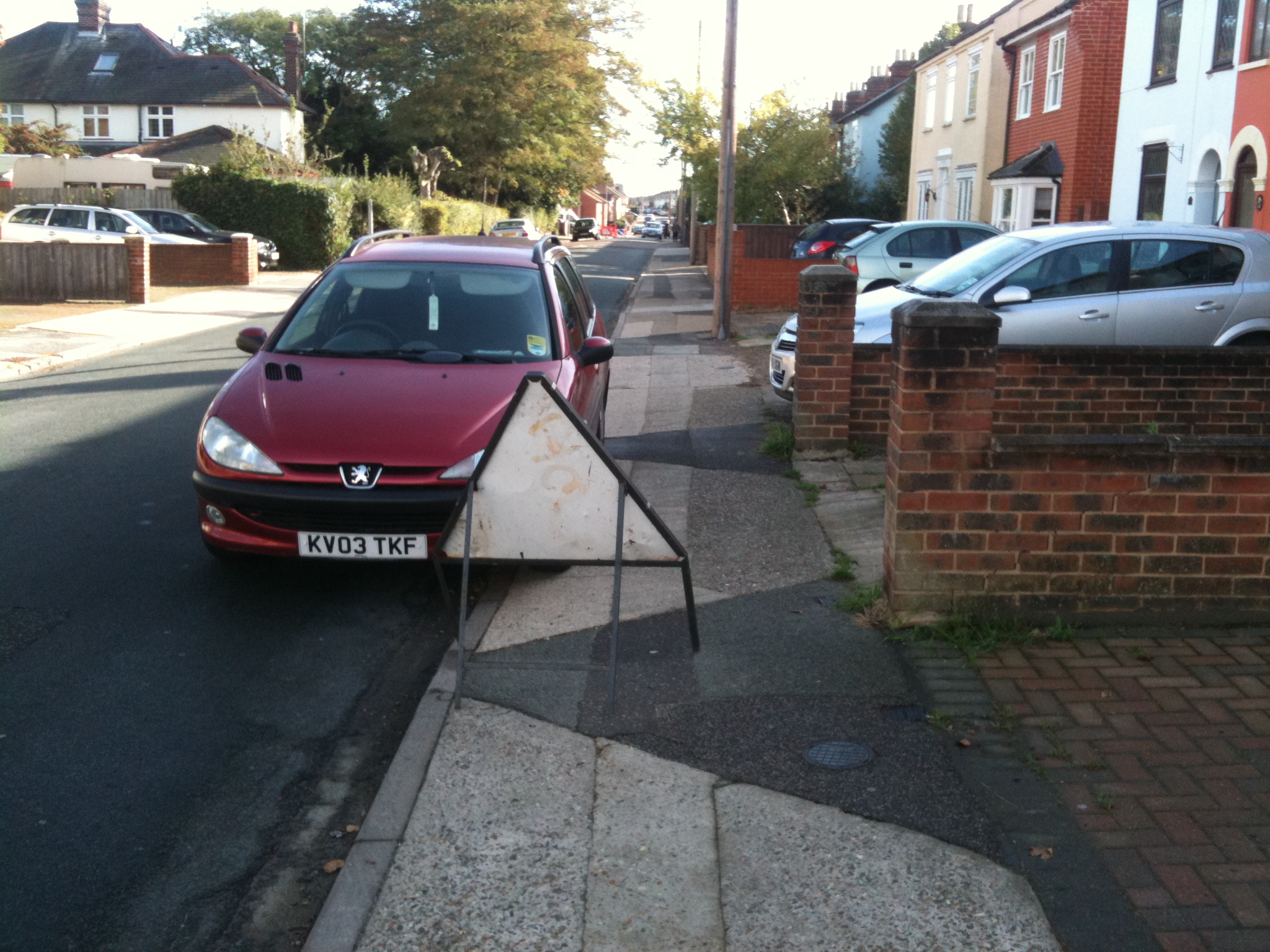
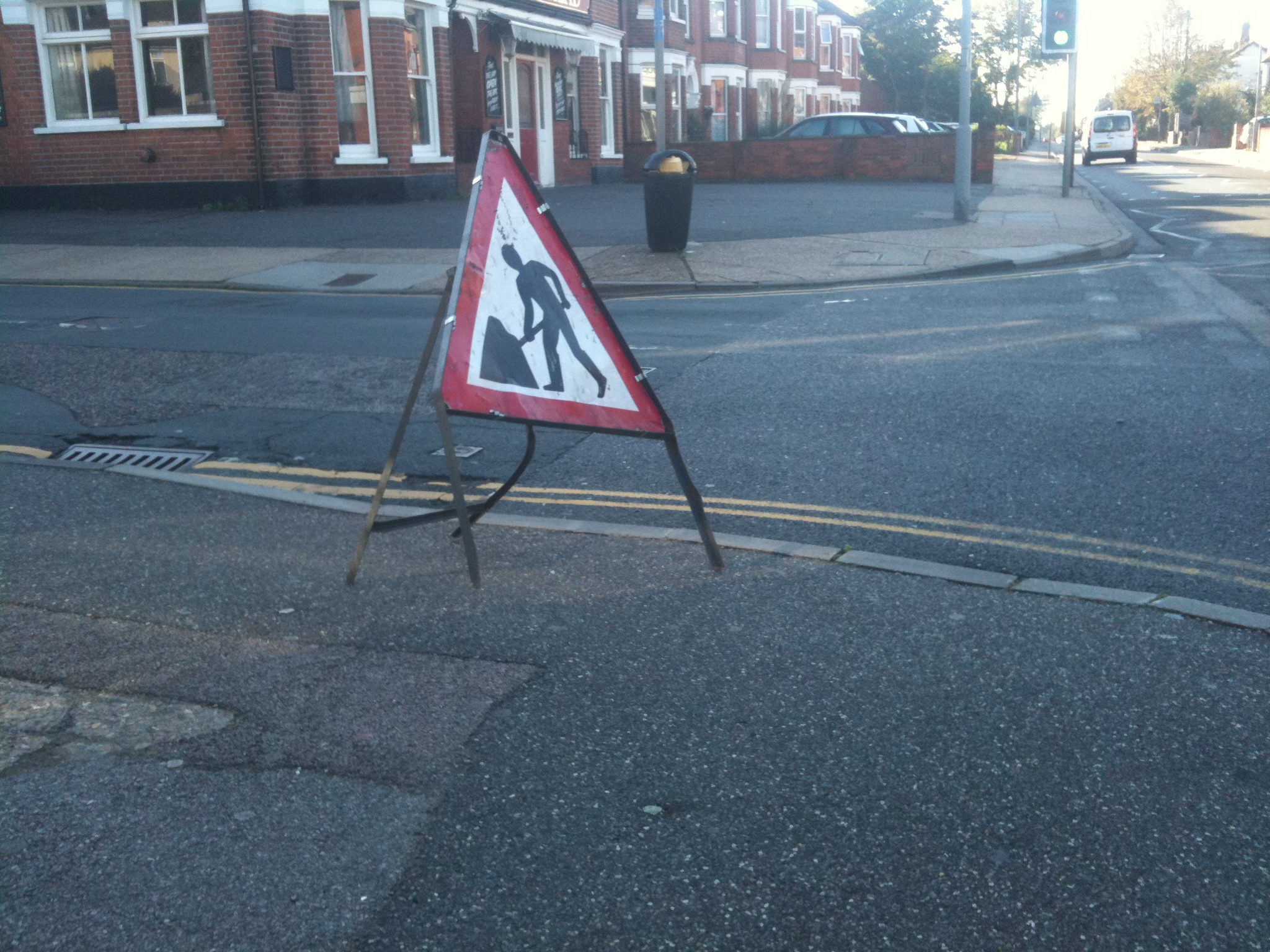
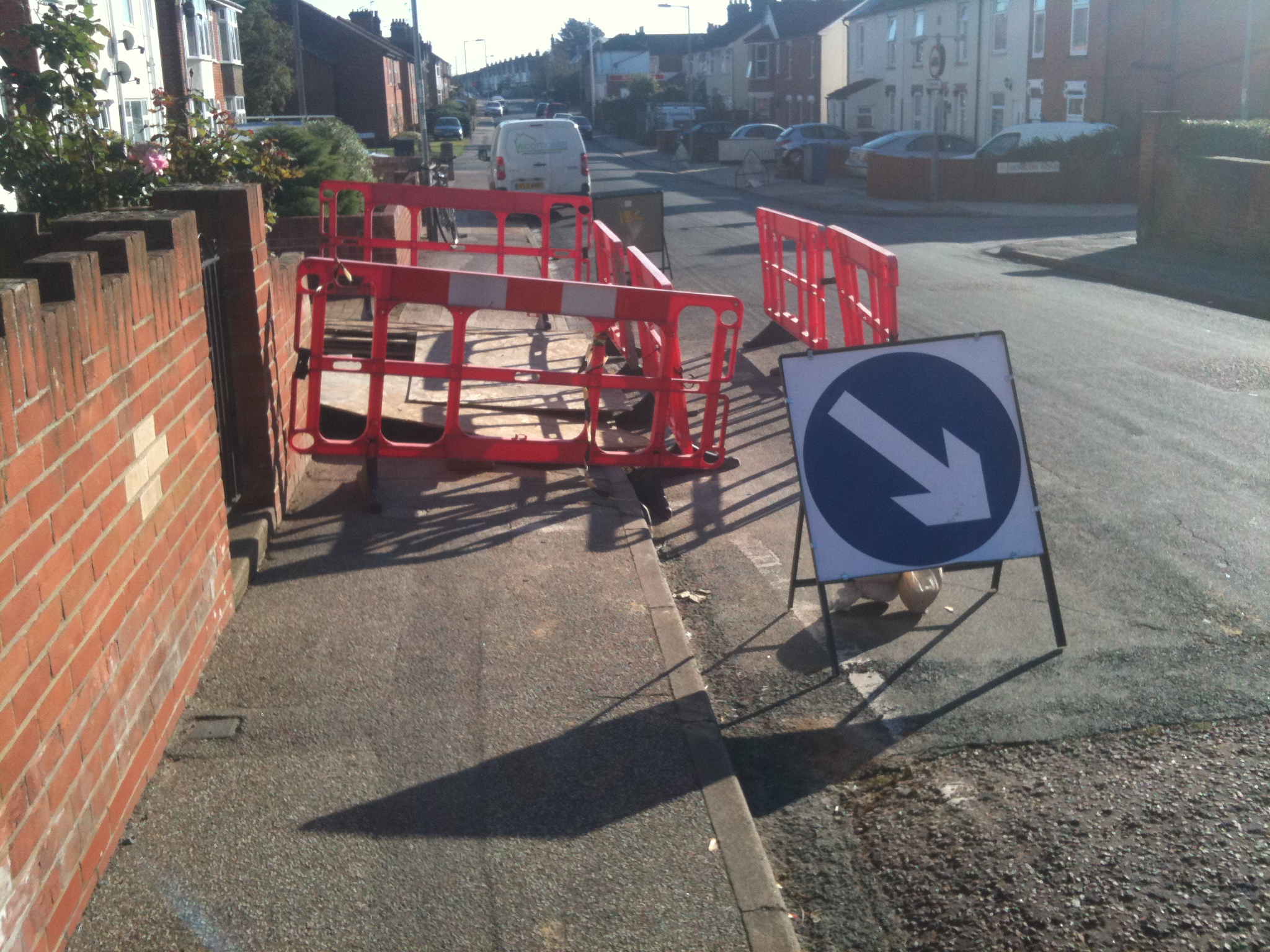
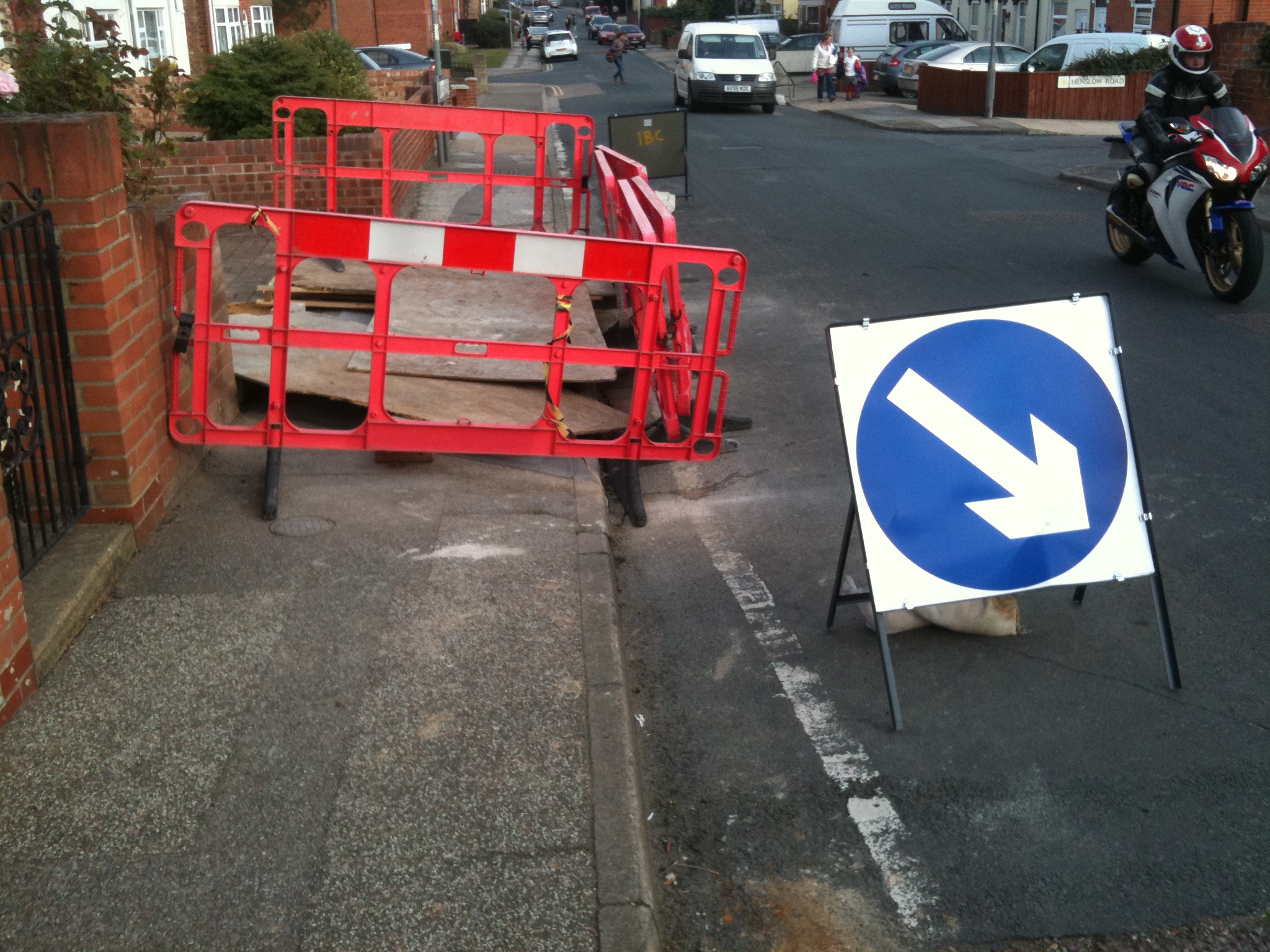
Ipswich Borough Council staff are disrupting pedestrians near to road works by leaving signs on pavement with only 800mm clearance (which is about the width of an external door to a house and less than the legally required 1 meter for road works signs). Only when pressed did they confirm that they knew the law about 1 meter clearance. Their justification was that they were concerned about the risk to motorists if the signs were further into the road – no concern at all that I heard about the risk to pedestrians and old people from leaving them on the pavement. I have reported this on fixmystreet which the council monitors and responds to.

Here are some photos of the signs in question. The good news is that there is a 100% clear rule that they are breaking in this case. No excuses about it being a ‘necessary obstruction’ or a ‘willful obstruction’. It is however a very clear example of the contempt that pedestrians are treated with and is, I am sure, repeated across the country. Incidentally I am still waiting for May Gurney to ask for their signs backwhich they left blocking a pavement over a week ago!

Only 800mm for pedestrians

Only 800mm for pedestrians

Making the pavement even narrower (less than the legal 1 meter as well)

Making the pavement even narrower (less than the legal 1 meter as well)

Blocking the pavement illegally and useless due to parked car!

Blocking the pavement illegally and useless due to parked car!

Damaged sign, no sandbag, on pavment across dropped kerb by local shop

Vehicle sign blocks access to pedestrian walkway for disabled

Update

The following day all consideration of pedestrians had disappeared.

No consideration for pedestrians at all the next day

Attacking the A40 bus lane in High Wycombe

17 Oct

Having abolished the M4 bus lane some hard-line motorists are now gunning for getting rid of bus lanes and are regretably even getting the support of local papers. A great example of this sort of thing is the campaign to get rid of the bus lane along the A40 into High Wycombe is now being championed by the Bucks Free Press who have created a ‘ban the bus lane’ petition to support their ’cause’.

The advocates of removing the bus lane say that it is dangerous and slows motorists – the council patiently explains that removing the bus lane will not increase the number of vehicles able to get into the town and will only result in slower journeys because of bus passengers switching to cars. The bus company point out that the lane is well used by buses and that they are about to increase the level of service with new buses.

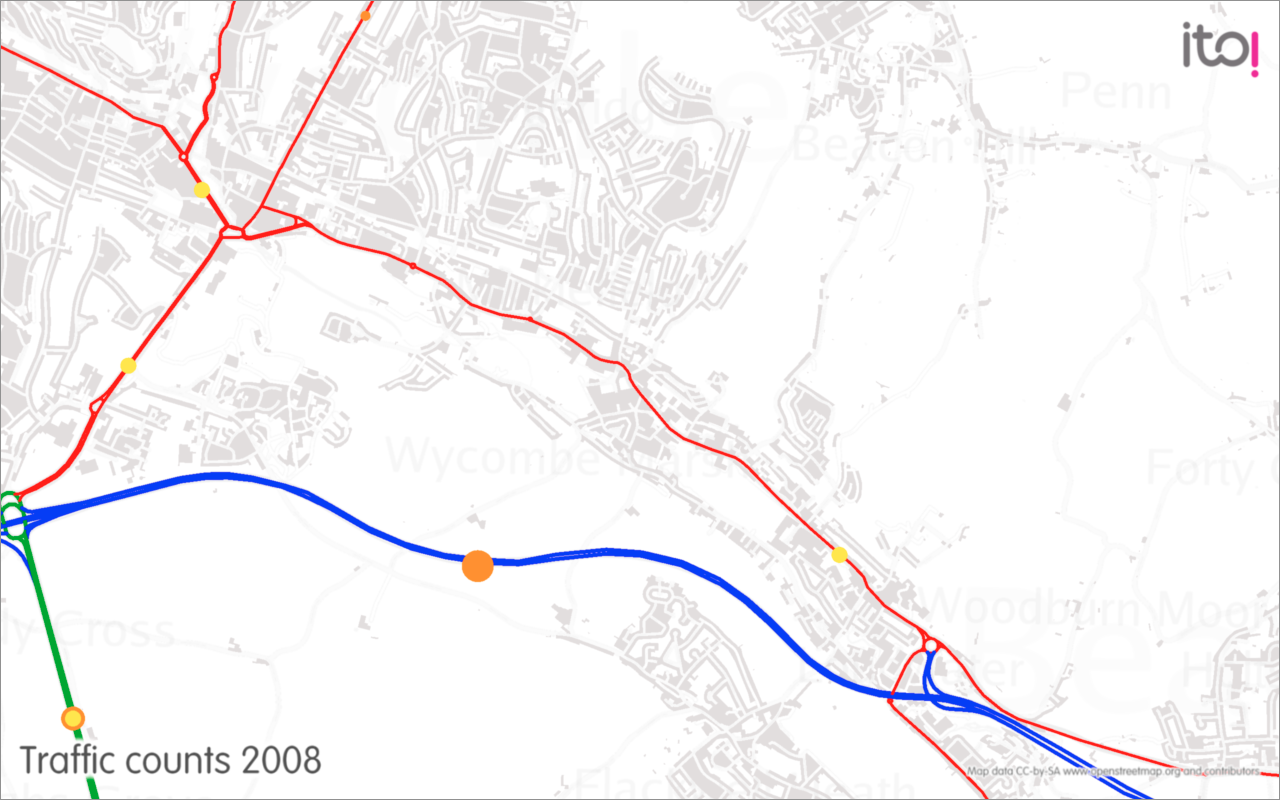
Here are some maps showing what is going on (all taken from official data). The first one shows bus service frequency on roads in the area (yellow most frequent) and confirms that there are many bus services along the A40 from Loudwater in the bottomm right of the map into High Wycombe at the top left. The second one shows traffic counts and traffic mix in the area in 2008 – the small yellow dot on the A40 towards the bottom right indicates that over 85% of the vehicles using that road are private cars or taxis. This confirms that the problem of congestion on the road is from cars not buses!

Bus service frequency on A40 into High Wycombe

Traffic counts and traffic mix around High Wycombe

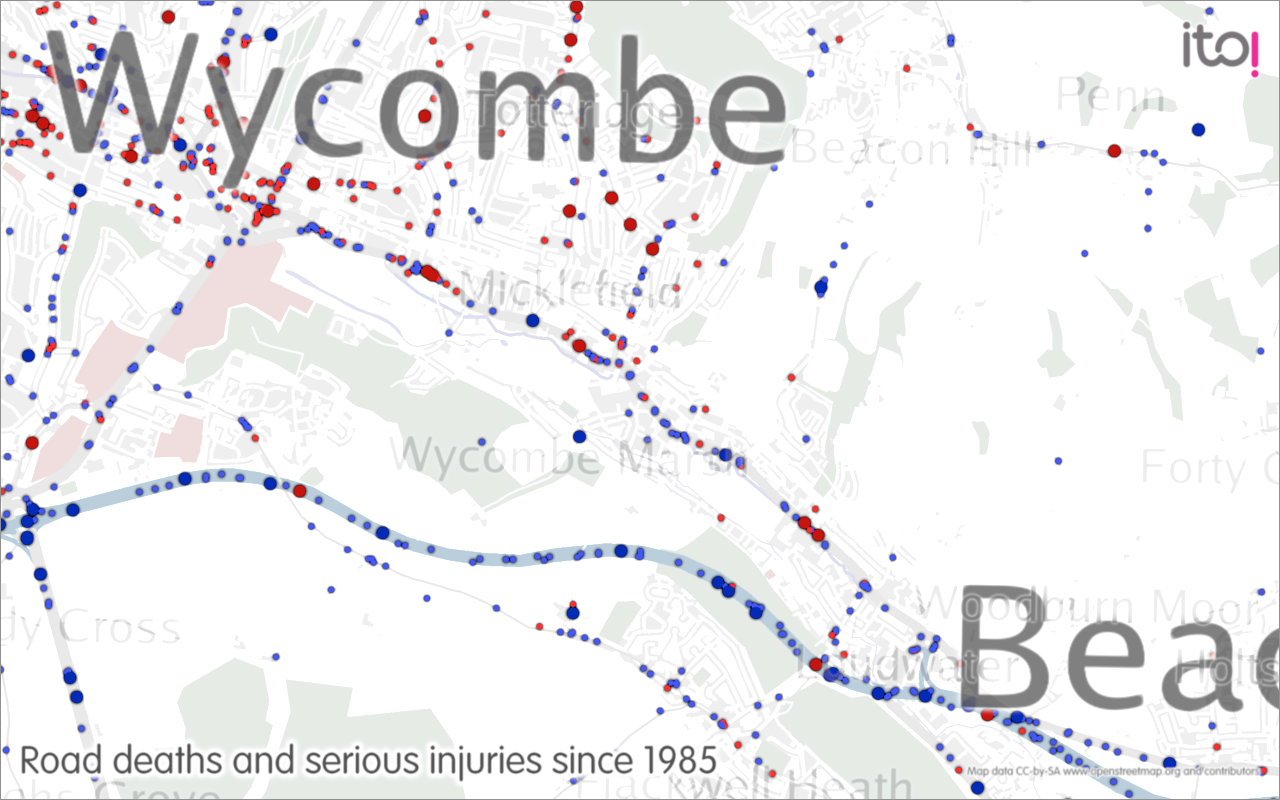
One of the reasons given for removing the bus lane is because ‘it is an accident waiting to happen’. Here are the actually accident results since 1985 on the road (big red dots a pedestrian fatality, small red dot a pedestrian serious injury, big blue dot for a driver fatality and a small blue dot for a driver serious injury). There have regrettably been six of pedestrian fatalities and two driver fatalities and also a number of driver serious injuries (how fast do you have to be traveling in a car in an urban area to have a serious injury I wonder)! Possibly this is a good reason to slower well-enforced speed limits rather than the removal of a bus lane?

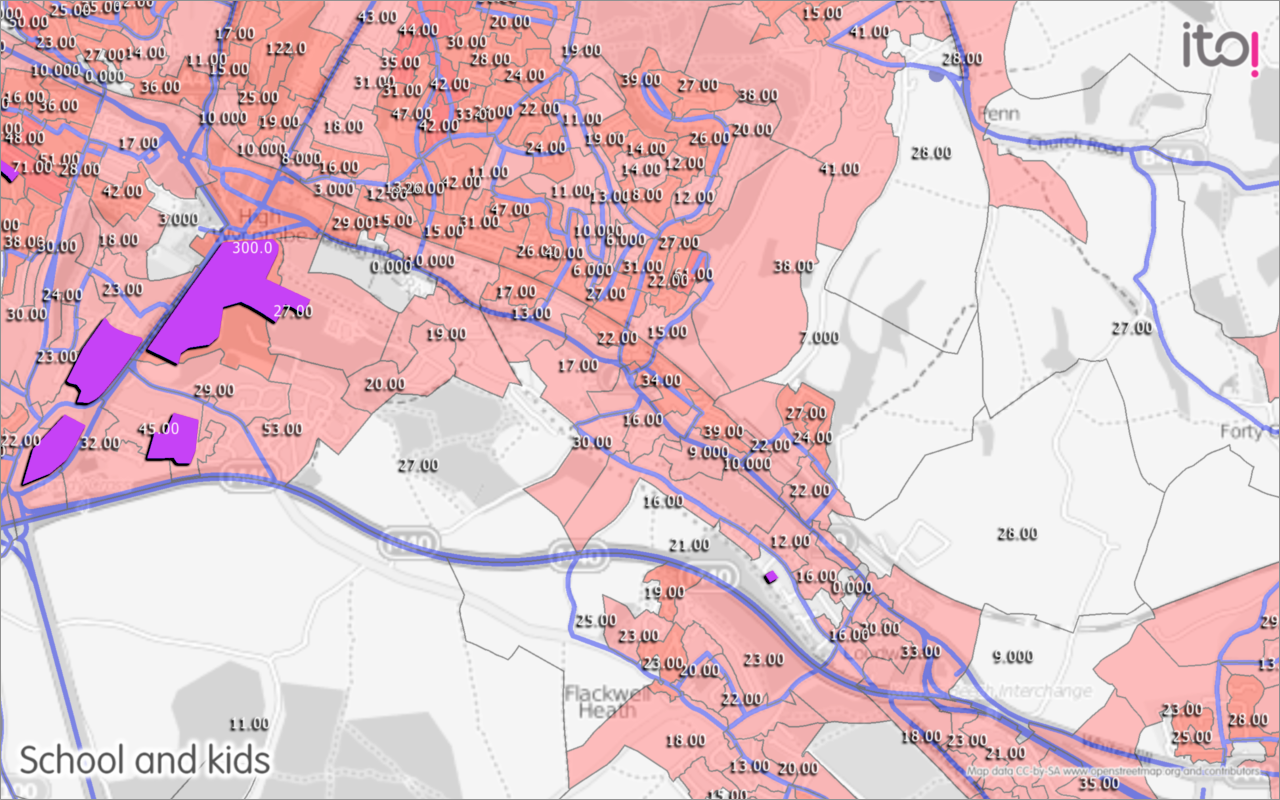
The final map shows where the schools are and where the kids live. As you can see most of the kids have to cross the A40 road to get to school each day.

Fatalities and serious injuries on the A40 approach to High Wycombe

The location of school and school-age kids to the SE of High Wycombe

All maps produced by the pre-release version of ITO Map. Base mapping OpenStreetMap and contributors. All maps cc-by-sa 3.0.