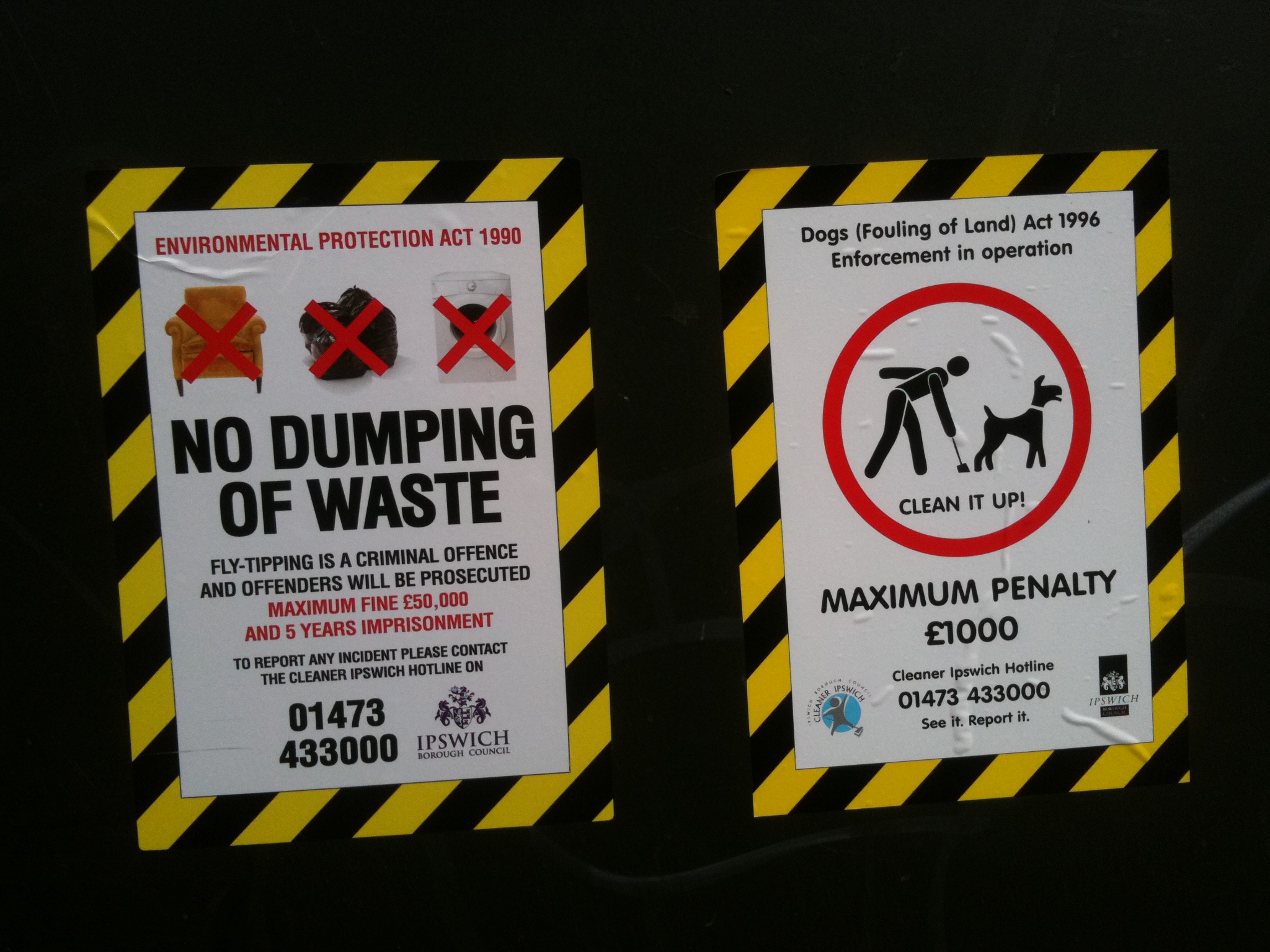
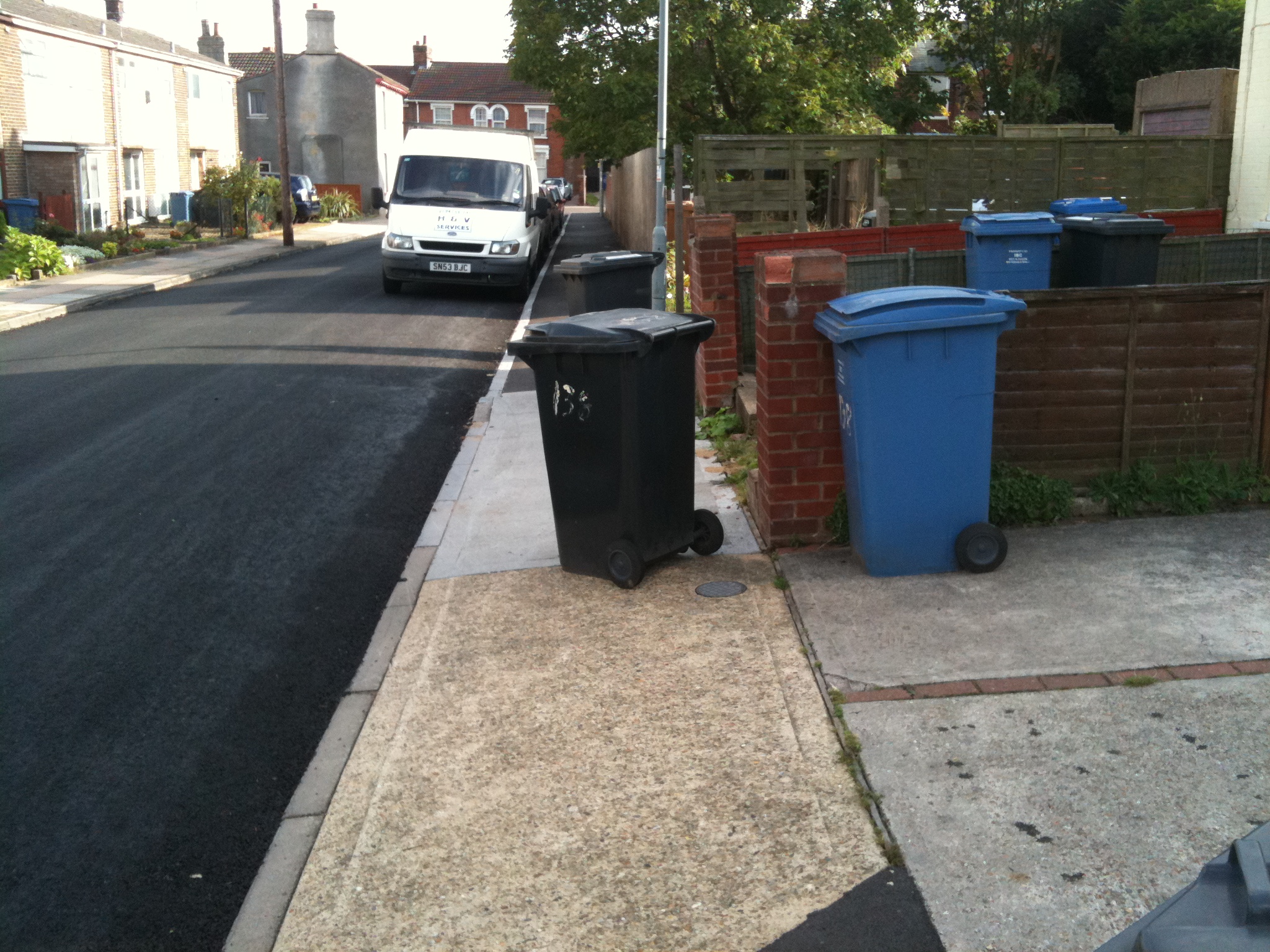
The council has recently put up signs in the area warning of penalties including fines of up to 50K fines and five years in prison for dumping rubbish on the pavement. Serious stuff! I assume there are referring to the Environmental Protection Act 1990 (section 33). Unfortunately they then go and leave wheelie-bins all over the pavement every week after collection! The following two pictures are taken on the same street. The first shows signs warning that dog poo on the pavement costs up to £1,000 and the fines for fly-tipping. The second photo shows how the council leave bins all over the pavement after emptying them for no good reason that I can discover. Cars on the pavement are not being challenged of course.
RIP school travel mode statistics – burying bad news?
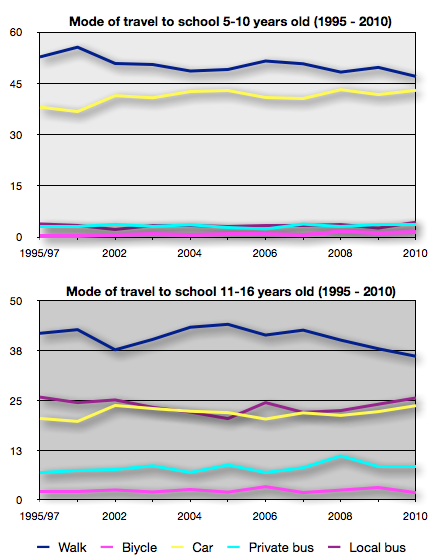
1 SepMinisters have just announced that there will be no ‘travel mode’ question in the next school census. I find this curious because the school run is a hugely challenging and emotive subject for parents and for other car commuters. Here are a couple of charts showing who how things have changed over the past 15 years during which time this information has been collected. Notice that more primary age kids will be traveling to school by car than on foot soon if current trends continue, also that the car and local bus is gaining with secondary school age kids at the expense of waking. Cycling is lost in the noise at the bottom. I wonder if the parents at these Brentwood schools parents will start chucking rocks at traffic wardens again? Was it relevant, per-chance that these statics were first collected in 1995 just after the previous conservative government abandoned the ‘great car economy’ following an epidemic of road protests in the 1990s? (walking is dark blue and is highest for both groups, cars are in yellow and are next highest for primary school kids and have similar percentage as for local buses for secondary school kids. Local buses are in dark purple).
Car free sundays
31 AugWaterloo, Ontario had its first Car Free Sunday a few weeks ago. The 2011 Paris Plage came to a close a week ago and New York Summer Streets worked great. Brussels has one on the 18th September and London also had one (err. that is London, Ontario actually). London, England will of course get a taster on the 4th September when the Mayor hopes to get more than last years 85,000 cyclists out for the 2011 London Skyride. Our very own public health minister, Anne Milton suggested that streets in the UK should be closed on sundays so children could play after learning about how they close streets in Bogota, Columbia every Sunday. Unfortunately the health ministry said that ‘would be something for local councils to consider’ (sounds like a ‘no’ to me!) Maybe next year 🙂
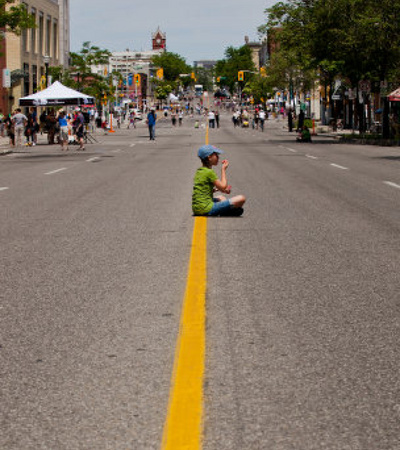
Here are some tasters for this summer’s events. I love the kid in the first picture and the total silence in the New York video – when is New York ever that quiet? I love the jazz and the I am hopeful that there is some very serious unstoppable energy building around this idea and that it will be coming to more and more places more often until it becomes as normal as smoke-free restaurants have become over the past few years.
A new clean URL and a re-energised twitter account
31 AugI have finally upgraded the WordPress account so that we can operate on the new simpler URL of ‘http://pedestrianliberation.org‘. The old addresses will still work btw but you will find that you get redirected to the clean one automatically. I have also just linked the PedestrianLib twitter account to the WordPress RSS feed so there should always be a nice new tweet for every blog post from now on and will be using twitter from time to time going forward for this and that.
And, just in case we forget what forces we are up against, here is the scene from outside our local ‘convenience store’ a while back, I guess it is convenient for a few people at least!
Archie wants to walk to school
30 AugIn 2009 a father phoned to police to say that because the country road between his house and his child’s school was dangerous, and because his son wanted to walk to school that he was going to drive slowly behind him to protect him from approaching drivers on the 60mph country lane. He was then intercepted before he had got to school by police to who drove the boy to school over “fears for his safety” and warned the father that he could be arrested for ‘a willful obstruction’ of the highway if he did it again. The father has subsequently written an article titled “Why do drivers have more rights than the rest?” (paywall). A good question which I will explore below.
Let’s analyse this in some detail.
Firstly, I assume that the police were referring to section 137 of the Highways Act 1980 (“If a person, without lawful authority or excuse, in any way wilfully obstructs the free passage along a highway he is guilty of an offence”) or to section 28 of the Town Police Clauses Act 1847 (“Wilfully causing an obstruction to any public footpath or public thoroughfare“). Unfortunately “it has been held that to constitute an offence there must be proof of an unreasonable user of the highway” (Parliamentary briefing 2010)
It is worth mentioning at this point that all roads in the UK are ‘all purpose roads’ and should therefore be available for all road users with the sole exception of ‘special roads’ (better known as motorways) which were created by the Special roads Act 1949 on which no pedestrians are allowed. There is no suggestion in the highway code that pedestrians should not be able to walk in the carriageway where there is not a pavement. (rule 2)
It is also worth mentioning that the highway code reminds drivers to at all times “Drive at a speed that will allow you to stop well within the distance you can see to be clear“.(rule 126) According to the Crown Prosecution Service, driving too fast is reason for prosecution for dangerous driving for which the penalty is disqualification and up to two years in prison. (Careless driving, a lesser offense is not use in cases of driving too fast it seems). However a 25 year old found guilty of drivng at 103mph avoided a conviction for dangerous driving and was banned for only 90 days. A policeman who was ‘familiarising himself with his new police car’ who was recorded driving a 159mph, (and also at 120mph in a 60mph area and at 60mph in a 30 mph area) was found not guilty of both dangerous driving and of speeding! The Crown Prosecution Service overturned the ruling and he was subsequently found guilty but given an absolute discharge; before having his conviction overturned following an appeal by West Mercia Police Federation.
So, was the father acting ‘reasonably’? He appeared to be protecting a walker who wished to assert their right to walk along an ‘all purpose road’. Motorists appear to have been only inconvenienced to a minor degree. The police seemed to agree that motorists were traveling too fast to slow down safely for a slow vehicle. As such should they not have prosecuted the drivers for dangerous driving, rather than opting for the a simpler but rather implausible route of using wilful obstruction for the person protecting the pedestrian?
I am reminded of Duncan Cameron’s submission to parliament on pedestrian issues who noted that “If pedestrians placed a chair on the carriageway it would be removed immediately, even though it would obstruct a smaller proportion of the road than when a car parks on the pavement. Cars could slow down and take care to avoid the chair, as pedestrians have to with parked cars. The Highways Act applies equally to the road and the footway. Pedestrians are being discriminated against“. In this case the same police who normally avoid using obstruction legislation against parking obstructions at almost any cost leapt into action to use it against someone protecting a pedestrian. Remarkable!
There are some parallels in this story with that of the blind man who was arrested and locked up within minutes of phoning the police to say that he was going to let down the tires of cars that were persistently blocking the pavement.
Yes, pedestrians do face discrimination and this blog’s primary aim seems to be to help expose how this particular discrimination operates.
Envirocars – doing their bit to damage the planet!
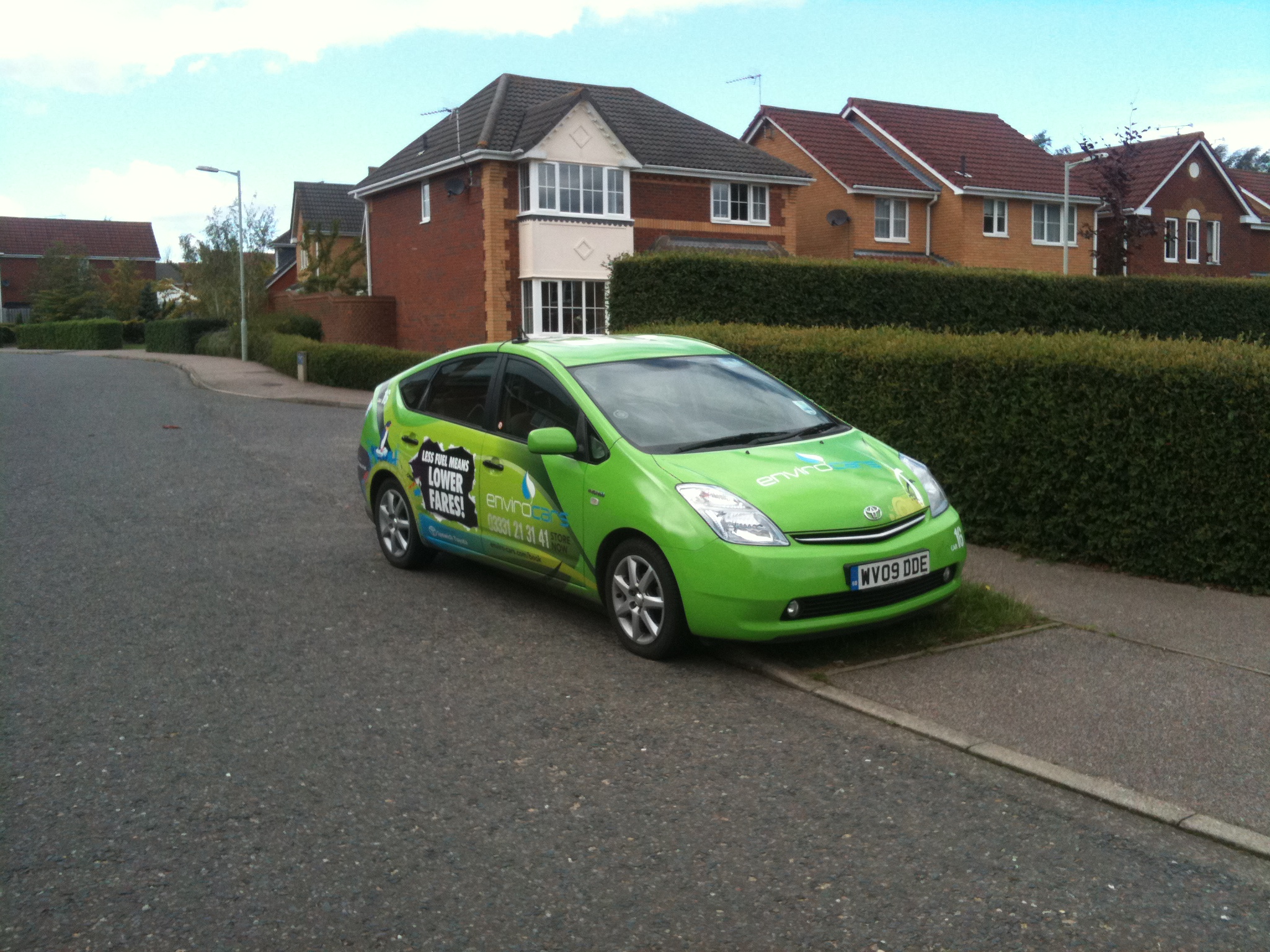
30 AugContinuing the recent theme of highlighting companies that park their vehicles in a manner that make a mockery of their company values, here a photo of a vehicle belonging to ‘Envirocars’, a new local taxi company with a strong environmental theme parked needlessly across a verge. Every car is plastered with ‘green’ messages including one that claims ‘all emissions offset by tree planting‘ which is good, but it does mean that they are going to need to a broad range of environmental policies to avoid criticism, for example to not parking on the verges. I phoned the company and I was put through to someone who listened considerately and said they would follow it up with the driver. I would love to report at some time in the future that they put effective policies around verge and pavement parking into place so this will never happen again!
Young men and fast cars – a thing of the past?
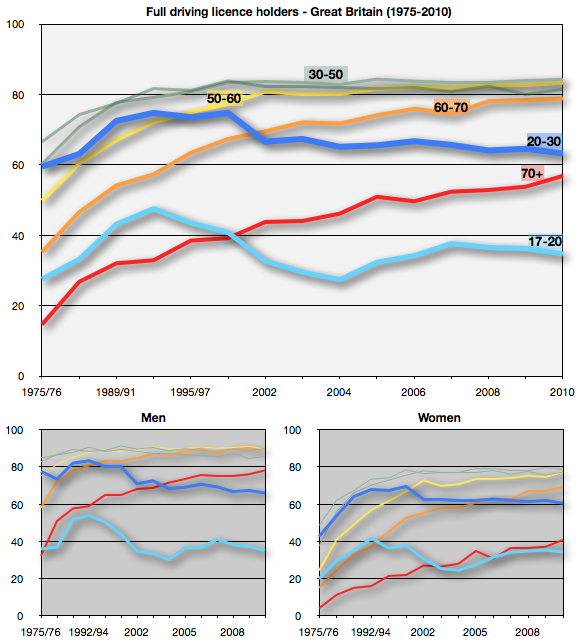
28 AugExploring the idea of ‘peak car‘ a little further, here is a chart showing the percentage of people with full driving licences by age and how this has changed over time. It seems that driving is morphing from something that younger people do to one that older people do and from a male thing to a much more gender-neutral thing. Notice how the percentage of 17-20 and 20-30 year olds has fallen since the mid 1990s and how the number of 50-60, 60-70 and 70+ year olds has been rising steadily; the percentage of people 60-70 year olds overtook the percentage of 20-30 year olds in 2001 and the 70+ year olds are about to do the same.
The two smaller charts break this data down by gender. The percentage of 70+ men overtook 20-30 men in about 2003. The percentage of women with driving licenses grew fast from a much lower base in 1975 getting much closer to parity with men over time. The recent decline in licences held by younger women has been less pronounced than for younger men. Source data from the Department for Transport.
Regional trends in car owership
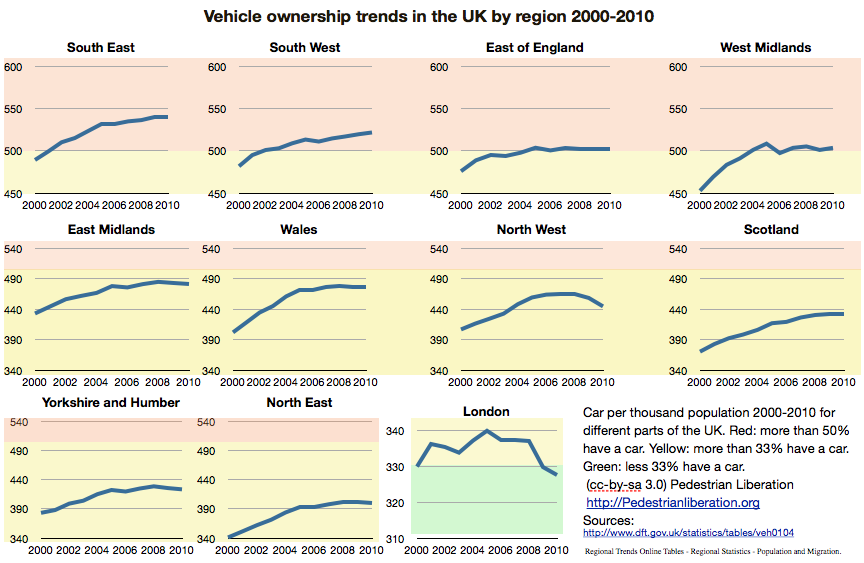
26 AugHere are an interesting set of charts created from data published by the DfT showing car ownership levels in each of 11 areas making up GB (the nine English regions together with Scotland and Wales). These figures have been adjusted to changing populations within each region. What is interesting is to see how some areas with high ownership levels already are continuing to add more every year (South East and South West for example),but that levels are much more stable in the East of England and West Midlands with percentages decreasing significantly in London and in the North West. Is this an effect of the recession, of regional economic issues or ‘peak car‘? I suspect that all of these issues are relevant to different degrees in different places. The total increase in registered vehicles in the period 2000 and 2010 for Great Britain was an impressive 4,015,328 units or of which have had to go somewhere, mainly in the south it seems.
Update
I have updated the above chart to include population changes within the period using this data.
Local council must change its bin policy
25 AugThe official bin-collection policy of Ipswich Borough Council policy is to leave bins after collection ‘at the very back of the pavement on the curtilage of the property … not obstructing residents’ driveways, preventing usage of drop kerbs etc‘. I have asked them why they don’t return the bins to where they found them (which is normally within the curtilage of the property on a driveway) and have also reminded them of their duties to the blind/wheelchair users and other groups under disability legislation. The response was: “We have discussed your interpretation of the Equalities Act with our resident equalities expert and we are of the opinion that we are taking the best possible action in this respect“. Umm… Strange, given that the work ‘pedestrian’, ‘wheelchair’ and ‘buggy’ don’t even appear in the text.
Here is my proposed replacement text: “a) Bins MUST NOT be left in a position where they create a safety hasard. b) Bins MUST NOT be left in a position where the available footway is reduced to less than 1m and should not left in a position where the width is reduced to less than 1.5m. Bins can often be returned to a position just inside the curtilage of the property. Where this is not possible they may be left on the footway or carriageway as long as the conditions in a) and b) are satisfied. Where no viable option exists then alternative provision for the collection of waste will need to be arranged. This policy is to ensure that all road users, including pedestrians, some whom may require additional width (wheel chair users, people with buggies and shopping and those with visual impairments) are able to use the highway safely“.
Here’s the reason why a change is needed. In these two following pictures there is no space for a wheelchair user of parent with a buggy to use the pavement when the current guidelines are following. In both cases it would however be trivial for the bins to be returned within the curtillage.
The law is very clear on this. Lets start with Department for Transport guidance on the ‘Pedestrian environment and transport infrastructure’:
- “Since October 1999 service providers have had to take reasonable steps to change practices, policies and procedures which make it impossible or unreasonably difficult for disabled people to use a service … These requirements apply to facilities and services in the pedestrian environment’.
- “Those who are travelling with small children or are carrying luggage or heavy shopping will all benefit from an accessible environment, as will people with temporary mobility problems (e.g. a leg in plaster) and many older people. Thus, the overall objective of this guide is to provide inclusive design and through that achieve social inclusion
- “Manual wheelchair users need sufficient space to be able to propel the chair without banging their elbows or knuckles on door frames or other obstacles. But someone who walks with sticks or crutches also needs more space than a non-disabled walker; so too does a long cane user or person carrying luggage, or a lot of shopping bags, or with small children. Thus providing adequate clear space on pavements, along passages in public buildings, through doorways etc, is of benefit to many people.
And also the DirectGov guidance re the Equalities Act 2010:
- The Equality Act 2010 provides important rights not to be discriminated against or harassed in accessing everyday goods and services like shops, cafes, banks, cinemas and places of worship… The Equality Act 2010 gives disabled people rights not to be discriminated against or harassed in relation to the use of transport services. This also covers access to travel infrastructure such as railway stations and bus stations. You also have a right to reasonable adjustments.
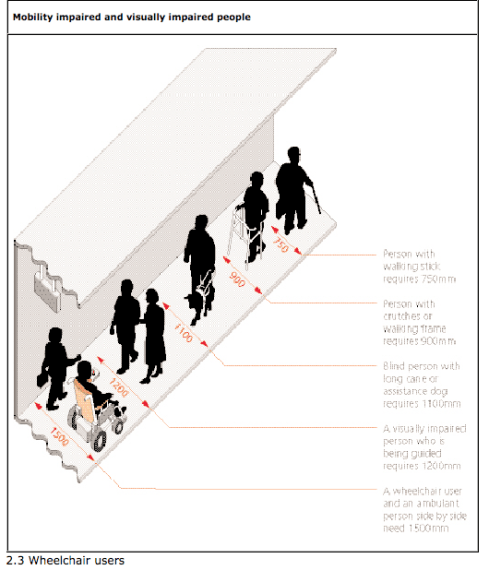
And here is a helpful diagram published by the DfT showing the pavement width required by these different groups of pedestrians. Is it however unfortunate that the diagram is so hard to read which probably goes against their own guidance on legibility, but we can’t have everything!
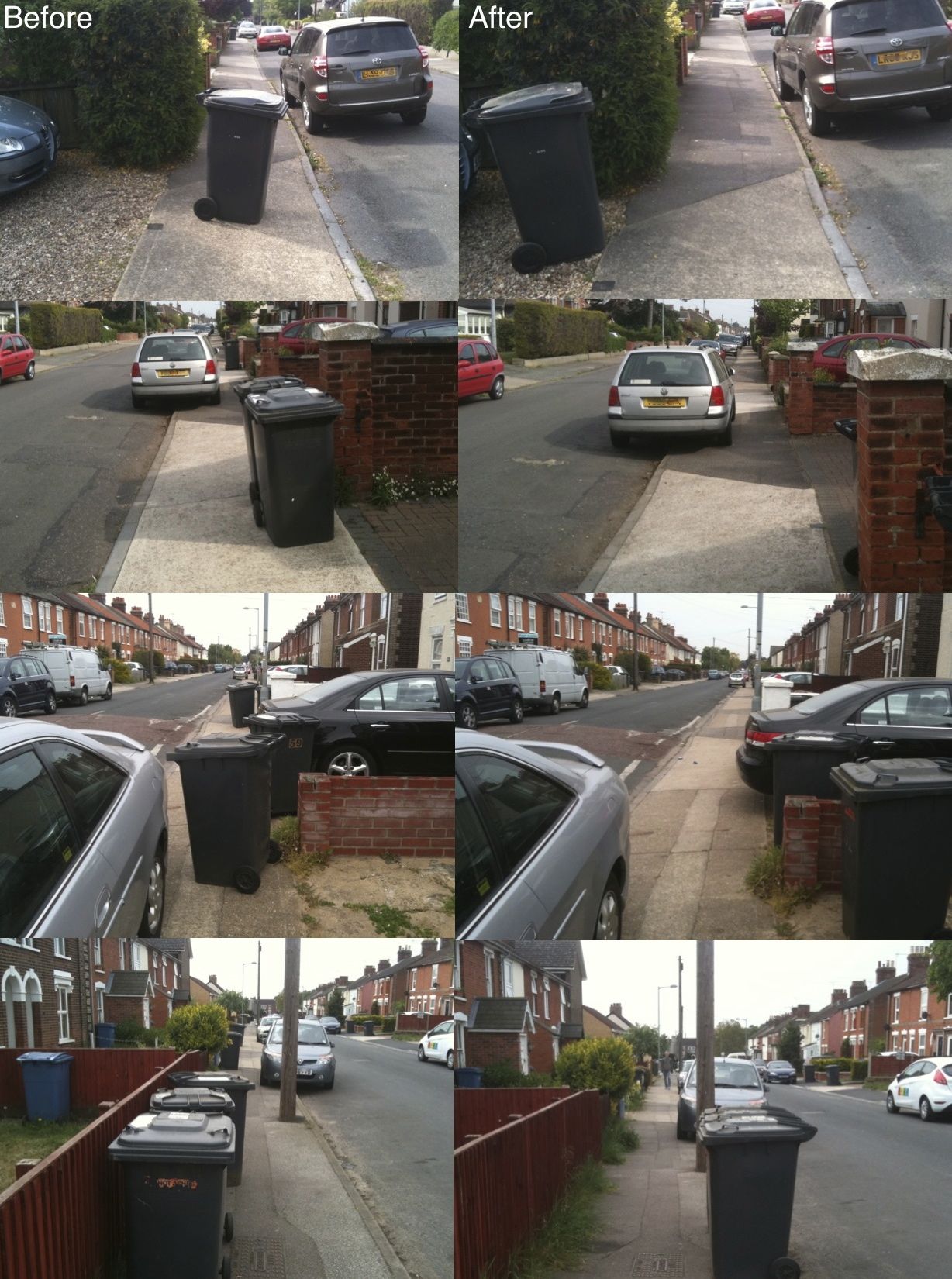
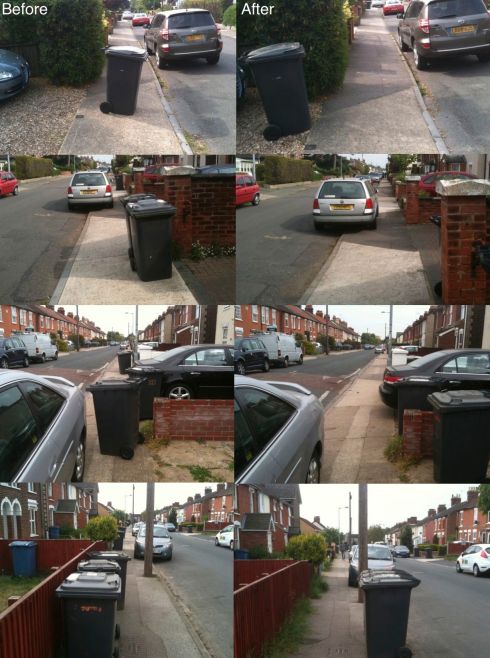
Finally, here are a set of photos illustrating the ‘reasonable adjustments’ that I am proposing to the council. The photos on the left show where the council leave bins currently and on the right you can see where I am suggesting they should be left to allow free passage (or as good as can be achieved with all the pavement parking!).
I will be sending a copy of this post to the council and ask them to reconsider. If that doesn’t work then possibly the local paper would be interested in taking this on as a local issue.
25K pageviews and a new facebook group
24 AugPedestrian Liberation has just topped 25,000 page views since it started and is now regularly getting 2,000 page views a month which seems like a great time to launch a new Pedestrian Liberation Facebook group where people can discuss issues, ideas and plan responses. If you are interested in creating a better pedestrian environment then please sign up to the group and get talking. The group is ‘closed(open)’ which means that the discussion is only visible to members of the group(visible to everyone). There is no restriction on joining. Just just click ‘join group’ and you are in.
Fyi, here is our usage since we started:
And just here are the search terms people used to find the site over the past month. My favourities include:
- “which campaigns deals with pavements,road signs
- “can wheelie bins be left on dropped kerb
- “how to convince parents not to park their cars outside school gates for their own children’s safety
- “why are cars allowed to park on pavements?
- “how much does cow need living space” (not sure about that one!)
- “why are roadsigns placed on pavements to block pedestrians?
- “are people allowed to park on dropped kerbs?
- “cars obstructing pavement law definition uk
And here are some of the more popular search terms:
is it illegal to park on the pavement 25
pavement parking 10
road works 6
road obstruction sign 6
raised crossing 6
pedestrian liberation 6
leicestershire pavement parking 5
dhl unmarked 4
archway road highgate during world war 2 4
pedestrianliberation.wordpress.com 4
can wheelie bins be left on dropped kerb 4
example of road life 3
council yellow line enforcement private land 3
parked on footway 3
road work signs 3
biased maps 3
unloading on a dropped kerb with double yellow lines 3
fast lane speed mph 3
council clearing pavements campaign 3
destroyed road 3
roadworks 3
rectangular bananas 3
legislation for parking vehicles on footpaths for business purposes 3
welwyn garden city 3
is it an offence to park a vehicle on a drive that obstructed the footpath 3
signs for pedestrians on paveement 2
parking lot paid space toy car 2
paving leaflet 2
pavement obstruction law uk 2
pavement kerb 2
without favour or affection malice or ill will 2
alternative parking 2
highway maintenance cars 2
which campagins deals with pavements,road signs 2
safety beacon leaflets 2
new forest cow in road 2
office people 2
damaged pavement 2
parking pavement narrow road 2
problems pertaining to pedestrians and law enforcement of pedestrian offence 2
street parking laws pavement blocking 2
pedestrian liberation cycle track act 2
to be treated with contempt 2
is it illegal to park on a pavement 2
highway maintenance van 2
parking on pavement leaving 1 meter 2
road works diagram 2
car sticker wheelchair pedestrians 2
no parking on pavement 2
is the pavement common land 2
is it illegal to leave bins on pavement 2
apc overnight depots in ipswich 2
west yorkshire police rogues gallery 2
footways use 2
chapter 8 road work sign positions 2
openstreetmap speed limit time 2
street slabs 2
how to convince parents not to park their cars outside school gates for their own children’s safety 2
other road pavements 2
is it legal to park on pavement? 2
parked on dropped kerb outside my own garage in cardiff 2
driving on pavement law 2
map speed limits milton keynes 2
no parking on the curb sign 2
parking on double yellow includes verge and footway 2
problem pertainig to pedestrian and law enforcement of pedestrian offences 2
asphalt pedestrian footway 2
child bending over puddle 2
speed limits for ipswich 2
i hate stickers 2
car walking 2
stevenage footpaths 2
department of transport parking on footpaths 2
why are cars allowed to park on pavements? 2
netherlands 130km 2
are you allowed to park on the pavement 2
cause unnecessary obstruction by motor vehicle 2
broken pavement 2
funny parking in the uk 2
zigzag traffic lights 2
no pedestrians 2
dpd 2
yellow lines parked pavement case 2
trek highway services 2
traffic management signs 2
are cars allowed to park on pavement 2
safety signs laws for works on pavements 2
archway road 2
sandwell school parking campaign 2
is it an offence to drive over a footpath to gain access 2
bollard planter 2
new paving designs 2011 2
broken slabs 2
speed limits on urban a roads 2
summer streets 2011 2
local regualtions regarding obstruction of a pavement 2
tnt lorry 2
road traffic act parking on pavements 2
is it illegal to park on the pavement 2010 2
what are the benefits of using email with regard to speed cost 2
range rover classic passenger safety 2
dpd van on fire 2
law on construction along the highway and busy street 2
no wheelchairs 2
lamp post damage 2
wheelchairs 2
dropped kerbs law 2
cumnor primary school 2
illegal to park on pavement 2
how much does cow need living space 2