Has parking in shared use footways been illegal since 1988?

15 Oct

When I was recently reading the Road Traffic Act 1988 (as one does), I noticed this interesting clause that makes it illegal to park on ‘cycle track’s, which incidentally includes shared use pavements. To quote:  “any person who, without lawful authority, drives or parks a motor vehicle wholly or partly on a cycle track is guilty of an offence” S:21). Their definition of a cycle track is any track that allows cycling and also a shared pedestrian/cycle route, but not one that allows any motorised vehicles.

I have marked the key elements in bold because for normal footways it if only illegal to ‘drive’ on them, not to be parked on one. The above appears to make it much easier to give someone a ticket for parking on a shared-use path for parking on a normal footway. At least one doesn’t have to worry about bicycles and parked cars!

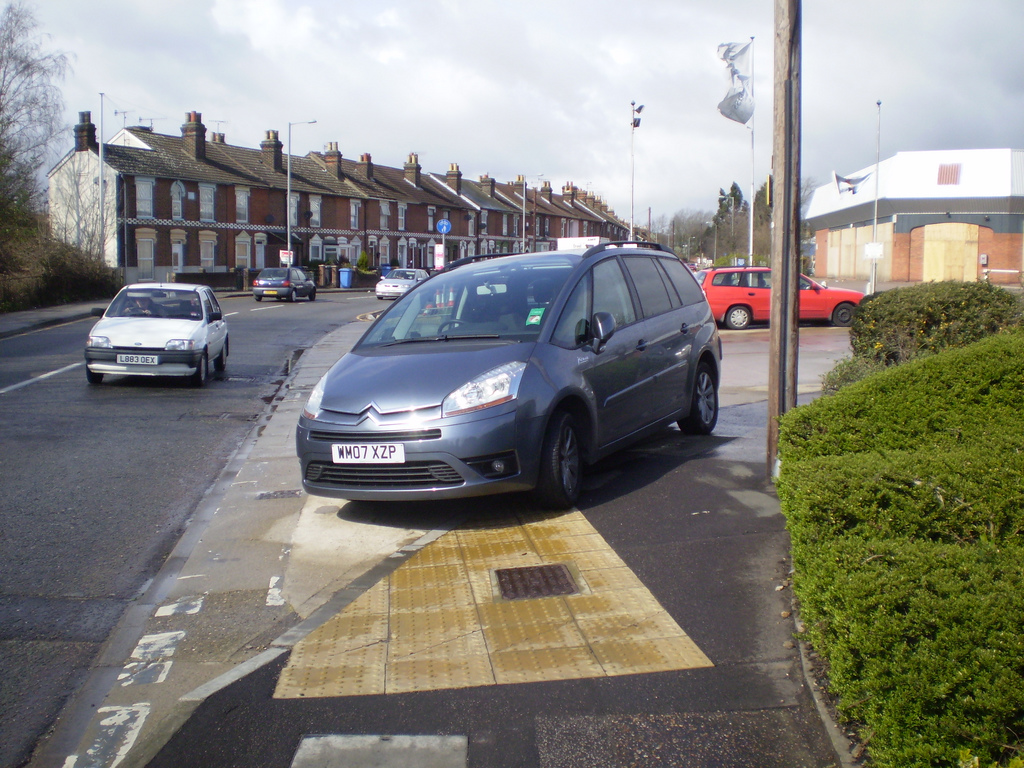
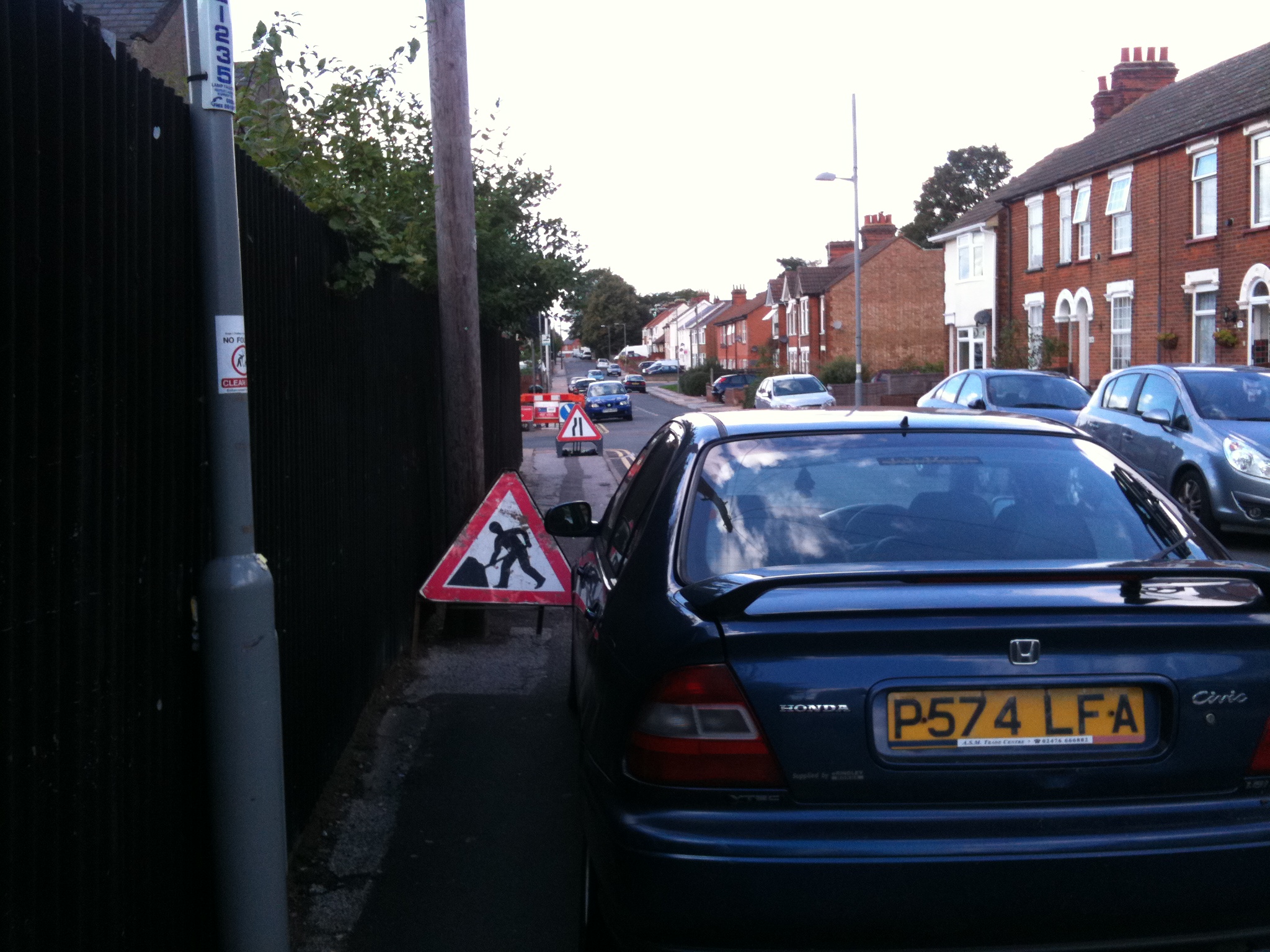
This appears to mean that the police already have the powers to fine drivers for parking on share-use paths. I am a little cautious about my interpretation because no one seems to have picked up on this yet. My friendly local policeman was certainly unaware of the ruling, Living Streets don’t mention it in their guidance on combating pavement parking and nor to the cycle campaign groups. but is going to check and get back to me. If I am right then the following drivers are already committing an offense:

Car parked on a shared-use footway

Car parked on a shared-use footway

Update…

I have just been reading a useful post which defines the legal terms used for parts of the highway. It includes definitions of Cycle Track, Cycle Lane, Footpath and Footway and gives me more confidence that I am right.

They say that a Cycle track is ‘a route other than within the carriageway (e.g. on a footway adjacent to a carriageway, adjacent to a carriageway but separate from it and the footway, or a route completely separate from a highway – and which could be “permissive” or be a “right of way”). They quote the legal definition as being “a way constituting or comprised in a highway, being a way over which the public have the following, but no other, rights of way, that is to say, a right of way on pedal cycles (other than pedal cycles which are motor vehicles within the meaning of the Road Traffic Act 1972) with or without a right of way on foot [Section 329(1) Highways Act 1980]. The words in brackets were inserted by section 1 of the Cycle Tracks Act 1984.

And.. I have also noticed that the Highway Code – Rule 240 confirms it. It says you MUST NOT stop or park on … a cycle track.

A forum run for police specials seems to agree and suggests that the appropriate fine would be £30-£80.

Another update:

There seems to be some difference of opinion within the cycling world as to whether a Cycle Track can be along a pavement or whether they really more like footpaths and bridleways (ie routes not beside the highway). I have queries out with various organisations as to their interpretations of the law. I will keep you posted.

Nope, that’s not an obstruction!

15 Oct

The picture below shows a car parked almost completely across the pavement. This would not currently classed as obstruction by our council or the local police because no one is actually being obstructed at this very moment and would use the fact that the woman seen walking away from us with her shopping was able to get past (just) as evidence for the lack of obstruction.

The fact that an elderly person who uses a wheelchair lives a few doors down is considered irrelevant because he is not trying to pass at this moment. The fact that the person may not even bother trying to get down the pavement any more because they knows that it is impossible is not considered relevant. To add insult to injury, if someone passing the vehicle accidentally scratched the vehicle with a bag, buggy or wheelchair then they would have caused an offense against the owner of the car!

Not an obstruction

The only reason that it might be classed as obstruction in this case is because the person may have had to have ‘trespass’ onto private property to get past. A police officer I have just been talking to about this thought that this would indeed be evidence of obstruction.

New rules protect dropped kerbs

15 Oct

The Traffic Management Act 2004 (section 86) introduced to protect dropped kerbs from parked cars. It also covers places where the carriageway has been raised to meet the level of the footway for the same purpose.

To quote my local authority ‘ If an enforcement officer observes a vehicle parked fully or partly on a dropped footway provided for ease of access to cross a road or at a pedestrian crossing the motorist will receive an automatic penalty charge notice.’ This change means that it will finally be an offense for which a vehicle owner can be given a penalty notice to do this:

A Prius parked across a dropped Kerb is now always an offence

Again, this is now an offense (ie parking across a dropped kerb)

Car parked on dropped kerb

Conveniently for motorists the same regulatory change appears to allow home-owners to ‘claim’ the highway outside their house for their own private us! Our authority explains ‘If you find an inconsiderate motorist blocking the dropped kerb access to your home you can get in touch with Ipswich Borough Council’s Parking Service and action will be taken’.

Notice that it is only the owner of the property who can complain in this instance. This of course means that anyone who replaces their front garden with a parking place and a dopped-kerb now gets two protected spaces for the price of one. The first being in their (ex) front garden, the second right outside their house on the highway. I have created a separate post about why the car on the pavement is not currently causing an obstruction. Which all means that we can probably expect a lot more of this:

Dropped kerb creating parking for 2 cars

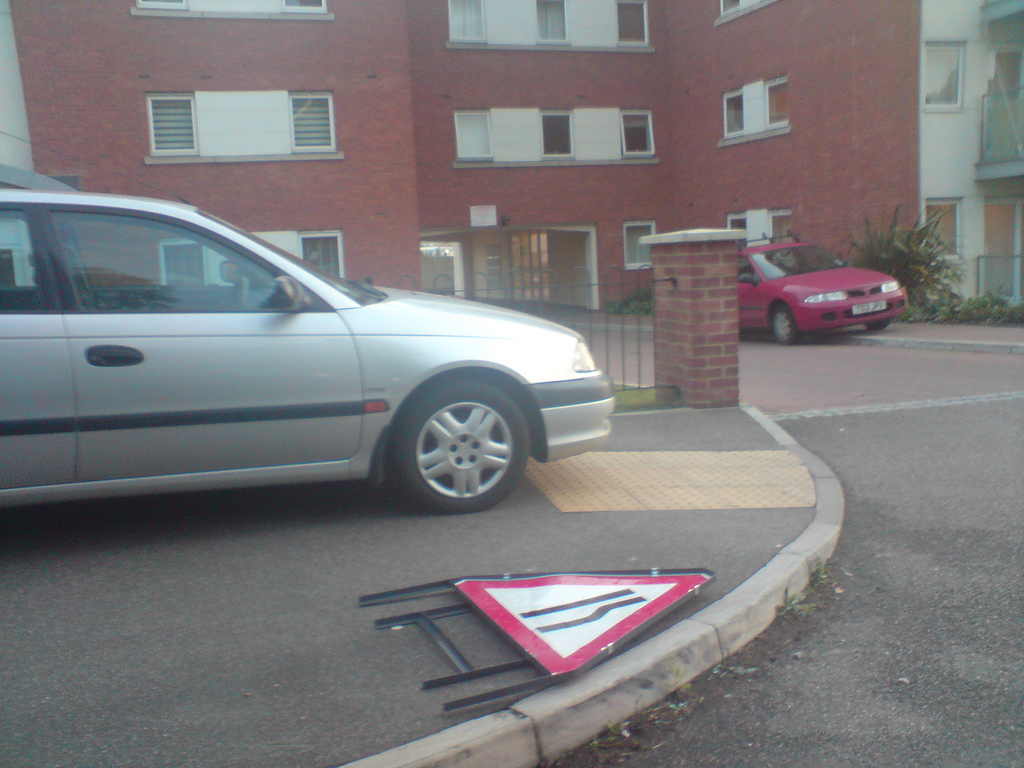
Finally… this car is not covered by the 2004 Regulation because it is not on the carriageway and my authorities would probably consider that it was not current obstructing anyone!

Probably not an offense!

In the above photo notice, yet again, a roadways sign that is obstructing the pavement. See my post about obstruction warning signs that cause an obstruction!

Cycles parked on the pavement are a health and safety issue, Range Rovers are not!

15 Oct

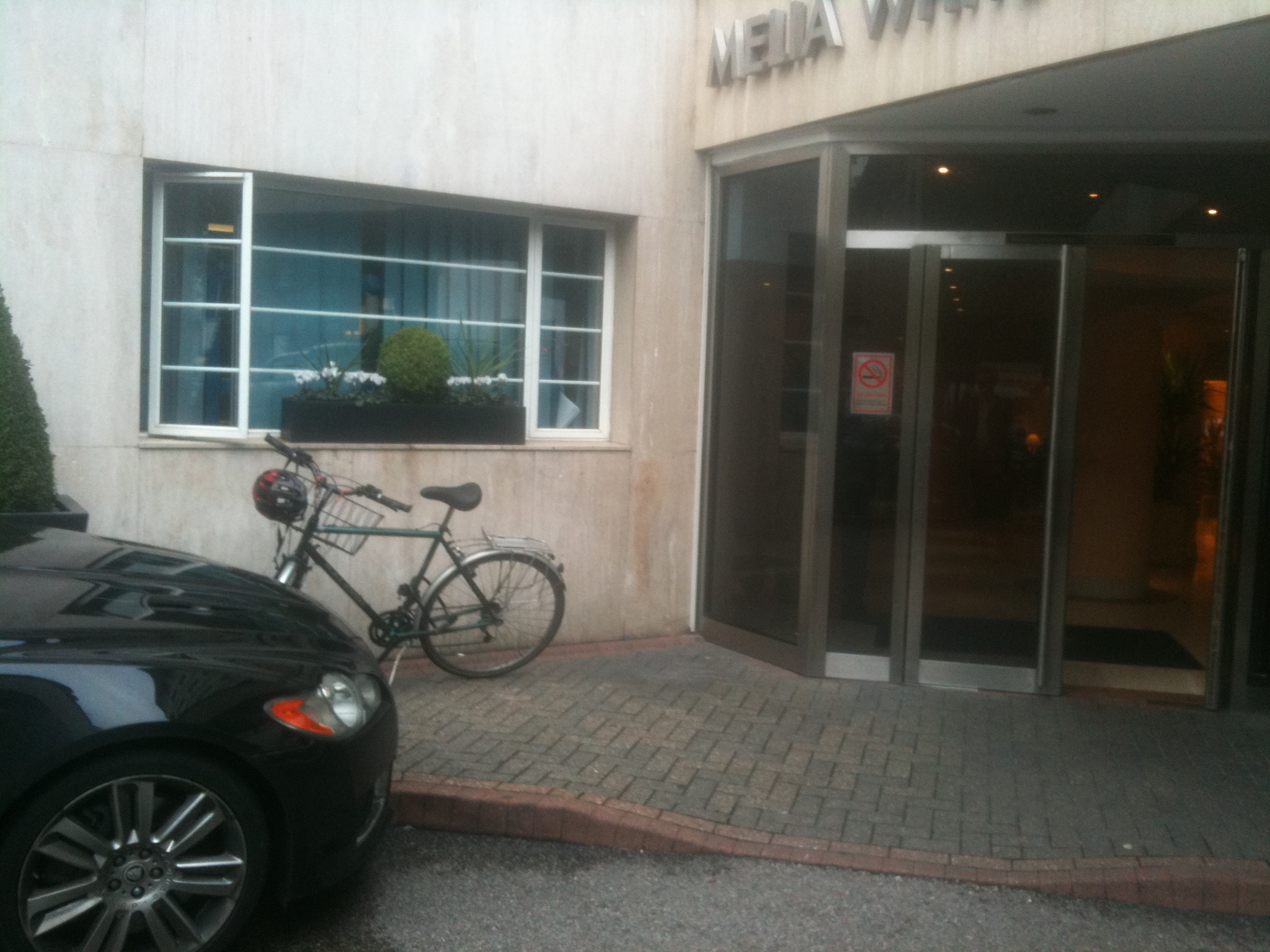
When I arrived at the Melia White House Hotel in London recently I found that there was no convenient and secure place to lock up my bike. Feeling rather irritated about this and noticing the impressive range of cars parked up on the pavement around the entrance I choose to leave my bike on an unusable section of pavement close to the font-door where the porter could keep an eye on it.

Unfortunately, the porter told me that I couldn’t leave it there for ‘elf and safety’ reasons. I press him politely, I then pressed his boss and then that person’s boss as well. The conclusion was that if I left my bike there then it would get removed, but that I could carry it through the hotel up into my colleague’s room which was a bit weird. Unfortunately, by that time my colleague, who had been fascinated by the conversation, was ready to leave so I wasn’t able to test out their lifts with my very grubby bike.  We left, took a few photos and put my bike somewhere else. The staff were helpful, polite and very professional throughout, but were being constrained by some very stupid and indefensible hotel policies. Health and Safety being yet again wheeled out as the catch-all reason to enforce any daft prejudice.

My bike was a ‘health and safety’ risk, the BMW and plant container on the pavement next to it were not!

White House Hotel, London. Parking

These Range Rovers on the pavement outside the hotel clearly aren’t a health and safety problem

Obstruction signs obstruct the pavement!

15 Oct

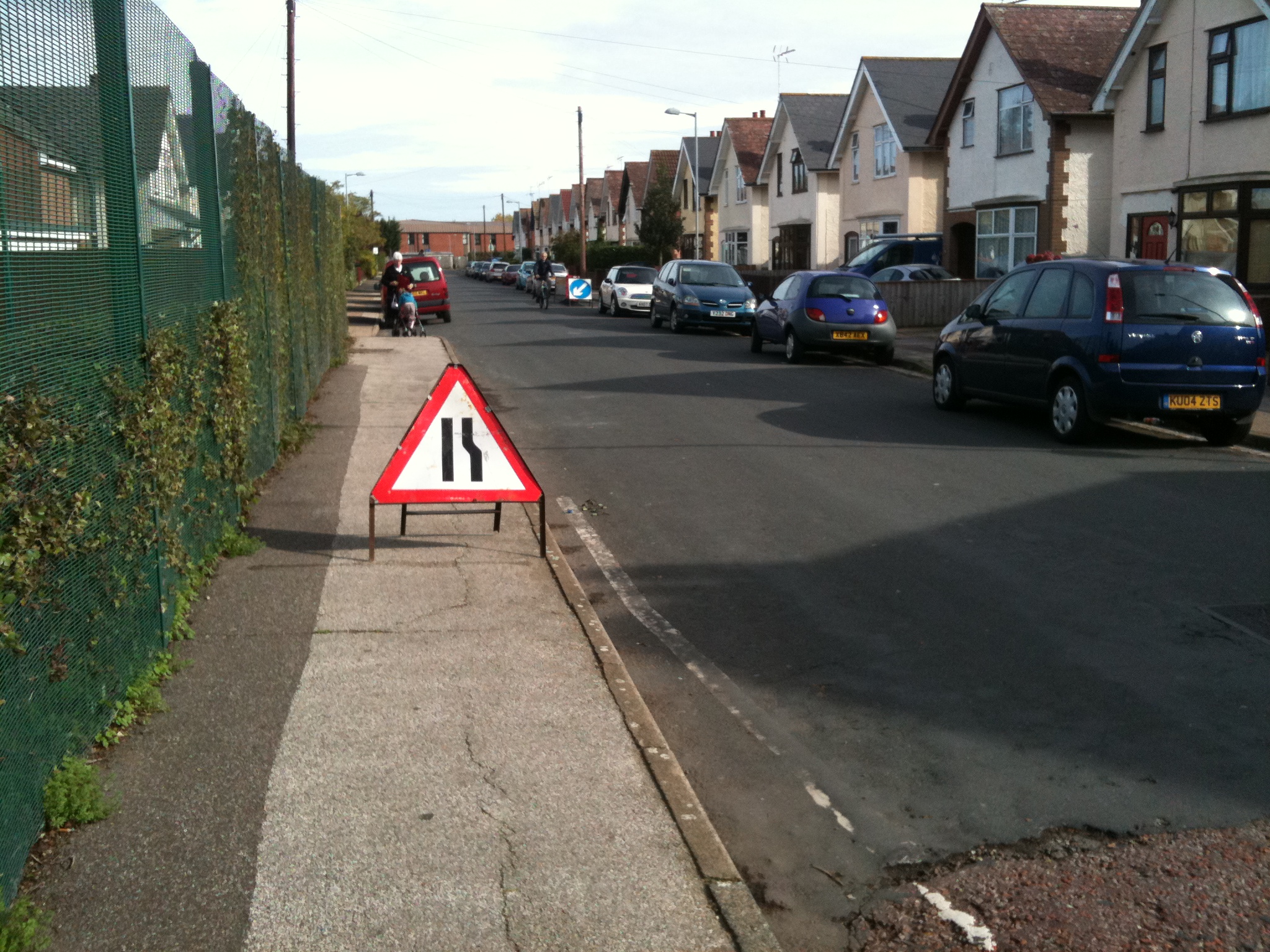
I have started noticing how ‘road narrowing’ warning signs get left on the pavement where they obstruct pedestrians! This is yet another excellent example of how pedestrian realm is taken over for the benefit of the motorist. How does that fit with the Disability Discrimination Act apart from anything else?

Here are a few examples. Note that in none of the case is the road actually being narrowed and that in first two cases there is a pedestrian trying to use the pavement who will be!

I still can’t believe that someone would leave a sign here

This next ones were on the approach to a primary school in Newnham in Cambridge. There are a total of four signs on a short lenght of pavement. Notice that the road-works are not actually even protruding beyond the parked cars.

Obstruction signs in Cambridge on the pavement as well

I say ‘were’ because they are now placed in more useful locations.

Should ‘road narrows’ signs actually be placed by parked cars?

Excess signage has been placed in ‘storage’ by the road-works themselves.

Excess signs

Excess signs have been moved into ‘storage’ by the road works themselves

Back in my home town I came across this one. There is no good reason for this sign not to be in the road which is where it now is!

Sign for motorists obstructs the pavement

Sign for motorists obstructs the pavement

Of course when one combines these cunning signs on the pavement with cars parked on the pavement then one can create complete chaos for pedestrians let alone anyone who is blind! This one is also in Ipswich.

Yet another ‘road narrows’ sign, this time there is also a car to complete the picture

Policeman parks on pavement to ‘buy his lunch’

30 Aug

Here is a video clip that appears to show a policeman parking on the pavement in Liverpool to go and buy something from a local shop which is possibly his lunch. If the very people who are responsible for enforcing these laws can’t abide by them then how do they expect others to? Luckily his boss is taking it seriously and the incident will be investigated.

Jimmy Justice over in New York makes it his job it bring attention to officials who break the law. This is a pretty robust approach to citizen activism!

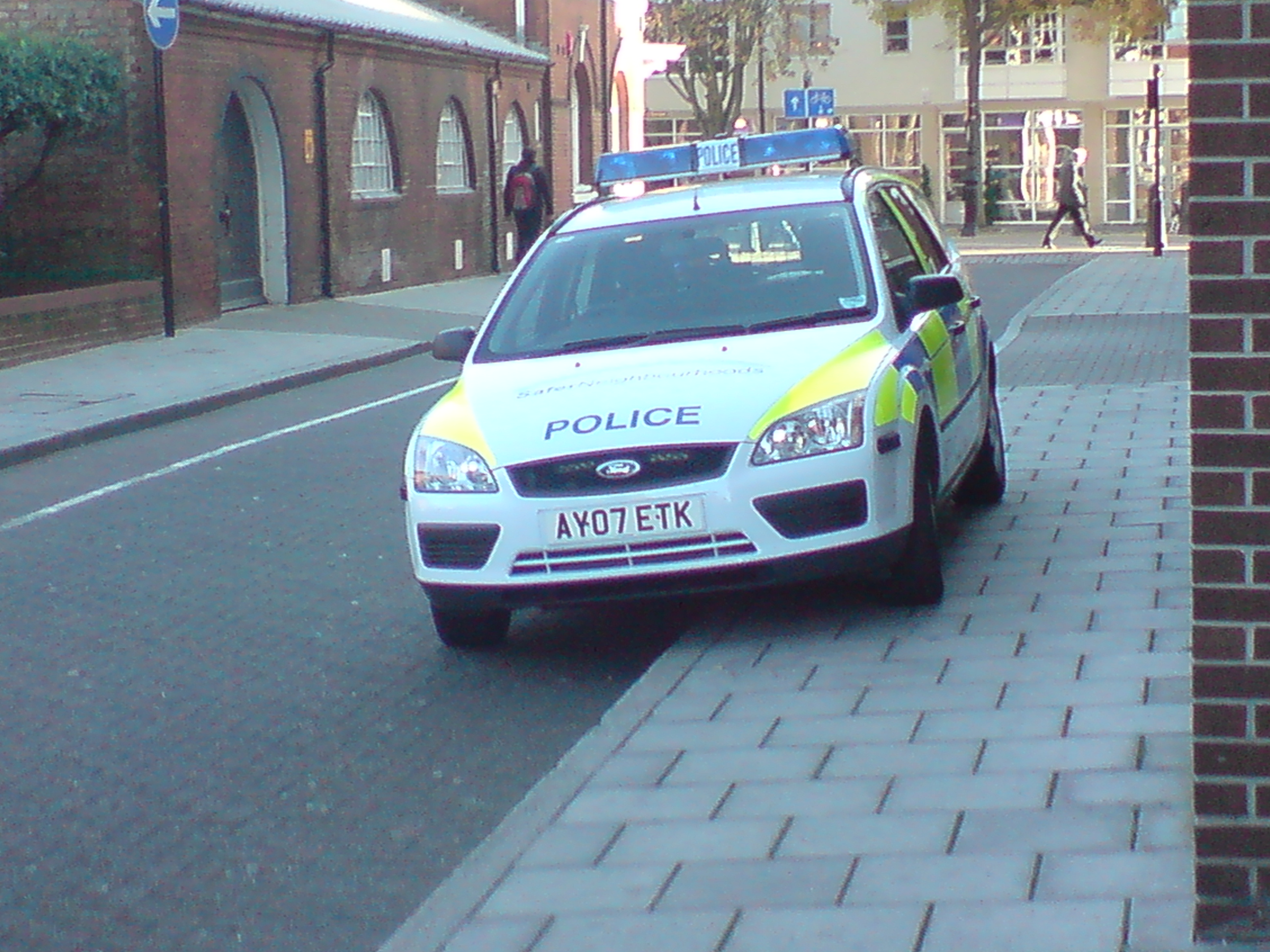
Closer to home I can see no particularly good reason for this police car to be on the pavement in my home town when there is plenty of room on the road.

A police car showing how not to do it!

And here is another incident where the policeman, who is stood in the building society doorway, has parked half in a bus-stop for no apparent operational reason.

A police car overhanging a bus stop causing difficulty for the buses.

Clearly we need to get the police on side on this one for starters!

Are vehicles allowed to park on the pavement?

30 Aug

The question “Are vehicles allowed to park on the pavement?” sounds like a pretty simple one and one to which one might expect a clear answer!

According the common knowledge it is not illegal to park on the pavement in most parts of the UK but it is an offence to drive on the pavement. Clearly it is not possible to park on the pavement without driving on it but it is harder for the authorities to prove who actually drove onto the pavement. It would be simple to legislate to make it illegal to be parked on the pavement but until now the authorities seem reluctant to enact it for obvious reasons.

The Highway Code rule 244 says “You MUST NOT park partially or wholly on the pavement in London, and should not do so elsewhere unless signs permit it. Parking on the pavement can obstruct and seriously inconvenience pedestrians, people in wheelchairs or with visual impairments and people with prams or pushchairs”.  ‘Should not’ is code for it not being illegal. The Highway Code fails to mention that it is also, rather randomly, illegal in Exeter which has it as a clause in its own Act of Parliament, the  ‘Exeter City Act 1987’! Is every town going to have it’s own act of parliament to get this problem solved?

It is also however common knowledge in the transport industry that there is not actually any legislation in place that allows people to leave, or to ‘store’ vehicles on the highway at all, so who is right? I have been poking around the legislation and here is what I have found:

The core legislation appears to be the Highways Act 1980 which states that an offence has been committed if “a person deposits any thing whatsoever on a highway to the interruption of any user of the highway”, (S:148) and then goes on to say: “If any thing is so deposited on a highway as to constitute a nuisance, the highway authority for the highway may by notice require the person who deposited it there to remove it forthwith”.(S:149)

Personally I believe that pavement parking often ‘interrupts’ other users of the highway and often can be shown to cause a ‘nuisance’. If that is the case then why is this clause not used? Possibly I am missing something, or possibly no one has dared to use it yet!

The Act does include other sections covering various specific ‘things’ that can be left on the highway in certain prescribed circumstances, these include “skips”, “scaffolding” and “structures”. It also itemises various things that cannot be left on the highway including “dung, compost or other material for dressing land, or any rubbish“, and also  “booths, stalls or stands, or encamps” established by “hawkers”.

Curiously the Road Traffic Act 1988 includes legislation making it illegal to park vehicles on cycle tracks, which incidentally includes shared use pavements. It says that “any person who, without lawful authority, drives or parks a motor vehicle wholly or partly on a cycle track is guilty of an offence” (Section 21). I am not clear why cycle tracks have been singled out for this favourable treatment but it could be useful in some situations. Incidentally the definition of a cycle track is any track that allows cycling and also a shared pedestrian/cycle route, but not one that allows any motorised vehicles. My reading of this is that a shared use pavement is classified as a ‘cycle track’.

The 1988 Act also  states that “a person who parks a heavy commercial vehicle wholly or partly on the verge of a road, oron any land situated between two carriageways … or on a footway is guilty of an offence” (Section 19) . Incidentally a “heavy commercial vehicle” is defined by the Act as “any goods vehicle which has an operating weight exceeding 7.5 tonnes“. Unfortunately this legislation also excludes parking these heavy vehicles on the pavement or verge “for the purpose of loading or unloading loading where this can not be satisfactorily performed without parking on the footway or verge“. As such the legislation actually seems to create a legal right for heavy commercial vehicles to park on the pavement in situations where it did not exist before!

Another useful but little used piece of legislation is the Disability Discrimination Act which according to the government gives disabled people “important rights not to be discriminated against in accessing everyday goods and services like shops, cafes, banks, cinemas and places of worship“. It seems clear that not ensuring that pavements are usable by disabled people would fall foul of that one.

What do local authorities have to say on the subject? Many say nothing,  Hampshire County Council do helpfully provide details of their interpretation of the law relating to pavement parking on their website. They refer to various types of ‘obstruction’ but fail to mention the more general clauses in the Act relating to ‘things’ or make any reference to vehicles on pavments or the Disability Act. To quote:

“Obstructions on or over the highway prevent the legitimate use of the highway and are a potential safety hazard for road users and measures shall be taken by the Authority for the removal of the obstruction. Obstructions on the highway take various forms and the most commonly encountered occurrences are as follows: Unauthorised signs, erections, materials or trading booths. The Highway Authority shall serve notice under the appropriate section of the Highways Act to deal with the removal of the obstruction:

  • Section 132 of the Highways Act 1980 – unauthorised signs and structures.
  • Section 138 of the Highways Act 1980 – illegal erection of a building or fence.
  • Section 148 of the Highways Act 1980 – removal of dangerous deposits.
  • Section 154 of the Highways Act 1980 – removal of dangerous trees.
  • Section 143 of the Highways Act 1980 – removal of structures.

Where are the references to Section 148 relating to ‘things’ or the 1988 Act relating to Cycle Tracks and Heavy Commercial Vehicles or the Disability Discrimination Act?

The Department of Transport ducks the whole issue. Prior to the last general election their website said:  “in some narrow residential roads with a lack of off-street parking provision, drivers have little option but to park on the pavement to avoid causing traffic hazardsThe Government has no plans at present to introduce new legislation specifically aimed at banning pavement parking on a national scale“. Clearly the DfT is trying to avoid confrontation with car drivers at the expense of pedestrians and are possibly falling foul of the Disability Discrimination Act at the same time.

Interestingly a complete ban on pavement parking was included in to Transport Act 1974 , which went through parliament successfully but was then blocked by successive transport ministers, it  failed to become law and was junked in 1991 due to ‘potentially enormous costs to local authorities and police of securing proper policing and enforcement of such a blanket ban’.

The good news is that the current law seems to provide for much wider police action than is acknowledged by either the DfT or many councils. We will see if we can get formal legal advise on the above in case I have missed something.

See The Law for more juicy details.

Yet another low quality waterfront car park

6 Aug

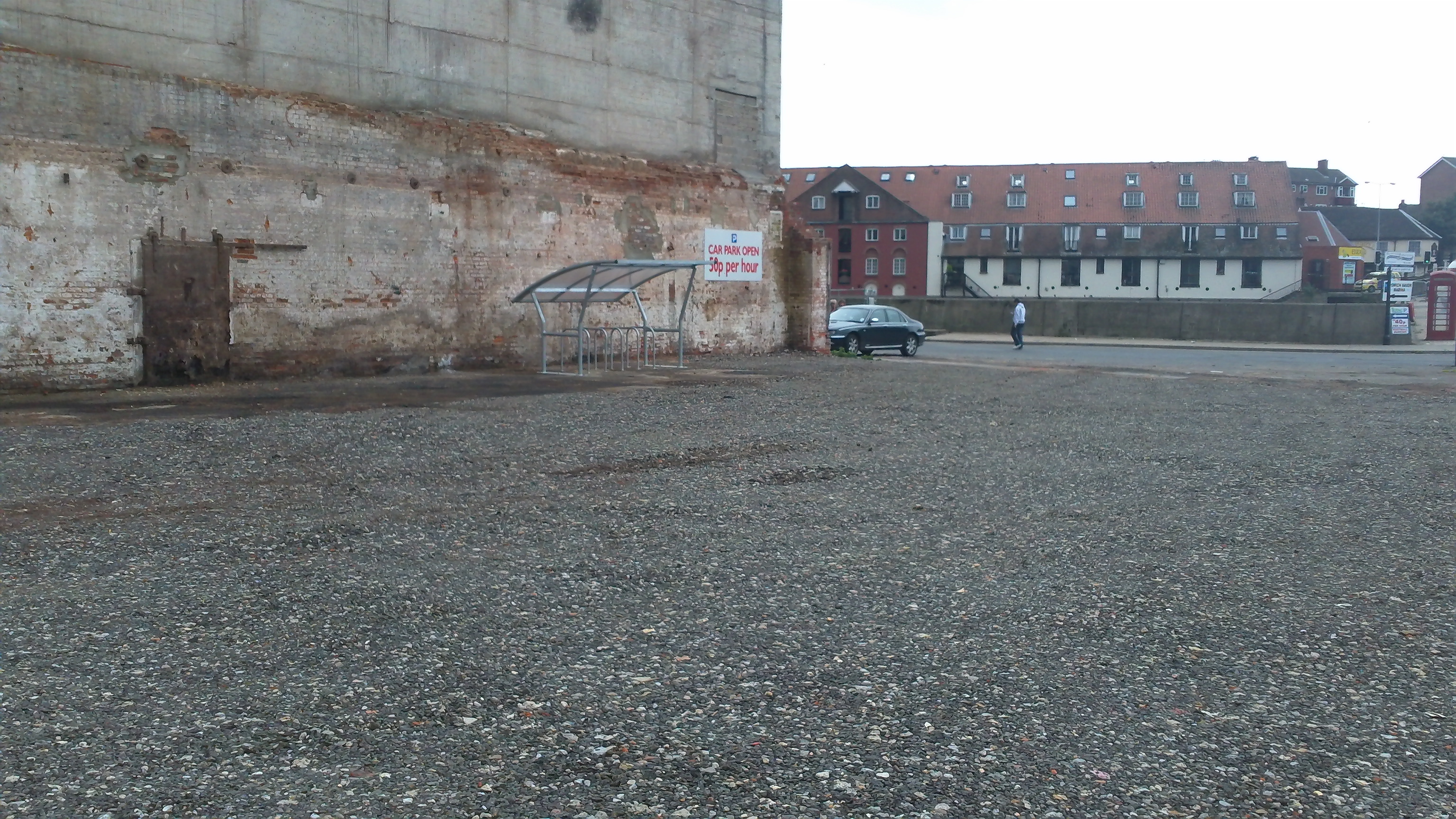
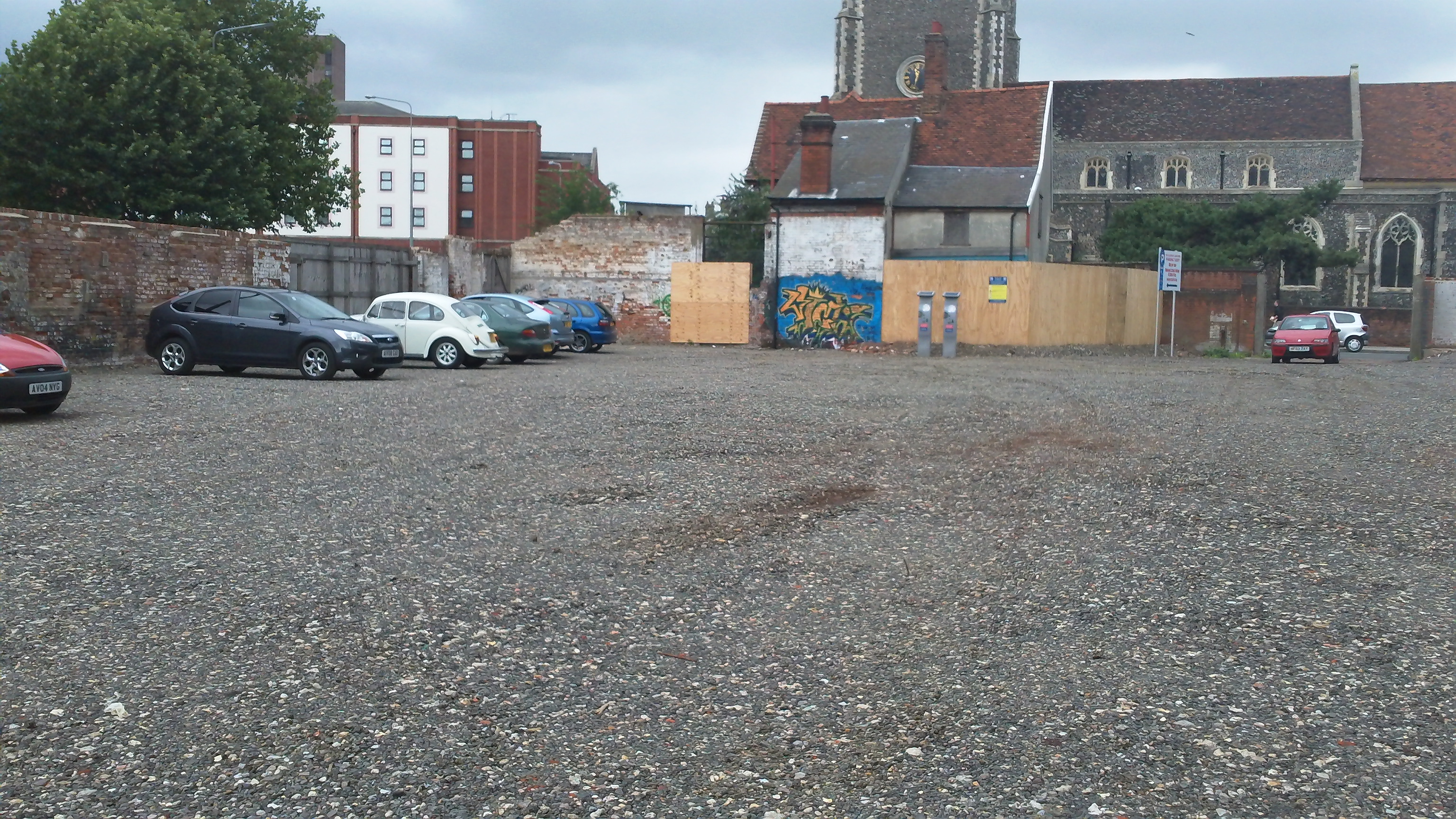
A new Car Park at the Waterfront. Now, where have I heard that before? I think I’ve lost count of the Car Parks in this area now. This was a space that we were interested in as it is or was a large unused space that had some potential to be a really nice public space, but instead it is being used for yet another Car Park when the existing ones are still underused and mainly empty.

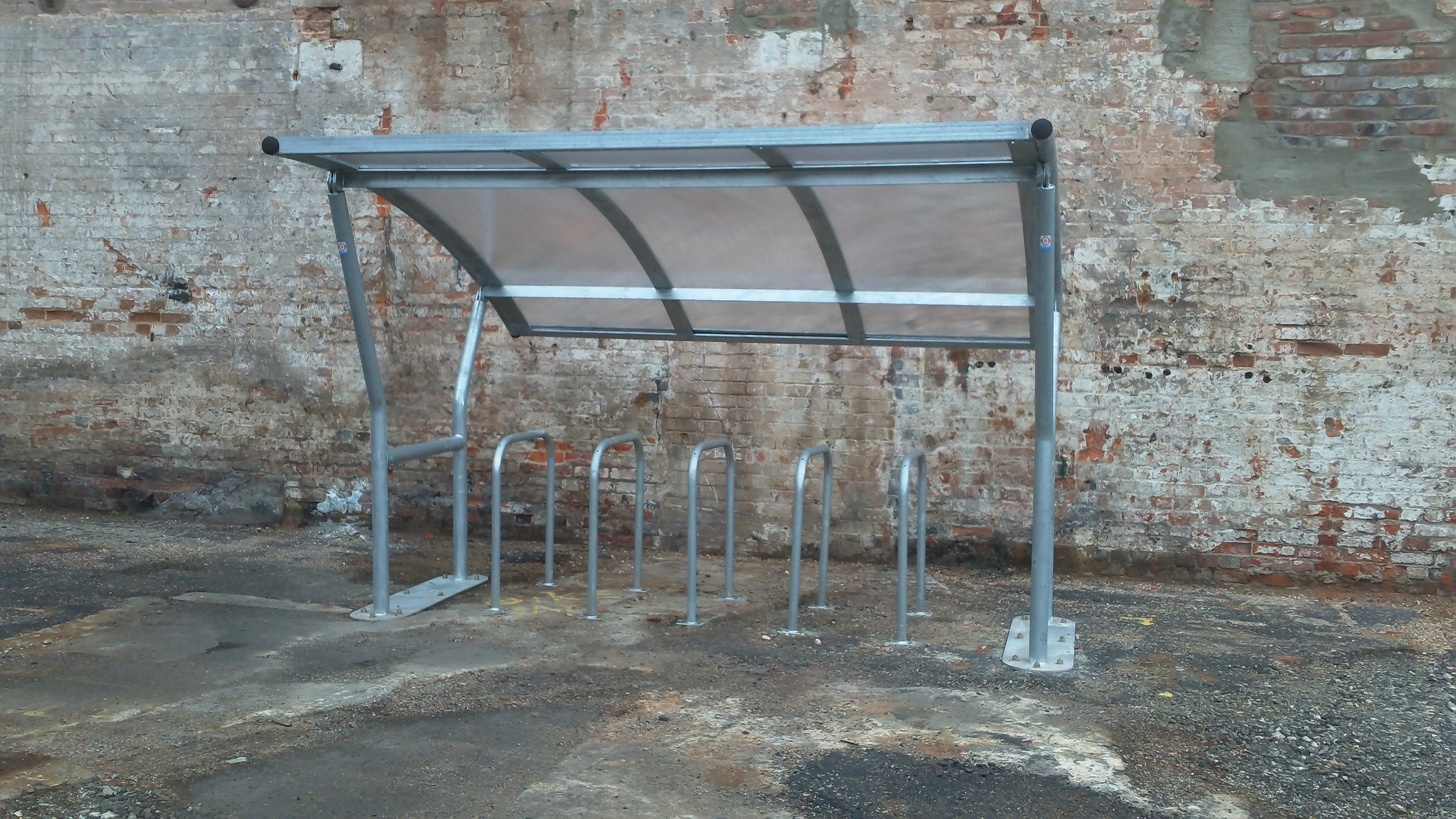
One very noticeable feature of the Car Park is a very nice covered bike park. Its great to see them using the space in different ways and that they are thinking of cyclists though its placement does seem a little strange.

I spoke to an attendant and asked if there was going to be any further development to cheer the place up and he said that improvements may be made to the area when business picks up and it starts to make some money. I say “good luck” if the other Car Parks in the area are anything to go by.

So the new Car Park has shown early signs of moving in the rightdirection in being friendly not only to Cars but lets hope that some further development see’s some tree’s and flowers green the place up a bit. Amongst the modernity of the new waterfront it would have been great to see a picnic park area adding some life and loveliness to all those buildings and Car Parks instead of the easiest and laziest way of making money.

An ‘autoban’ on the autobahn!

20 Jul

There is a growing trend for cities to close major roads to motorised traffic for periods of time to allow them to be enjoyed by pedestrians and cyclists. Germany recently banned cars from the A40 motorway for a party to which 3 million people turned up (three times the expected number).

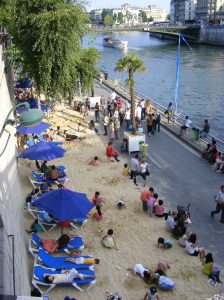
Other examples include the Paris Plages which have taken place in Paris each summer since 2002 on roads beside the River Seine. Initially there was one ‘beach’ with a second added in 2006, in 2007 some 4 million enjoyed the event. We have already reported on the separate closure of the Champs-Elysees which attracted 2 million people in 2010.

In London the ‘mayor of London’s Sky Ride‘ (previously London FreeWheel) has taken place since 2007 with a 14km road closure in central London from Tower Bridge to Buckingham Palace each September. In a separate event Oxford Street and Regent Street are closed to motorised traffic before Xmas each year.

In New York Summer Streets involves the closure of 7 miles from Central Park to close to the Brooklyn Bridge on three consecutive Saturdays in August. It has taken place since 2008 and in 2009 an estimated 100,000 people came out on the first day.

In Bogotá, Colombia they have a weekly event in which over 70 miles of city streets are closed to traffic.

Of course there was a time when it was only the protesters and activists who were challenging the dominance of the car on these roads and the authorities were trying hard to keep the traffic moving! Reclaim the Streets organised many un-authorised street closures during the late 1990’s and early 2000’s and Critical mass have been holding mass cycling events around the world for many years. What is encouraging is that what started as illegal protests are now becoming an important part of the culture of many of our largest cities with huge numbers of people get to experience cities without cars, many for the first time.

Here is the route of the London event.

Route of the 2009 London Skyride

Route of the New York Summer Streets event:

Route of the New York Summer Streets event in 2009

Ravenswood – progress!

19 Jul

Shortly after my last post I received a call from a local Councilor who said that he shared our concerns with the parking problems at Ravenswood primary school. We had promising meeting and hopefully will be working together to get something sorted. I provided him with a copy of a presentation about our work and methods which he seems to like.

If you have any ideas or would like to offer any help then please leave a comment, hit us on twitter or email us at pedestrianliberation@gmail.com. Here is the presentation: