The source of all those road-works signs on the pavement

2 Nov

I have recently posted about the nonsense of placing ‘road narrows’ signs and ‘road works’ signs across the pavement when it is clearly unnecessary and they only cause problems for pedestrians, especially those with buggies or wheelchairs etc. This evening I have come across the manual that appears to tell them to do it. It is the ‘Traffic Signs Manual‘.

Chapter 8 of this document is titled ‘Traffic Safety Measures and Signs for Road Works and Temporary Situations’. It has has lots of lovely general text about being aware of pedestrians and one specific requirement about the pavement never being narrowed to less than 1 metre. Here are the relevant sections:

  • D1.1.2 Road works on or near a carriageway, cycleway or footway might impair the safety and free movement of vehicles, cyclists and pedestrians (particularly those with mobility and visual impairments)
  • D2.1.5 During the planning stage of road works schemes… attention must be paid to the needs of pedestrians. This applies especially in the vicinity of bus stops, shops, post offices, leisure facilities and day centres.
  • D4.4.1    Signs should be placed where they will be clearly seen and cause minimum inconvenience to drivers, cyclists, pedestrians and other road users alike, and where there is minimum risk of their being hit or knocked over by traffic. Where there is a grass verge the signs should normally be placed there. If no verge is present, the placing of signs on the footway is permitted but in no circumstances must the width of the footway be reduced to less than 1m, preferably not less than 1.5m.

Unfortunately the rest of the manual seems to require maintenance companies to place all sorts of signs on the pavement. For example, this diagram, which one finds replicated across the country, shows two signs on each approaches to the road works all of which are placed on the pavement. Nothing that I can see talking about using these signs with discretion, there is no discussion about what to do in situations where there are rows of parked cars and cars on the pavement and there is no suggestion that discretion and common sense should be used:
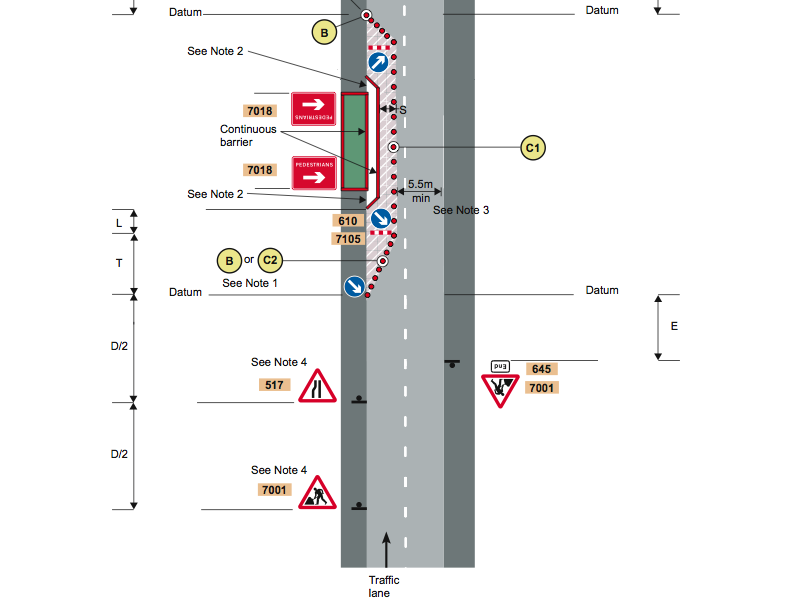
Road works layout

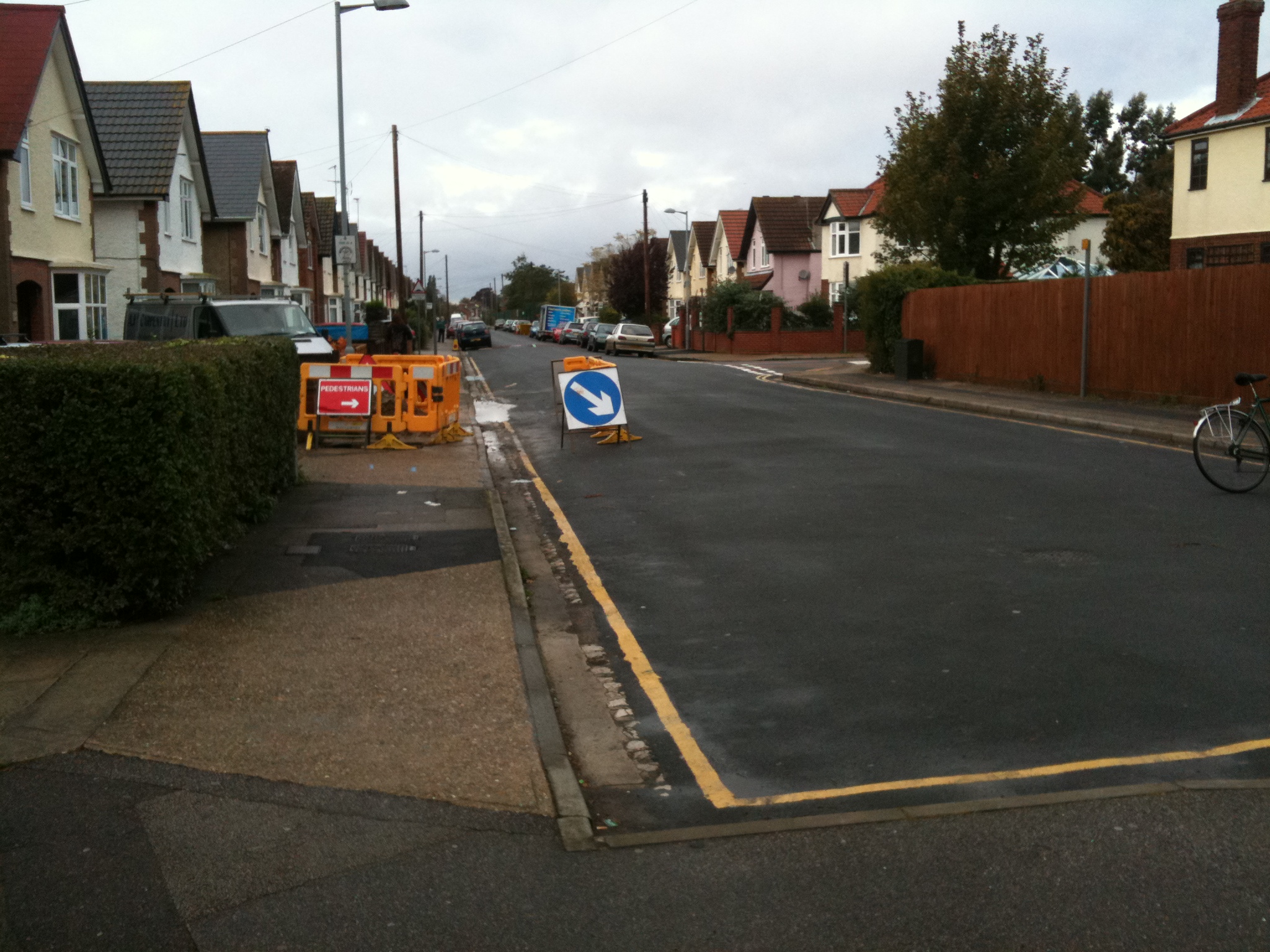
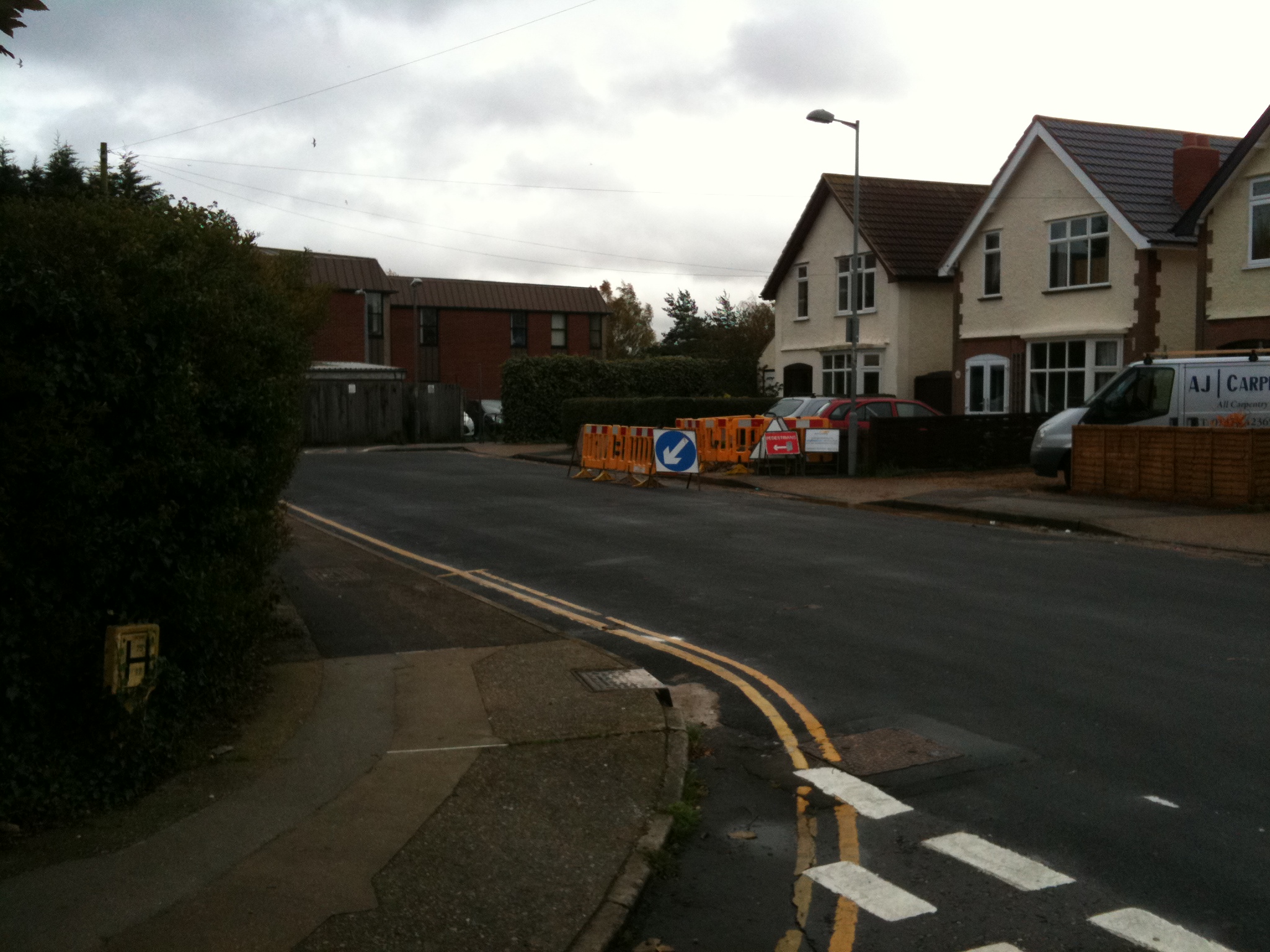
I don’t think that the authors considered these real life situations in our car littered towns. In this first example the road works are between two parked cars so the road is not actually narrowed, but the pavement certainly is!
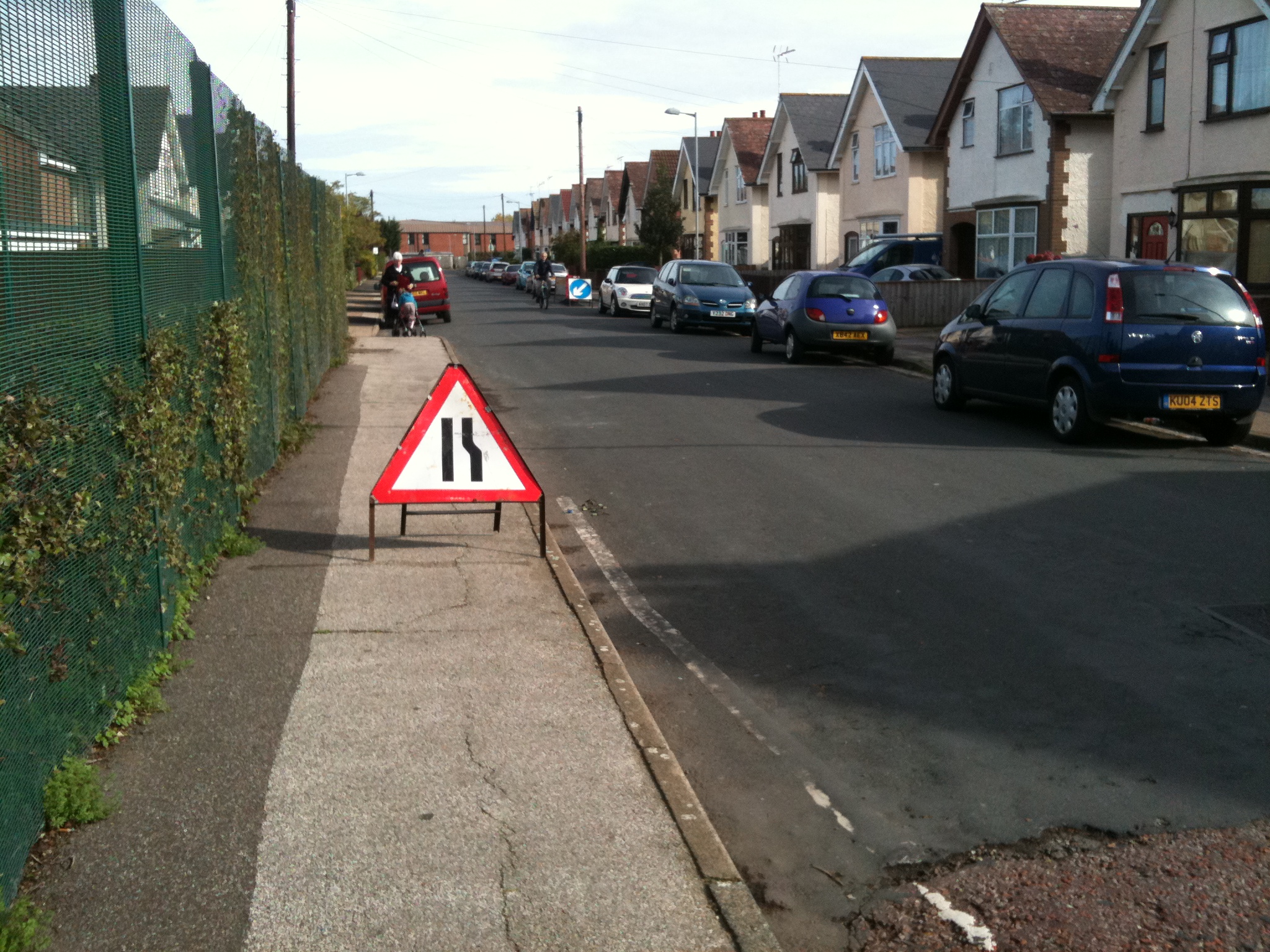
I still can’t believe that someone would leave a sign here

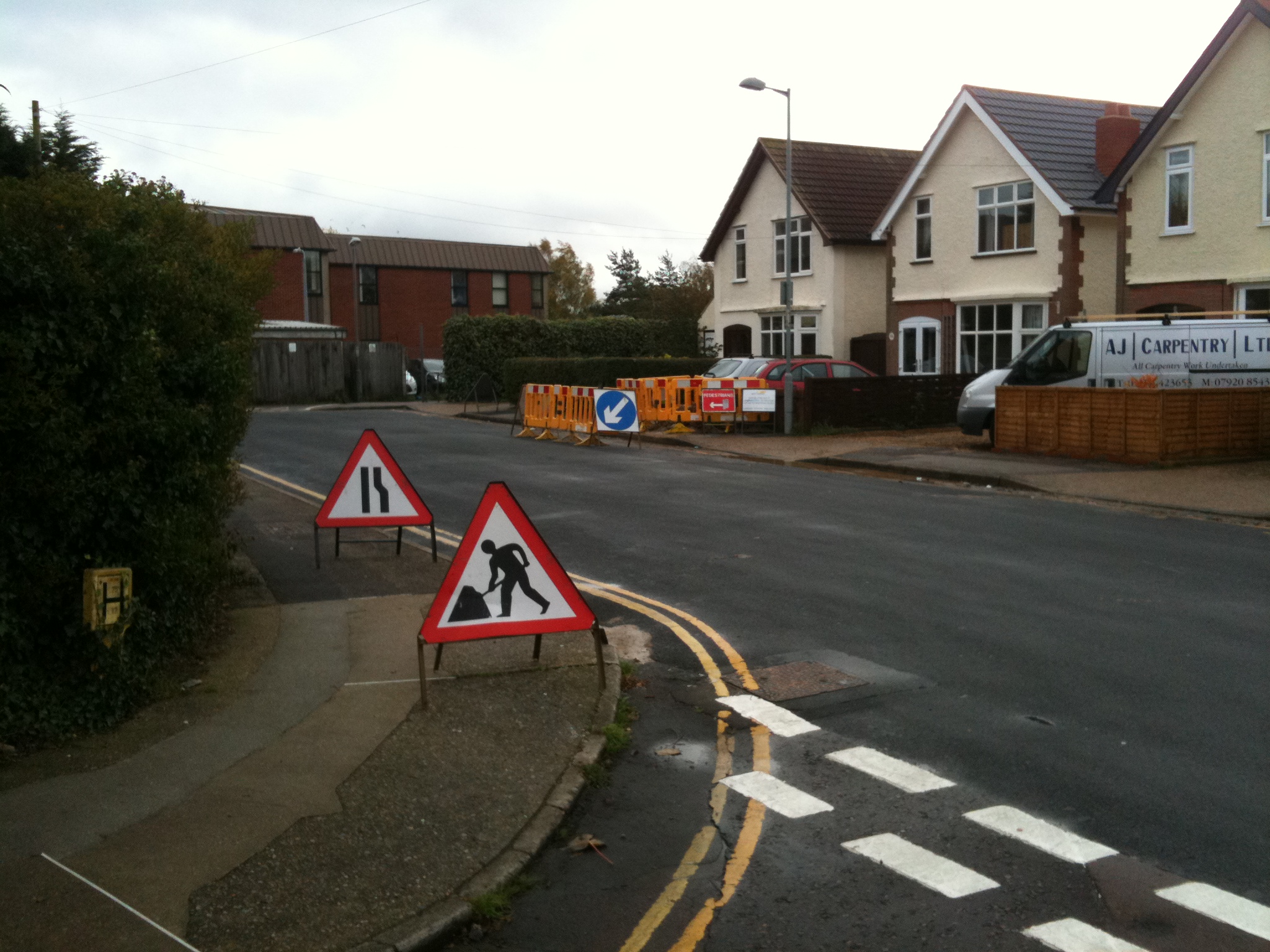
In this second example the works are at a dead-end so the only people coming are going to be on foot!

Not so clever

An this final situation shows just how bonkers it can all get in the extreme. Notice that yet again the road is not actually narrowed at all, but the pavement is now completely unusable!
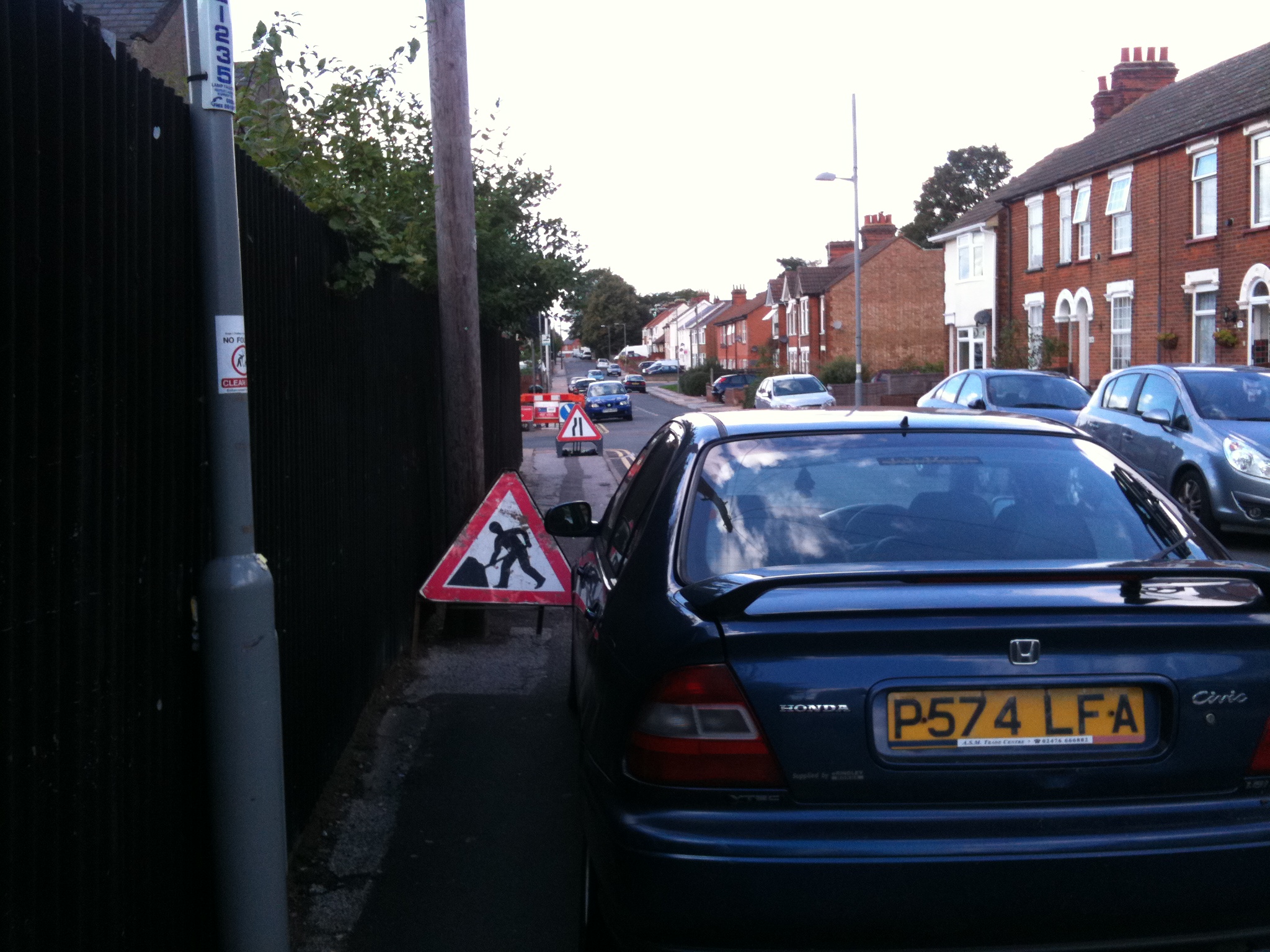
Yet another ‘road narrows’ sign, this time there is also a car to complete the picture
Foxhall Road – a lethal road that needs a crossing patrol

1 Nov

Suffolk County Council recently decided that it will not replace the lollipop lady who helps parents and children who attend Britannia Road Primary School across Foxhall Road at the junction with Britannia Road. She retires next March and the currently plans are that she will not be replaced. Have then forgotten how dangerous this road is or did they never know?

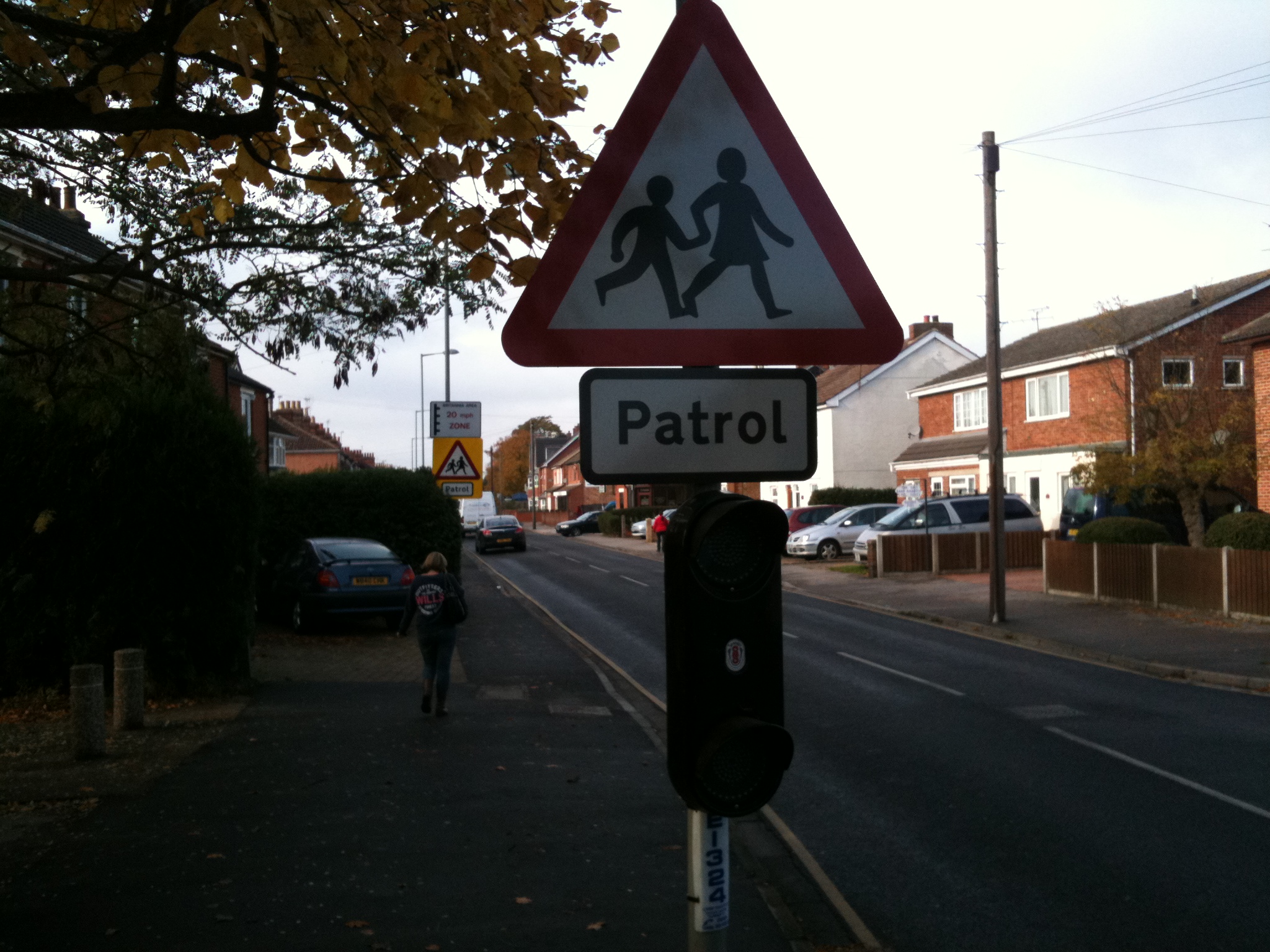
Crossing patrol sign on Foxhall Road

The location of the crossing patrol with its nice new dropped kerb.

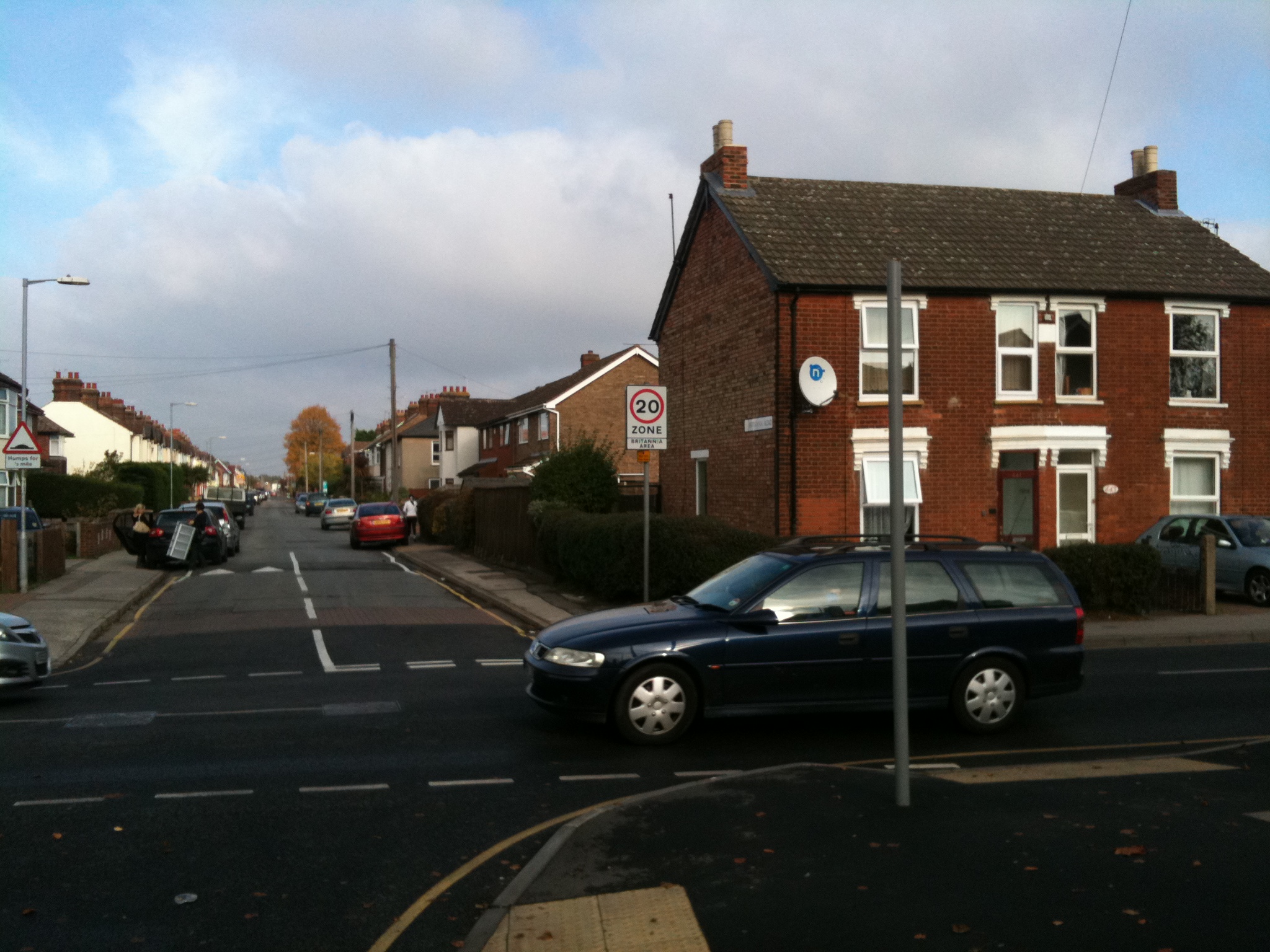
The view across Foxhall Road

However… have they forgotten that four people have been killed on Foxhall Road within the past 10 years within 100 meters of that spot and another car passenger not far away. This must make it one of the most lethal roads in the town.

For the record in 2001 a 14 year old boy was killed walking on Foxhall Road outside St Clement Hospital on 26 January 2001. Then a 22 year old man was killed walking along Foxhall Road by Dover Road on 22 March of the same year. Next it was the 18 year old passenger who died in a car crash further along the same road on 14 November 2007. Most recently  in February last year it was the turn of two women were also killed while walking along Foxhall Road.  You can check the figures using the BBC interactive casualty map.

Before you get too alarmed… Road casualty rates have been falling for 45 years. They peaked in 1966 at a staggering 7,985 in one year. The figure for 2009 is 2,222 which is the lowest since records began in 1926. During Labour’s recent term in office between 2000 and 2009 they dropped an impressive 44% (from 3,409 to 2,222) and the number of children killed fell even further (by 61%). Don’t believe me? Well check out this Wikipedia article which I helped create and follow the references back to the Department for Transport website. To give them their due, the previous conservative government also saw big falls, from 5,953 to 3,599.

My concern that the current government has pledged to ‘end the war on the motorist’ and has cut the road safety grant by 40%. They have also cut local council budgets. See this article in the Telegraph for a reasonably cynical view! Lets fight to keep this patrol also for continued progress on road safety. Why not write to your councilor or to your MP. You can do this easily from this wonderful website.  Does anyone affected wish to start a petition? If so then let me know.

Finally, here a a chart I created shows the trend in GB road fatalities since 1929 together with many of the associated road safety interventions during the period.

Fatalities on GB roads 1926-2009

Update

My initial post incorrectly suggested that Ipswich Borough Council was responsible for this decision. They were not, this is a decision by Suffolk County Council who are the transport authority. Apologies to Ipswich Borough Council. More recently fears have been expressed that all 72 crossing patrols in the county could be axed.

Stop for the lollipop

1 Nov

Stop for the lollipop (c) copyright

Sounds simple doesn’t it! However a few selfish drivers honk, rev their engines or just push past and on at least one occasions risk the official’s life. “MOTORISTS are being reminded they must stop at school crossing patrols after a lollipop lady in North Yorkshire was nearly knocked down by a car.” see this newspaper article.

There are campaigns in many parts of the country now.

Kids provide backup! photo copyright Leicestershire CC

‘Car Walking’

31 Oct

Some German neighbours of mine told me about this remarkable man, Michael Hartmann, who confronted truly horrific levels of pavement parking in Munich by ‘car walking’ and then went on to challenge motorists sole right to the road by waking in the road to slow the traffic.. Strong stuff!

He started this in 1988 and it resulted in numerous arrests, time in jail, time in hospital and being sent for psychiatric testing twice. He responded by saying that he wouldn’t stop and that he was the one who was sane! He also got a lot of publicity and was sent many letters of support. Make up your own mind!

The pavements in Munich seem to be pretty clear of cars now as far I can see on Google Streetview.

Here are some links:

Following the leader

28 Oct

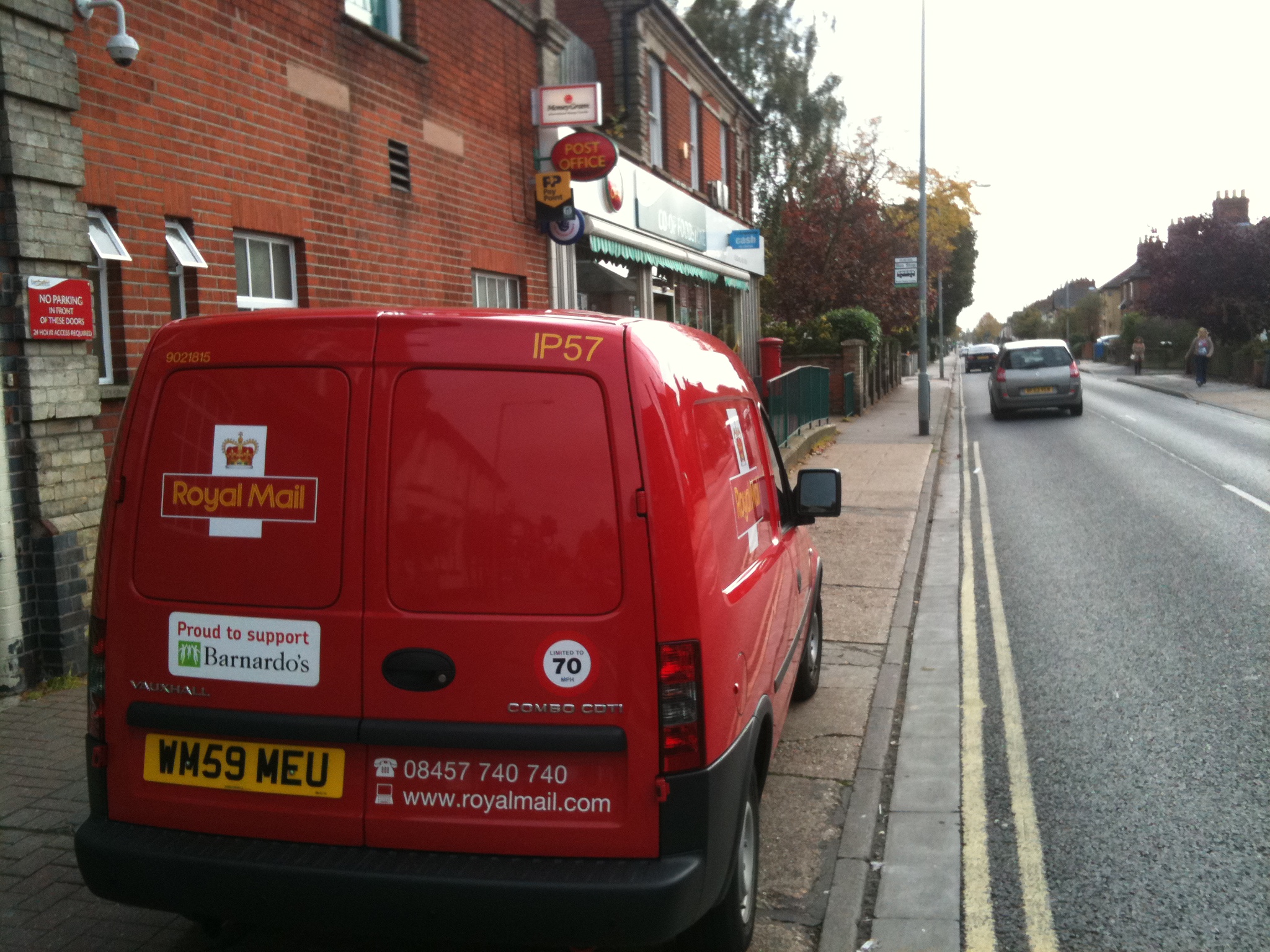
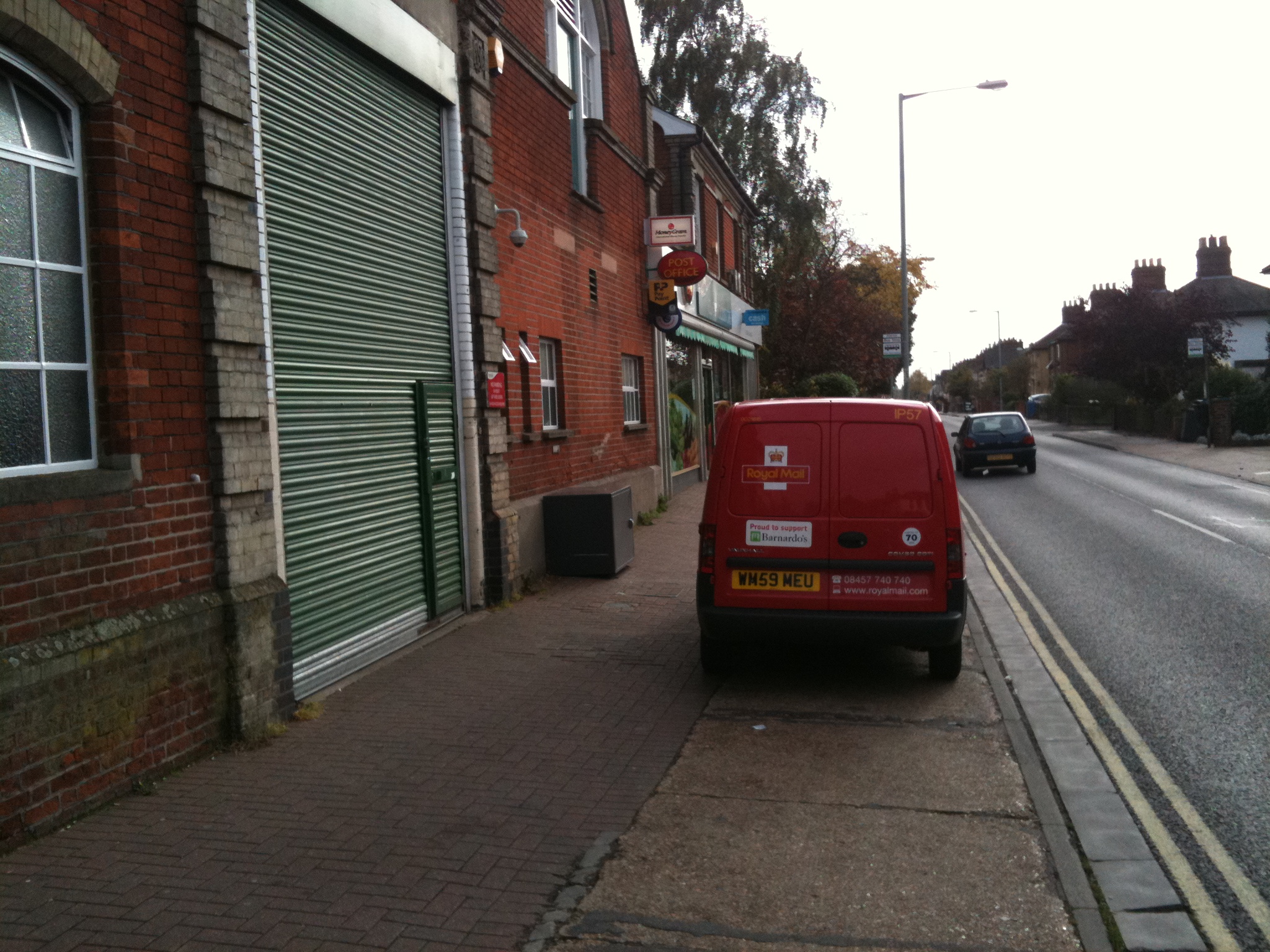
People follow leaders. Here is a post office van parked right across the pavement outside Cauldwell Hall Road Post Office in Ipswich.

A post office van this time

By the time I had come out two more vehicles had lined up, one in front and one behind.

And then there were three!

It is actually possible to park off the pavement, but once one vehicle has parked across the pavement then others are much more likely to do so as well.

There is actuallly room to park off the pavement

Indeed, anyone parking legally would actually be making it even harder for people to get by. Here is the other way of parking three vehicles outside a shop, just round the corned from the post office. Not a lot of following going on here!

Another way to park three vehicles

Delivering essential services…

27 Oct

May Gurney have been mending a leaking water main on Newbury Road in Ipswich today which is exactly what they say they do on their website: ‘Delivering the Essential Services for Everyday Life’. Who can complain about that? See if you can spot the problem. Answers below:

Not so clever

In the first picture notice: a) A nice helpful red ‘pedestrians this way’ sign showing people how to access the nice protected walkway along the road. Nothing wrong there and all super safe. However… notice b) a triangular ‘road works’ sign on the pavement blocking the pavement before one gets to the nice pedestrian sign. Then notice c) That this is a dead end road – it would be impossible for anyone in a car to read the nice helpful road works warning sign. Now notice d) That there are two more signs blocking the pavement on the other side of the road. Personally I think a pavement is an essential service and I am sure they do too really.

When I first went past the workmen were there. I asked them to move the signs but they said they couldn’t. I returned later when they had left and the signs were still in the same position. A bit later I noticed that they had all been packed away neatly.

Excess signage seem to have gone

The excess signs are now safely stowed where they can cause no harm

Here is a view from the other direction

Now you see them

Now you don’t!

This isn’t the only problem we have had on Newbury road. Check out this earlier post about the same issue and the one about the vans parked on the pavement on the same road. I have also blogged about the new rules about not blocking dropped kerbs Of course those regulations don’t apply to ‘safety’ signage? Funny old world.

Is it really the law that they must block the pavement even when it is patently daft? I am going to email them now with a link to this blog and ask them. I will let you know what they say.

Update

May Gurney have just written a very helpful reply which confirms that these companies appear to be required to lay out signage in this way as covered in my more recent post. I will take a look at the legislation mentioned in their response (below) and do anyone post in due course. Good on May Gurney for responding to us!

Here is what they say:

“Thank you for your recent communication regarding the use and positioning of temporary road signs.

“Firstly, may I assure you that the safety of both our workforce and that of other highway users is of paramount importance in any work that May Gurney carry out.

“To address your question regarding the legislation covering these type of works, we are bound by Section 65 of the New Roads and Street Works Act 1991 and Section 174 of the Highways Act 1980.

“I note from your blog that you are aware that positioning of the signs is dictated by reference to the Safety at Street Works and Road Works manual.

Update 2

I subsequent discovered that on no account should road works signage be positioned in such a way as to reduce the width of the footway to less than 1 meter (preferably not less that 1.5 meters). I didn’t measure the width remaining for these signs but it looks less than 1 meter to me.

When drivers won’t risk leaving their cars on the highway

26 Oct

Is Back Hamlet too dangerous for car drivers to risk leaving their cars on the road? If so then what about the many people who walk and cycle up and down it every day to get to the college/waterfront and station?

Since the change to Duke Street Roundabout cars are no longer able to use the road to get into town now that a short section of road has been made one-way (upwards out of town). Much less traffic uses the road, however local residents are clearly still concerned about leaving their cars fully on the road, and park in the newly laid out parking bays with two wheels up on the pavement!

Cars up on pavement in new parking bays

This is probably due to the fact that some motorists seem to delight in driving up it really fast, possibly because it is now virtually one way (except for access the college car park). Incidentally there was a major shunt on this road last year when a car piled into a line of parked cars in one of the bays so fast that it damaged four cars in a row.

If it is too dangerous for local people to leave park their cars then what about pedestrians. And what about the many cyclists, myself included, who cycle slowly up the hill? Strategically positioned parking bays protected by new plant containers could be used to create a chicane above the brow of the hill. This would: slow traffic reducing risk to pedestrians and cyclists, allow residents actually use the parking bays, free up the pavements for pedestrians and also reduce noise. Almost everyone would be a winner!

I am sure there are many places where such initiatives would have a huge benefit. Some will have already been completed, but there are many more still to do. Look out for them a find a way to bring them to the attention of your council, a blog is a great tool. If you do create a blog then try to always promote solutions and not just wallow in the problems which doesn’t get us very far.

I am forwarding a link to this article to my councilor now and will tell you how I get on.

Update

My councilor responded promptly saying that there were many areas competing for traffic calming schemes like this and that there was ‘no money’.

Privatising the highway

24 Oct

I recently  blogged about how the Traffic Management Act 2004 had introduced new regulations to protect dropped kerbs where people cross the road from being obstructed by parked cars.

I commented at the end of the post that this legislation also unfortunately allowed home-owners to ‘privatise’ the highway outside their house as long as they installed a dropped kerb and dug up their front garden! What I have now noticed is what happens when lots of people do the same. In this first photo, which is not untypical of streets around where I live, there is a continuous 44 meter section of ‘privatised kerb’ where no-one is allowed to park without the permission of one of the owners.

44 Meters of dropped kerb with automatic parking restrictions

On this nearby street there are 150 meters of almost continuous dropped kerb on one side and nearly as much on the other.

Dropped kerbs along almost the whole street, both sides

In case you don’t get the message immediately, one can of course put up a ‘private’ sign. To be fair I don’t know if they are referring to their driveway or the highway in this case.

Private!

This of course creates even more pressure on the pavements which don’t have dropped kerbs especially by larger vehicles as in my recent post about this van which was parked across the pavement outside a recreation ground which of course has no need for dropped kerbs!

A van parked inconveniently on a section of pavement without any dropped kerbs

How’s my parking?

24 Oct

Some vehicles helpfully have phone numbers printed on them making it easier to feed information about poor parking back to the employer. Today I passed a van belonging to Sliderobes parked in a stunningly inconsiderate place right outside a kid’s playground on a sunny Autumn Sunday afternoon leaving a 900mm gap between the wing-mirror and the fence. I contacted the company by phone, asking them to get the driver to move it to one of the free parking places on the road. After a bit of discussion where the driver was trying to convince me that it wasn’t obstructing anyone he moved it.

Sliderobe’s van on the pavement outside a playground

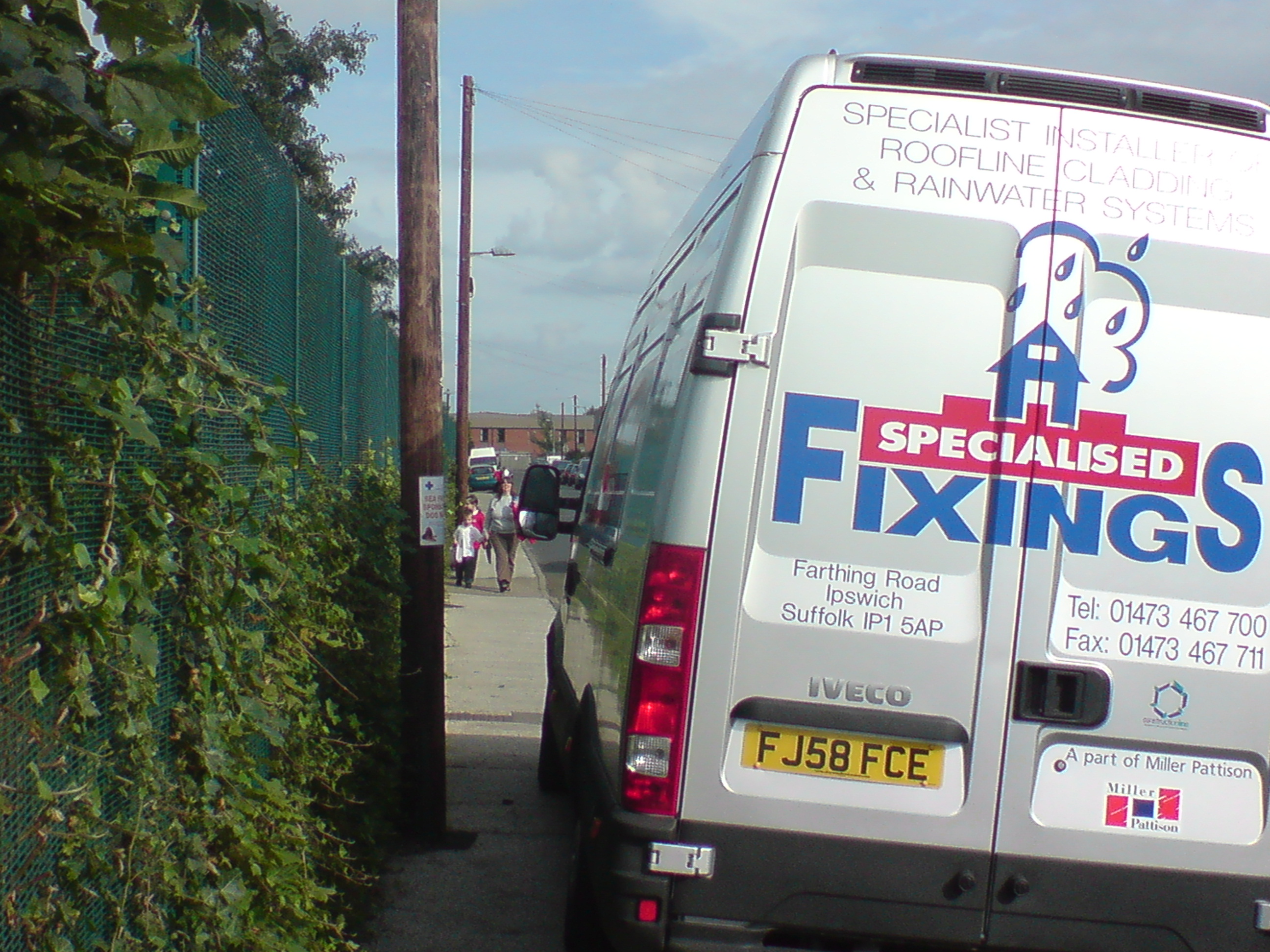
Sometimes to takes two phone calls – this van from Specialised Fixings made a speciality of parking on the same stretch of pavement. I phoned the company to complain and didn’t see it on the pavement for a couple of weeks. When it returned I complained again and I haven’t seen it on the pavement since.

Specialised Fixings’ vehicle on the pavement outside a playground

Of course it is not only vehicles that create obstructions on this section of pavement. Last week I did a blog post about these ‘obstruction’ signs for road-works that were left obstructing the same section of pavement.

Obstruction signs obstructing the pavement

Update
I have just seen the comment left on this post by Sliderobes themselves apologising. Not sure it the message is from head-office or from the Ipswich franchise. Whichever it is, the message seems to have got through this time which is good.

Too much stuff!

19 Oct

Outside this house on Burrell Road in Ipswich there is a parked car and 5 large wheely-bins. Some attempt has been made to keep them off the pavement but it has not been 100% effective. Interestingly no 99 next door is boarded up so this person appears to have the use of all of these bins.

This is on a major pedestrian route to the Railway station and much of the rest of the street is lined of wheely bins.

To much stuff!

This pair of houses (below) on Burrell Road have 6 bins on the street between them. The one this end could keep them on their driveway. What about the left hand house? Well they do have off-street space.

Convenient but not necessary – bins could easily be kept off the highway

Finally, this terrace. The houses have no front gardens and no alley-ways obviously visible to get to the back of the houses. Do they really need such large bins? Could other provision be made or has part of the highway been permanently ‘privatised’ for storing household rubbish?

Lines of bins narrowing the pavement

I am going to ask for clarification from the council as to the rules about leaving bins in the street at all, and in particular of having 5 bins and a car outside a single house.