Bad parking day?

24 Nov

A colleague commented yesterday that ‘we all have bad parking days’. This person certainly was having one given that he was blocking the pavement with a car sporting a sticker saying ‘please leave room for wheelchair access’!

Please leave room for a wheelchair!

DIY enforcement

20 Nov

Some fake yellow lines turned up over night at a dangerous junction in Elmswell in Suffolk some time ago when a concerned resident took it upon themselves to tackle a parking problem. The parish clerk said: “The lines appeared on a corner which is incredibly busy and narrow where there had been some rather thoughtless parking”. The markings only came to light around six weeks ago when the parish council applied to create a disabled parking bay on the same side of the street. The parish council want them to stay, the county council say that they are illegal and go.

The legal process to create real ones costs £1,500 and there isn’t any money. Possibly we need a simpler process? Of course there are plenty of regulations about not parking where the vehicle may cause a nuisance or obstruction but the motoring lobby is basically too strong at present for the authorities to dare use them. That is why we need to build a stronger and more vocal ‘pedestrian lobby’.

Incidentally the UK seem to also be pretty keen on fake speed cameras created by local people. A retired policeman in Newbottle, near Houghton-le-Spring, Durham recently installed a fine bird-box in his garden that displayed remarkable similarities to a Gatso speed camera. A device also appeared in Congleton, Cheshire. Indeed their are a veritable rash of these devices across the country. The last month an enterprising resident of Cardiff decorated an ex-police van to look just like a mobile speed detection van and left it in his street.

The good thing is that these interventions do seem slow the traffic down. It is not illegal to install such devices on your own property and the van was legal because it didn’t say anywhere on it that it was a police vehicle. In some ways the rules that came in in 2001 saying that cameras have to be yellow and visible from a distance can be used to advantage.

Again the process of getting real cameras seems very complicated, however at least the macabre rule that only allowed cameras to be installed at locations where 3 people had died or been seriously injured in the last 3 years was removed in 2007. Imagine being told that a village had to wait for another death to get the camera they needed.

A farmer in the USA went as far as to install his own lower speed limit signs for the road and even had the local troopers issuing tickets on the strength of them.

Freedom, what freedom and for whom?

15 Nov

A DirectGov press release in August 2010 says.”Wheel clamping on private land is to be banned in England and Wales. The ban, which will be introduced in the new ‘Freedom Bill‘ in November, will impose tough penalties on anyone who clamps a vehicle or tows it away on private land”

Freedom for whom one has to ask. Freedom for the car driver to trespass, park and then drive away with confidence that they can ignore any signs saying ‘private’, ‘keep out’ and ‘no parking please’ with no more concern that they generally exhibit when parking on a verge, pavement, bus stop or anywhere else on the highway?

Needless to say the ‘motoring organisations’ have been pushing for this for some time. The RAC Foundation said that wheel-clamping was a breach of human-rights legislation because the concept of “one citizen “punishing” another is alien in English law”. The RAC Foundation’s did however say acknowledge  “We recognise the right of a landowner to enjoy his property without unauthorised obstruction.” The AA said that “bad and immoral practices” among private parking firms in England and Wales was “shocking and unacceptable”. Also that “The public have absolutely no protection if a private parking firm acts unfairly – it is a civil matter and no-one is interested in helping”. Finally in a flourish of brilliance that “Many elderly and vulnerable people have been ripped off by these callous cowboys.”

Lynne Featherston, the Home Office minister said that some firms were operating a “sort of entrapment” and an outright ban was the right answer and that “Most police forces do not spend their time prosecuting clamping companies”. The minister did however acknowledge on her blog that the police will not be able to cope, saying that “Cars that are parked dangerously on private land  – for example – blocking the entrance to a hospital or such like will be towed by the police. However, the police powers are for exceptional circumstances only”.

The British Parking Association acknowledged that reform was needed but that “If clamping is banned the Government must describe how it would protect landowners’ interests where vehicles are parked unlawfully on their land”. Matt Roberts, manager of Worcester Ten Pin Bowling who said that he was sceptical about the Government’s plans and was worried about parking becoming a “free for all” – “What alternatives are there to protect the car parking spaces that we pay for? I don’t like the idea of wheel clamping, if there is another way then I’ll do it”.

Which? magazine conducted a poll on their website which was split with a slight majority favouring the ban. The magazine was responding to readers concerns both about disabled people being frog-marched to cash-machines and those of land owners. A BBC ‘Have your say’ article attracted over 800 comments with the normal range of extreme views.

Now, I certainly believe that many clamping companies have indeed being run a racket charging exorbitant fees to release vehicles and that something should be done. Is not the real problem that drivers have got so used to breaking parking regulations in some many places and they find it a rude shock to actually get a ticket when parking on private property when they have been getting away for it for years on pavements, outside schools and on verges? We reported some time ago about the illegal parker who appealed successfully against prosecution on the grounds that he had done it many times before and never been challenged.

The huge opportunity now seems to be that we suddenly have business owners and even the ‘British Parking Association’ on our side. Every small business which owns and pays for a few parking places outside their property is going to need protection. Our challenge is to ensure that the action that protects their rights also protects the rights of the  “elderly and vulnerable people” (to quote the AA again) who wish to use the pavement and indeed the rest of us who have seen our rights and freedom trampled on for years.

The said Freedom bill, or “Freedom (Great Repeal) Bill” as it was described by the Queen in the Queen’s speech is very broad rangeing. It will cover many important concerns. For example:  ‘Restoring freedoms and civil liberties’, ‘Allowing members of the public to protest peacefully without fear of being criminalised’, ‘reform of libel laws to protect freedom of speech’, ‘protection of historic freedoms through the defence of trial by jury’, ‘restoration of rights to non-violent protest’, ‘Safeguards against the misuse of anti-terrorism legislation’, ‘repeal of unnecessary criminal offences’, ‘introducing new legislation to restrict the scope of the DNA database’, ‘Protecting privacy by introducing new legislation to regulate the use of CCTV’ and ‘Ensuring the storage of internet and email records is only done when there is good reason to do so’.

Let’s see if the bill can get them to acknowledge and deal with the whole parking mess across both public and private land. It is now predicted that the bill will be published in ‘the spring’.

Traffic management … or illegal obstruction?

14 Nov

A company called Traffic Management Solutions Ltd were called out to fix some traffic lights in Cambridge yesterday. Clearly it is good to get traffic lights fixed, however… this was the start of a very sorry tale for one of our intrepid local ‘PL support officer’ who spotted the parking choice at 10:15am and then again 90 minutes later when they challenged the driver. Before I tell you what happened lets take a look a the choice of parking spot. Firstly one has to say that no, the vehicle was not in motion – indeed if one looks closely there is no one in it. The second thing to say is that no, the vehicle was not just parked here for 2 minutes. It was there for 90 minutes. It is of course on a junction partly across a pedestrian crossing at a junction on a bend on double yellow lines within the zig-zag lines of a pedestrian/cyclist crossing opposite a dropped kerb.

Neat parking!

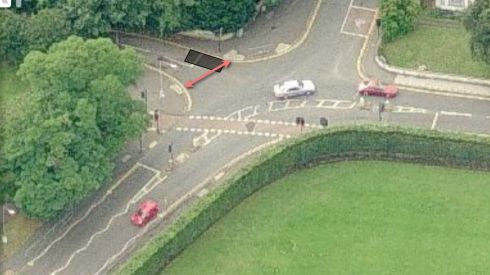
Here is the aerial view. The vehicle position is shown in black, the pedestrian route in red.

Newnham junction vehicle location in black

Unfortunately the driver was not at all interested and indeed claimed a legal right to park there! Clearly there were very much safer opportunities nearby, indeed reversing 10 meters further back would have helped a lot. He then got very arsey about having photos taken and threatened to phone the police claiming that it was against the ‘Data Protection Act’. So far so bad.

Our ‘officer’ then phoned the police to discover what their view on this was. They did not seem very interested in the parking but did ask if the vehicle was going to be there much longer, in which case they might swing by. They did however confirm that the driver could indeed claim ‘harassment’ or ‘alarm and distress’ if the photographer was ‘distressing’ them. Given the relative size of the two people – the driver was much bigger – and the short time the discussion took, I don’t think that would hold up in court. Also, it is my understanding that it is only harassment if a ‘reasonably person’ would have been distressed which clearly was not the case.

Lets hasard as guess about what the driver was doing wrong.  According to the Highway Code Waiting and Parking rules:

Rule 238

You MUST NOT wait or park on yellow lines during the times of operation shown on nearby time plates (or zone entry signs if in a Controlled Parking Zone)

Rule 240

You MUST NOT stop or park on

  • a pedestrian crossing, including the area marked by the zig-zag lines (see Rule 191)

Rule 242

You MUST NOT leave your vehicle or trailer in a dangerous position or where it causes any unnecessary obstruction of the road.

Rule 243

DO NOT stop or park

  • opposite or within 10 metres (32 feet) of a junction, except in an authorised parking space
  • where the kerb has been lowered to help wheelchair users and powered mobility vehicles
  • on a bend
  • where you would obstruct cyclists’ use of cycle facilities

That seems clear then! Note that in the above rules are identified by the use of the words MUST/MUST NOT are legal requirements, and “if you disobey these rules you are committing a criminal offence. You may be fined, given penalty points on your licence or be disqualified from driving. In the most serious cases you may be sent to prison.”

The words ‘Do not‘ mean that it is not necessarily an offence, but “The Highway Code may be used in evidence in any court proceedings under the Traffic Acts (see ‘The road user and the law’) to establish liability. This includes rules which use advisory wording such as ‘should/should not’ or ‘do/do not'”.

So… I will now email Traffic Management Solutions Ltd and ask them politely to have a word with their drivers and encourage them to be a bit more considerate and aware of the law. The embarrassing thing for me is that it turns out that the company is based in my home town of Ipswich! Do we have a special driving test in this town? It feels as though this is just the start of a very long campaign!

Pavement parking petition launched in York

12 Nov

A petition has been launched by York’s Labour group calling for urgent action to stop motorists parking on the pavement in University Road, York. Residents said the parked vehicles were putting pedestrians in danger. Terence Fisher, 73, of Fulford, said he saw a young woman with a pushchair forced into the road because a car was blocking the footpath. Read the whole of the York petition article in The York Press. The petition can be signed online at www.yorklabour.org.uk.

Of course I recently blogged about Labour councillors in Reading blocking a conservative initiative to ban pavement parking in that town calling it a ‘cash cow’. Funny old world.

Here is a nice example from York of parking on a cycle track, on double-yellow lines pushing cyclists onto the pedestrian path.

Photo by greensambaman

Disaster car parking

9 Nov

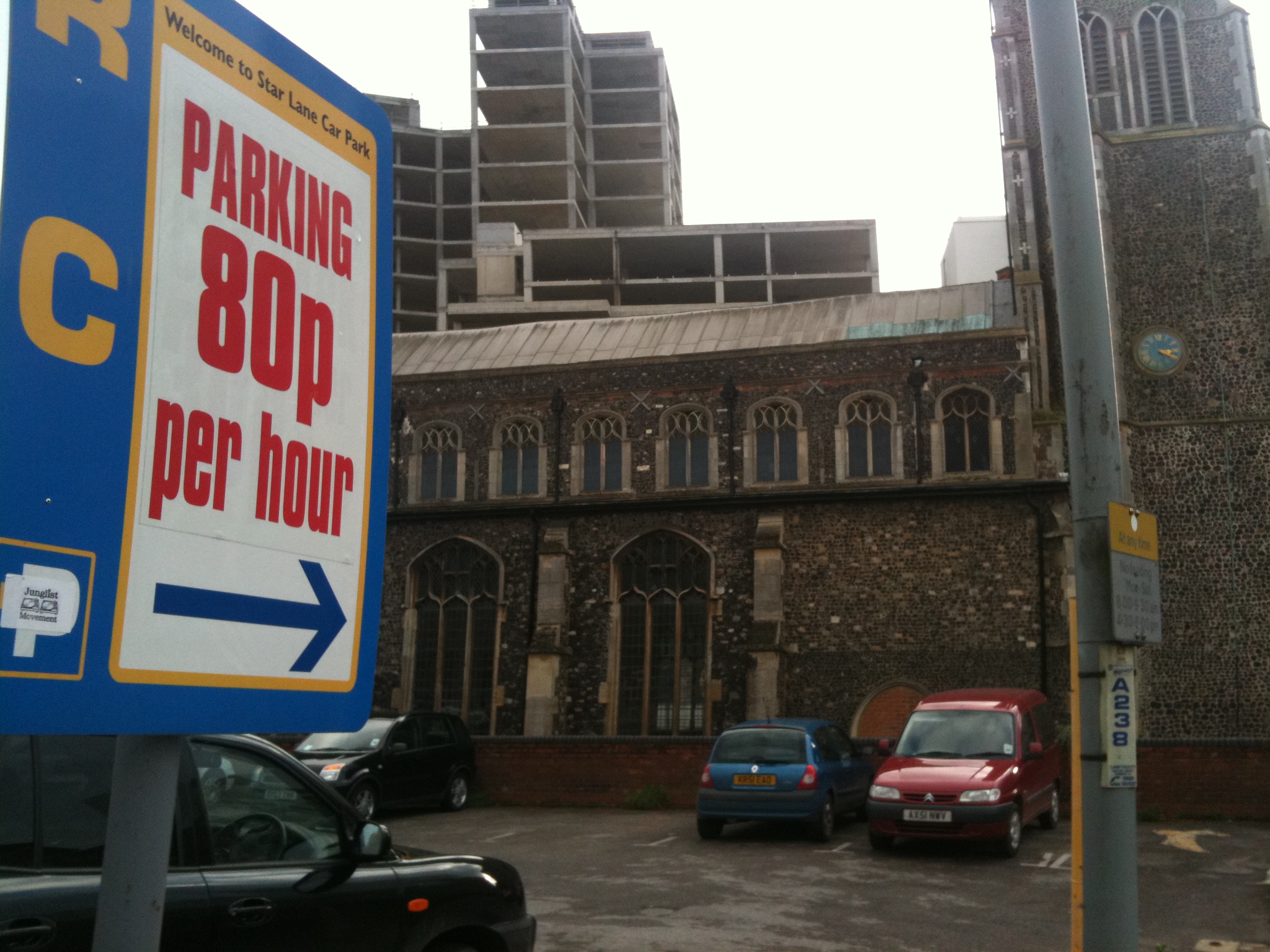
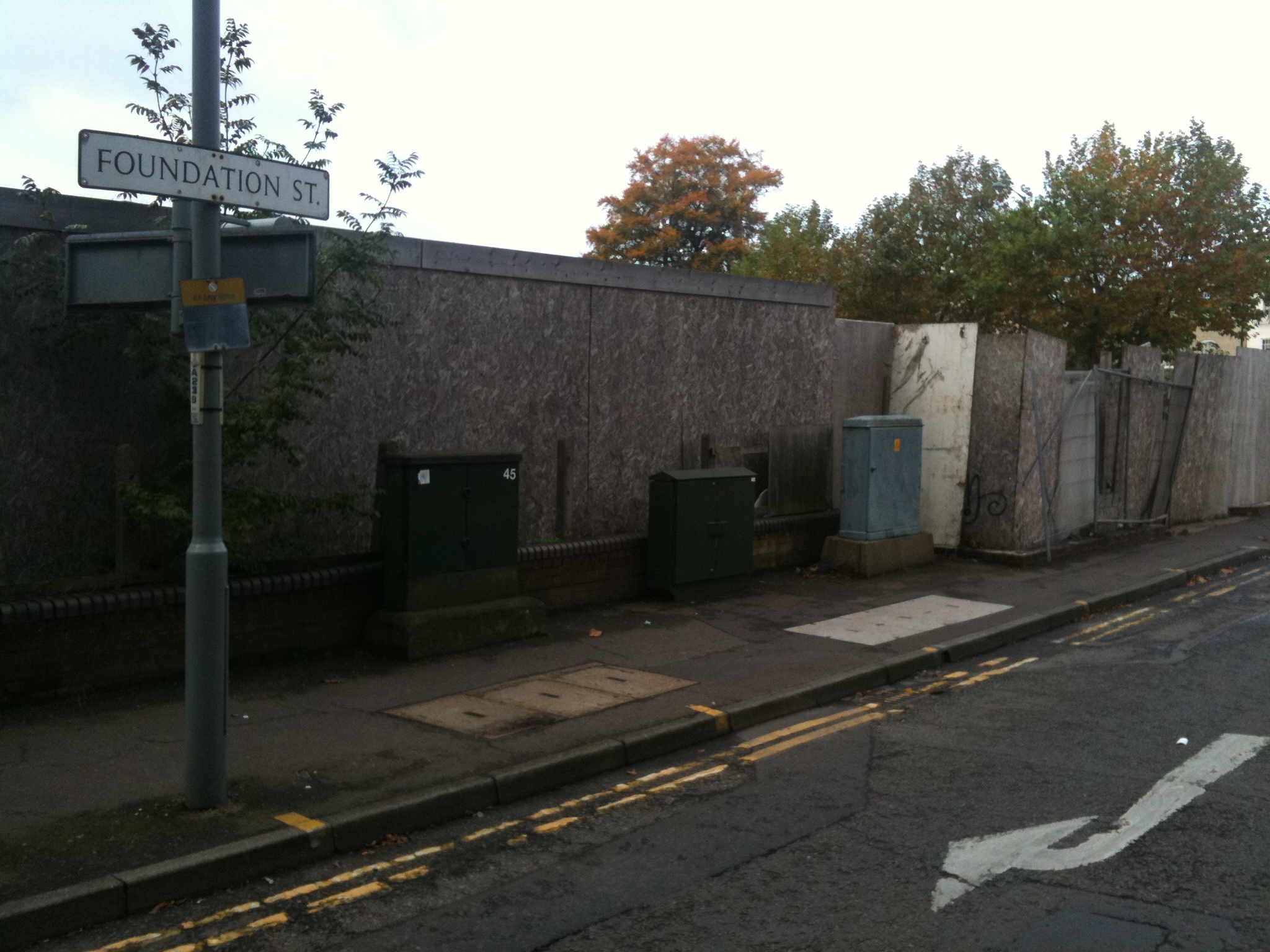
These car parks created close to our beautiful waterfront are a disgrace. Why are they given permission? They can’t make a lot of money and create a terrible impression. They are in the middle of a dual-carrageway gyratory, known as the Star Lane gyratory and the council has been advised to reduce car parking and convert one lane to pedestrian, cyclist and public transport use. However.. it is still two lanes, breaks EU air quality rules and every scrap of land is turned into a car park of the lowest quality. Yes, I know that there re great plans for the area, but why can’t we have something better in the mean time!

The fencing has been down for weeks on this one.

Disaster car park 1

The church is closed but the parking in cheap!

Nice church, 80p per hour

The irony of this next image is that the Tudor building in the middle of this car park is owned by, and is used as the head-quarters of Total Car Parks – a car park company with sites all round the country.

Car park plus Tudor building

And when it comes to creating a good first impression…

Notice the quality and attention to detail here!

Of course the most ironic car park is this one in Detroit. The massive 4000 seat Michigan Theatre was build in central Detroit in 1926 at a cost of $5 million on the site of the garage where Henry Ford built his first car. The theatre closed in 1976 because there was no parking nearby and everyone had left for the suburbs by then and was dependent on the car. And since then …. yup, the theatre has been used as a car park for the office building next door – and they even built a concrete multi-story car park within the theatre to increase capacity. So that is the journey from inventing the car, to culture and finally a car park.

Michigan Theatre in Detroit

Or Is it is final? Actually Detroit is reinventing itself at this very moment into a cycling city and ‘grow-town‘.

Blind man locked up over pavement parking dispute

9 Nov

After many calls to the police about pavement parking without any effect, Daniel Duckfield from Narberth in North Wales finally told the police that he was going to write on one of the windscreens and let down the tires of one of the cars. The police then responded within minutes and arrested him 50 meters from the vehicle and put in the cells for three hours. He was only let out after accepting a caution for threatening to cause criminal damage.

Daniel Duckfield. Photo copyright BBC.

I haven’t heard a clearer story of how the law is set up to support motorists over the interest of pedestrians. What had made him absolutely mad was being told by one person parked on the pavement that ‘she was only going to be 10 minutes because she was having her legs waxed’.

Further reading

BBC Article

88% of the people in 18% of the space

8 Nov

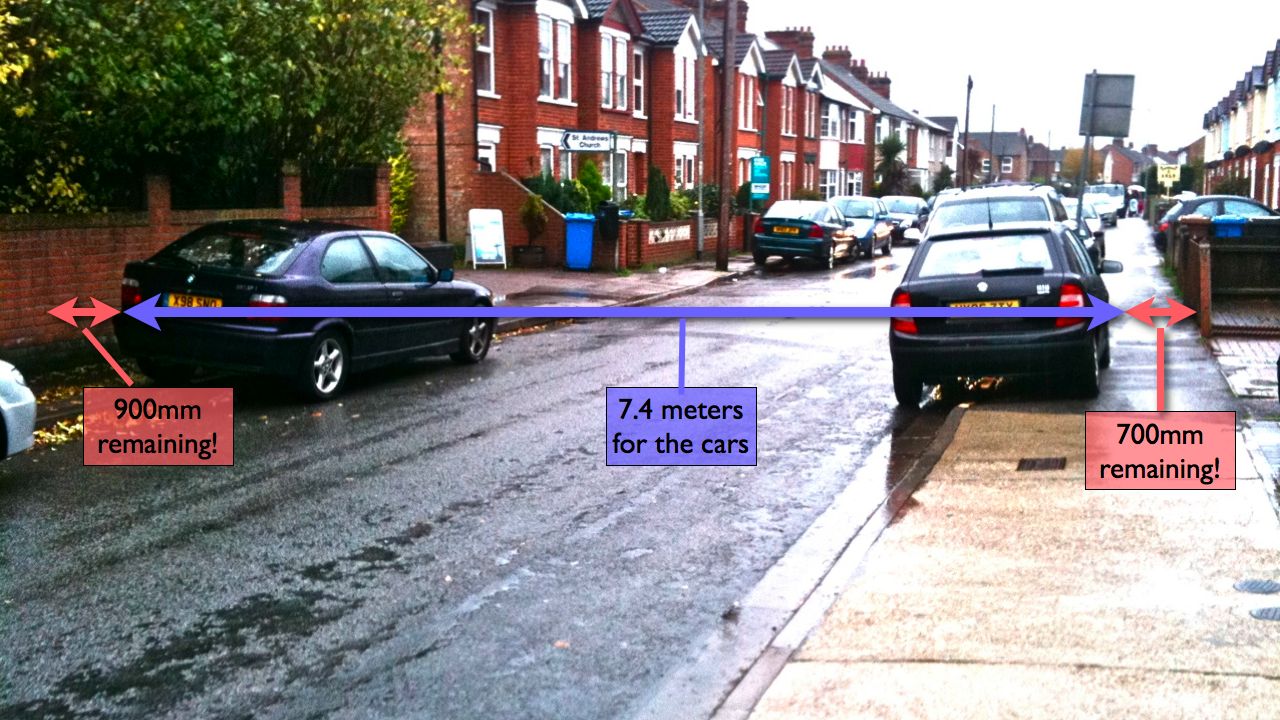
I did a simple traffic count outside a local primary school today using a pair two clickers. A total of 581 pedestrians passed me, and 80 cars which means that 88% of the traffic was on foot. I then measured the width of the road which was 9 meters wide of which 700mm was available for pedestrians on one side and 900mm on the other when the cars parked partially on the pavement were accounted for. A total of 1.6 meters or 18% of the road width was available to pedestrians.

88% of people are on the pavements with 18% of the space

In reality it was worse. There was a car parked across the raised crossing for some time, another car drove along the pavement for 20 meters or so to pass a vehicle on the road and then a car hooted as it reversed out across the pavement into the road making everyone wait.

We have being playing with the idea of Ofped inspections for schools, which would be an assessment that could easily be made for schools across the country. One measure would be how many people walk or cycle. Another would be how equitably the space was allocated between car drivers and pedestrians. Points would then be deducted for dangerous of illegal activity by motorists.

Cyclists are at it too

5 Nov

In Cambridge cycles are making this own claims to the pavement. In this street the back gardens were sold for housing which lost them their back access so the bikes and trailers now end up on the pavement. Possibly a cycle rack in the road in place of a resident parking bay would be in order? I have spoken to a London Borough who wished to do just this, however their legal guys thought that while it was legal to leave a big vehicle on the highway that it was possibly not legal to install cycle racks. They may have a point, but equally according to the Law it is not legal to leave any ‘thing’ in the highway and that includes cars.

Newnham cycles

Someone has since suggested one of these, cycle racking for 6 bicycles in the space of a single car. However there is likely to be a planning issue with installing something permanent on the highway.

Cycle rack the size of a car

Moo!

5 Nov

Tory run Reading Council are planning to bring in a pavement parking ban in January 2011 which will not only help clear the pavement of private cars but will also raise money for the council. Judging by the complaints it might actually be effective. Labour opposition are saying that it is a cash cow and that people have ‘no option than to park on the pavement‘ – yawn!

Cash cow!

The conservative transport leader, Richard Willis, says that they will start with warnings letters before issuing fines. Some Labour councillors have asked for all the roads in their wards to be exempted until there is a public consultation. Labour councillor Tony Page claims that the “The layout of our streets is such that many people have no alternative but to park on pavements or verges if they want to have their cars anywhere near their homes” and that is it just a cash cow!  Now where have we heard that before!

Kirsten Bayes , a Liberal Democrat seems to have a clearer idea of the issues, saying that whereas people “struggle to park without going on to the pavement” that the pavements were “meant to be used by pedestrians, disabled users, wheelchair users and buggy users”.

Hertz are being more helpful and set up a car club at the University last month.

Further reading and references

Some of these links are a bit unreliable. Sorry about that but I think it is a problem the far end