Government gets in a muddle over school crossing patrols

9 Feb

Goverenment, both central and local, are in a big muddle over school crossing patrols. Central government claimed that local authorities would be able to make the required savings without loosing ‘front line services’ and Eric Pickles is still sticking to that line saying ‘It just goes to show that cutting front line jobs and hitting front line services isn’t inevitable– it doesn’t have to be an option at all.’

There are 93 school crossing patrol sites in Suffolk of which 62 are currently in operation and these are used by an estimated 8,000 children daily. Each crossing patrol officer is paid £6.38 per hour for 7.2 hours a week. The annual cost to the council is £174,000. Suffolk County council is about to decide the fate of these patrols and many if not all will go. So much for front line services not being hit.

In order to find out where these crossing patrols are sited I made a Freedom of Information request asking for the information. The response was patchy and much of the information which would be required for a proper assessment was missing. They promised to collect the missing information by the end of January but have not responded to my request for them to publicise it where I can download it when it is available. I have converted the patrol sites information that they did give me into a Google map from which one can easily jump to Streetview images like this one in Ipswich where the streetview car just happened to capture the crossing patrol officers as they were completing their shift.
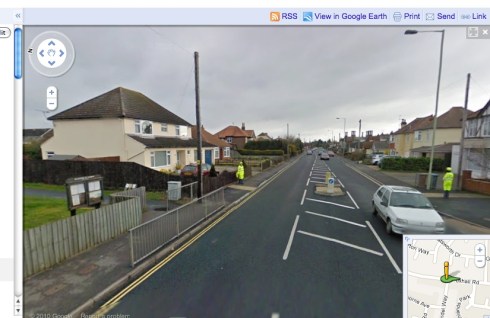
Foxhall Road crossing – click for Google Streetview

St Edmundsbury District Council has voted to pay for the crossing patrols in their area, Ipswich Borough Council refuses to take on an services that SCC dumps At one school a head teacher was manning one crossing herself and a local estate agent has offered to sponsor another. Crossing patrol officers in Lowestoft have collected over 6,000 signatures against the cuts.

Will ‘Big Society’ help us us out with this one? Personally I am fully in support of people doing more for themselves and believe that information technology can help people do just that, however… not all jobs can or should be done by volunteers. There are big problems with used volunteers to do school crossing patrols as the authorities are now finding out to their cost.

Can the job be done by volunteers? Well, no, or possibly or.. not sure…..  According to a newspaper article crossing patrol officers needs to be employed by the council or the police authority as it is only these organisations that have the right to stop traffic.  The SCC web site is however less clear on the matter, saying “it may be possible for a school or another authority to take on a volunteer to perform the duties of a patrol. However, currently the Law is very strict on how a patrol must operate and a school or another authority would need to fulfil all the supervisory responsibilities”.

The above newspaper article also reports that the new conservative MP for Ipswich, Ben Gummer, has taken up the regulations with the Department of Transport and he is hoping to have a meeting with junior minister Mike Penning will allow the change.

The portfolio holder for transport for Suffolk says he hopes that the MP is successful. I can understand why, because in the mean time a crossing patrol officer has been injured in Lowestoft. The officer suffered cuts to the head and shock and a driver has been reported to the Crown Prosecution Service for careless driving. The crossing patrol, across the Yarmouth Road (A12) is one of those that will potentially go. A 6yo child was killed at the same crossing in 2007.

In summary it is a mess and both front line services and children will be at risk. A huge amounts of time is being spent trying to invent a new operational and management model against looming cuts.

Do we really want the school heads (who are paid a lot more than £6.38 per hour) operating the patrol or worrying if the supervision is adequate. Who will deal with the situation when a volunteer crossing patrol officer isn’t able to to come in to work? Will it up to the school to sort out a replacement or the estate agency who sponsor’s the patrol or another volunteer? So much for ‘no loss of front line services’.

BBC documentary ignores pedestrian safety

8 Feb

The BBC documentary ‘Surviving a Car Crash’ (available on iPlayer until 8th March) was first shown on BBC2 on 7 February. The program covers a range of fancy technologies that could reduce the likelihood of death of the occupants of a vehicle during a car crash. During this hour they failed to mention pedestrians or cyclists once or any significant technological advance that would help them whilst at the same time taking about ‘ending all fatalities from car crashes’.

Significantly, they redefined car crash as being limited to collisions involve two vehicles and no one else – ie pedestrians, cyclists or motorcyclists. That is incorrect, the term also covers single vehicle incidents causing injury of death to pedestrians, cyclists etc.

When I complained about the article on the BBC News site that trailed the documentary they adjusted the article to at least acknowledge that pedestrians do exist and are injured/killed. In their response they explained that they were “largely focused on research being done in the car industry. Much of that, inevitably, relates to car occupants”.

Why was it inevitable that they focused on this without highlighting the limitations of the approach? Indeed, back in 2002 judges from the European New Car Assessment Programme – whose members include the AA, RAC, and Department of Transport  –  slated much of the industry of neglecting pedestrian safety while “ploughing millions of pounds into ensuring that car occupants survive even high-speed crashes”. They highlighed the Range Rover, Jaguar X-type and Vauxhall Frontiera as the worst vehicles for passenger safety noting that the Range Rover had ‘an immensely strong body that provides for its occupants safe’ but also that its pedestrian protection was ‘dire’. It was exclusively these high speed crashes and the safety of the occupants  that the BBC focused on 8 years later. That would have been fine if they hadn’t implied that these developments would ‘end fatal car crashes’. They won’t.

Their is very interesting work going on. The same judges back in 2002 emphasised that the number of pedestrians killed or seriously injured would be dramatically reduced if manufacturers took their safety more seriously. They highlighted Honda’s very safe designs who have subsequently achieved a maximum 5 star pedestrian rating for five of they models, the Accord, Civic, Jazz  and Insight. Unfortunately the documentary failed to discuss these interesting issues. Why was this not covered?

Also, the BBC didn’t mention ‘intelligent speed adaptation‘ which ensures that the vehicle won’t exceed the speed limit even if the driver is not intelligent enough to do this for themselves! Indeed some Motorists with a capital ‘M’ complain about how they have to spend all their time looking at the speedometer and not at the road due to the complexity of the speed limit changes and that it is therefore safer to have higher speed limits. Leeds University are trialing the approach saying that it “potentially provides one of the most effective strategies for reducing inappropriate speeds”. Transport for London are leading the way and have created a digital speed limit map for London and have developed software for Tom Tom units which is available for free as is the source code and speed limit data itself. No mention of any of this either.

They didn’t mention of risk compensation where people can adjust to a reduction in risk by taking more risks, in this case driving faster or paying less attention because the car is doing more work for them. This was unfortunate as because this effect is likely to reduce the benefit from these technical and medical advances to vehicle occupants and may even increase the risk to pedestrians by increasing speeds.

I am about to made another complaint and request that the BBC should attach a comment to the  documentary whenever it is re-shown clarifying that the program is focused only on two vehicle collisions and the safety of the occupants  are that the many deaths to pedestrians, cyclists and motorcyclists which are unlikely to be greatly changed by the technology discussed. I will encourage them to do a follow-up program on technology to protect those outside the vehicle. Do you think that is reasonable?

Update

I have now submitted the following complaint: “The program focused exclusively on the safety of the occupants of the vehicles in high-speed 2 vehicle crashes while implying that the technical advances might result in ‘an end to fatal car crashes’. Far from ending fatalities for those outside the car, risk compensation may actually increase risk to pedestrians. Much good research and progress into pedestrian safety was completely ignored. As a point of law and common usage, a ‘car crash’ is defined as a collision involving one or more motorised vehicle that causes damage, injury or death. As such the claim in the program of ‘ending fatalities’ is completely bogus. Please add a note of clarification about the scope of the otherwise excellent program to clarify these points when the documentary is re-shown. Please also consider doing a further program from the perspective of those outside the car.” I also provided a link to this post.

Do pedestrians even exist? not according to a BBC article on road fatalities

7 Feb

Update – see update note below – the article that I complained about has been updated in response to my complaint and now does mention cyclists and pedestrians.

There is an disappointing article on the BBC News website quoting vehicle safety experts claiming a “Motoring miracle” where “fatal smashes are eliminated”. it goes on to detail loads of super-clever and no doubt expensive technology that ensures that drivers survive “even truly catastrophic accidents” and to help passengers by explaining how the car “can also transmit detailed information about the crash forces experienced by passengers”.

The lead does correctly highlight that over one million people are killed each year on the roads and that human error and driving too fast are ‘at the heart of the issue’ however they then go on to imply that car crashes only happen between two vehicles and only talk about safety for drivers and passengers. No mention of features to protect pedestrians or cyclists, especially no ‘miracles’ that will eliminate the risk to a pedestrian from a vehicle traveling at normal urban speeds.

A ‘road traffic collision’ in legal and professional circles does not need to involve two vehicles. The definition clearly includes a single vehicle where anyone (other than the driver) is injured. The law defines a reportable road traffic collision as “an accident involving a mechanically-propelled vehicle on a road or other public area which causes:

  • Injury or damage to anybody – other than the driver of that vehicle,
  • Injury or damage to an animal- other than one being carried on that vehicle (an animal is classes as a horse, cattle, ass, mule, sheep, pig, goat or dog).
  • Damage to a vehicle – other than the vehicle which caused the accident.
  • Damage to property constructed on, affixed to, growing in, or otherwise forming part of the land where the road is.

The simple fact is that one of the best way of making roads safe for pedestrian is for vehicles to be made to travel more slowly, and to be required to protect everyone including pedestrians. The article fails to mention that the vehicles with offer virtually no pedestrian safety are still offered for sale. For example the £43,oo0 Range Rover which was described in the official report as ‘dire’ back in 2008 but which is still available for sale and use in urban areas.

I have made a complaint to the BBC about the article. Others may also wish to do so.

Update

The trailer for this article, the title of the article and possibly also the content of the BBC article referred to in this post are changing frequently this morning – possibly due to the interest it is generating or possibly that is normal practice. In particular the trailer now reads ‘Auto-braking -Could a computer stop your car from crashing?’. The title of the article is now ‘A future without car crashes’ but still claims that ‘fatal crashes could be eliminated’. A new sentence reading: “Drivers, passengers, cyclists, pedestrians and motorcyclists could one day be protected from bad driving” has been inserted.

I am getting a lot of comments to this post, many of they of the ‘get a life’ type which I am not approving. I have been approving comments which in my mind are justified. I have corrected the post to remove my incorrect assertion that the experts were ‘un-named’ or not expert following a comment pointing that error out to me.

On reflection the lead into the article does inform readers that ‘one million people die each year on the roads’ and also that most collisions are a result of human error including driving too fast for the weather conditions, make unwise decisions and fail to notice or anticipate potential hazards. I have adjusted my post to reflect that.

Update 2

The BBC responded to my complaint within a few hours saying that they had updated the article. To quote: “The article did not intend to imply that all victims of road accidents are in cars, and it has been amended to reflect that”.

The article now includes the text “Drivers, passengers, cyclists, pedestrians and motorcyclists could one day be protected from bad driving”. However… the Horizon documentary that it was promoting and which was shown last night didn’t once mention pedestrians or cyclists or motorcyclists or anyone else outside the vehicle. In their letter to me the BBC explained that the piece was “largely focused on research being done in the car industry. Much of that, inevitably, relates to car occupants.” I guess it will be inevitable until pedestrian safety ratings get rammed in the manufacturers faces! Not so good that the BBC fell for it though.

Considerate Parking Initiative in Essex

30 Jan

A ‘Considerate Parking Initiative’ was started in Brightlingsea, Essex by a partnership of Essex Police, Tendring District Council, Brightlingsea Town Council and the Tendring Crime and Disorder Reduction Partnership in December 2009.

Bogus parking tickets deliberately designed fool drivers, complete with the official logos and the right sort of plastic bag, were stuck onto the windscreens of vehicles which had been parked “inconsiderately”, but which didn’t break the law. The scheme won the ‘Living Streets Award’ and at the 2010 British Parking Awards and was extended in April 2010 and again in January 2010.

Inconsiderate Parking scheme launched

Norman Baker – our man

29 Jan

Norman Baker is the ‘Parliamentary Under-Secretary of State’  in charge of public transport issues, walking cycling etc and is therefore ‘our man’.

In the past he has pressed for action on the issue. In January 2010 as shadow Secretary of State for Transport he asked: “To ask the Minister of State, Department for Transport for what reason powers to ban pavement parking outside London were not included in the revised civil enforcement powers introduced in 2009.” to which he got the answer “Local authorities outside London already have powers to prohibit parking on the footway where they consider this to be a problem, using Traffic Regulation Orders and appropriate traffic signs. They are also able to use physical measures such as high kerbs or bollards, which are self-enforcing and effective… There are no powers in primary legislation for the Secretary of State to make regulations that would enable local authorities to ban parking on the footway without a Traffic Regulation Order”. He was right to ask and the suggestion in the response that Traffic Regulation Orders are appropriate was ingenuous. Traffic Regulation Orders are expensive and the cost is often given as the reason for inaction.

He is of course now making the rules not challenging them. In August 2010 he gave an in-depth interview on general issue of parking in Local Transport Today – available for subscribers only – which was detailed, and fair except that he barely mention the issue of pavement parking. He did however meet with Living Streets the same month who reported that he was ‘open’ to taking action on the issue.  We now need to raise the profile of the issue with all of our MPs so that he does!

Here are a few quotes from the Local Transport Today article:

“Baker sees nothing wrong with councils charging for parking in town and city centres. “Nobody likes to pay for parking if you can get it for nothing — that’s just human nature,” he says. “But if people step back and think about it they will accept it is legitimate to charge for parking. Provided it is a fair price, and it is properly enforced, then they are happy with that.

“I think motoring itself has a consequence for society in terms of emissions and everything else, which is reflected in charges levied, whether through national taxation or local parking charges

“A “fair price” depends on where you park. “A fair price in Brighton is very different to the price in a village. To some degree it is driven by public transport alternatives. I don’t object to parking charges being high in Brighton because there are very good bus and train services there. If I want to drive to Brighton I should pay a bit more to park there than if I drive somewhere where there is no public transport. These are localised decisions.

“Baker is in favour of car clubs, and points out that car club charity Carplus has received £40,000 in extra government funding to help it continue its accreditation, data collection and information services. He notes that membership of car clubs in the UK has gone up from 22,000 in 2007 to more than 127,000 this year.

“Councils should also consider setting resident permits and car park charges based on a vehicle’s emission level, suggests Baker. “You might look at some point in the future as to whether parking becomes cheaper for low emission vehicles,” he says.

“He wants to see an improved customer “interface” between civil enforcement officers (CEOs), operators and the public. “There is a need to make a distinction between different types of offender.” He offers the example of a heavily pregnant woman who overstays slightly at a pay & display bay. She should be given some leeway, says Baker, unlike “some guy popping into the kebab shop, who is just parked on the pavement because it happens to be convenient to do so, when there is a parking space opposite.“ These are different situations, so I want people to be trained to make those sorts of value judgements and not feel obliged to stick to the rules absolutely.”

West Yorkshire Police use facebook for ‘lively’ debate on pavement parking

28 Jan

The Poltifract Safer Neighboroughoods Team, which is part of West Yorkshire police have had great results from their Facebook page with debates on many subjects; the subject that created the most debate  … yup, pavement parking.

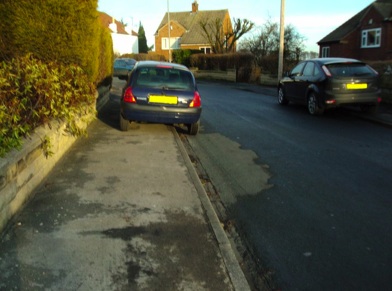
I was particularly pleased to see this report on a visit to a particular street by the police: “PCSO Paul Guest visited a street in Pontefract yesterday after reports of a number of vehicles parked on pavements. PCSO Guest was suprised to find that not only were the vehicles parked on the pavements, they were double parked and some vehicles were parked on the bend at the end of the street”. They went on to say: “PCSO’s will continue patrols in this area and if the same vehicles are seen parked on the pavement again, fixed penalty notices will be issued.” Also that “The pictured vehicles are both illegally parked. As you can see prams and wheelchairs cannot safely pass the vehicles on the footpath. They would have to go into the road to pass the vehicles”. Great stuff.

West Yorkshire Police say this car is causing an obstruction

Not all police forces agree that totally blocking a pavement is obstruction, for example the police in Bristol apparently deemed that this car was not causing an obstruction.

Police in Bristol said that this car was not causing an obstruction

Personally I am very interested is West Yorkshire’s use of Facebook. Many public bodies seem to shy away from debating anything in public. My experience locally is that the police are far better at this than local councils. Hopefully we will see many more Facebook pages for communities to debate with authorities on many subjects in the future.

Delivery van driver reverses over cyclist outside secondary school

26 Jan

A delivery van driver reversed over a teenage cyclist outside secondary school in Shrewsbury at 4:15pm on Monday 23 Jan 2011. The driver was unaware of what was happening until the girl banged on the van who was fortunate not to have fallen under the wheels. The police are trying to trace the driver who failed to report the incident as is required after an injury accident.

There is no evidence in the report that there were any restrictions on parking at the location, but it does emphasis the dangers created by vehicles backing into parking places in the vicinity of schools at busy times.

When There is Nothing to be Done, Perhaps It’s Time to Bring Out the Clowns

25 Jan

In 1994 in Bogotá was deemed to be the most dangerous city in Latin America with 1,300 traffic fatalities per year and about 80 homicides  per 100,000 residents. The incoming mayor, Mayor Mockus brought in clowns and mime artists to direct the traffic and defuse aggression, he distributed 350,000 “thumbs-up” and “thumbs-down” cards to citizens so they could signal their views to other people who were behaving foolishly or dangerously and then he asked people to pay 10% more tax and 63,000 did. These are only some of the initiatives he tried successfully and in the period traffic deaths halved and homicides fell by 80%. Now if clowns can half traffic deaths then I am interested.

And then there are the clowns in New York, who were, well, clowning around is I guess what you would call it. However, they had the deadly serious aim of drawing attention to the dangers of parking cars in cycle lanes.

a bunch of bike-riding clowns

Video of 2008 ‘Pie of March’ event

Video of the ‘Pies of March’ event in New York 2009

As the World Bank put it on their blog, yes they do have one, ‘When There is Nothing to be Done, Perhaps It’s Time to Bring Out the Clowns‘. Possibly it is time for us to deploy clowns police outside our schools to defuse tension and get people thinking instead of arguing and fighting?

Getting the attention of MPs

23 Jan

On Friday I have a meeting with my local MP, Ben Gummer,where I made a presentation of the issues and their urgency and was pleased to get his support. He offered to provide a link to the campaign from his new website when it goes live in a ‘few weeks’ and to also draw it to the attention of Norman Baker, the Parliamentary Under-Secretary of State for Transport with responsibility for ‘sustainable travel’. All good stuff.

As it happened, Julian Huppert, MP for Cambridge was pressing Terrasa Villiers, Minister of State for Transport in on the issue of pavement parking in the Commons on the same day saying: “Could the law be adjusted so that the presence of a vehicle in a cycle path or on a footway be taken as evidence that it was driven there, rather than appearing magically, as seems to be assumed at the moment”. Unfortunately Villiers failed to acknowledge or respond to the request. This problem isn’t going to get fixed over night!

DPD Express Parcels demonstrated the issue to be convincingly outside my MP’s office by parking diagonally across the pavement for no reason and then trying to justify it.

DPD express parcel delivery across the pavement outside my MP’s office

And then as I left I came across this nice pair of signs positioned to cause as much trouble as possible including a road works sign which maintenance companies are apparently required to leave across the pavement.

Why obstruct the pavement with warning signs!

Turf wars in Brighton and Hove

20 Jan

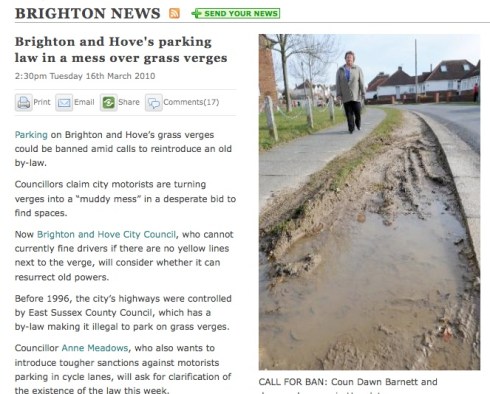
Back in March 2010 it was reported that Brighton and Hove council was looking into using a by-law created by East Sussex Council which banned parking on verges but which hasn’t applied to the area since the 1990s when Brighton and Hove became a unitary authority. Councillor Meadows, who was promoting the idea explained that: “Parking on grass verges not only causes a muddy mess during winter months but also problems for people wanting to cross roads safely”.

Given that I can find on further reference to this idea then I suspect that it may have been dropped. The local paper did however publish a helpful photo of a messed up verge.

Muddy verges could be a thing of the past … possibly (copyright image)

Needless to say, one doesn’t need to go to Brighton to see such scenes, there are plenty available closer to home!