Archive | policy RSS feed for this section

How many people do drive their kids to school?

10 Jan

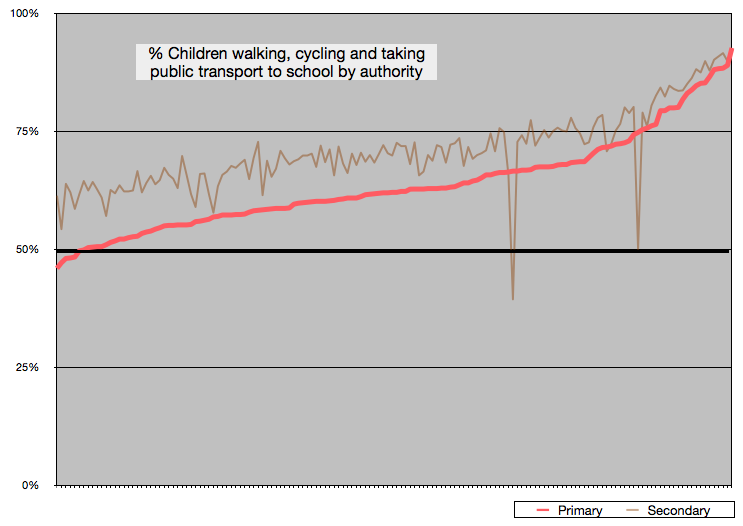
The government has just published a set of indicators indicating how children got to school across the country last year broken down into primary and secondary age groups. A graph based on the percentage of children walking, cycling or taking public transport to primary and secondary schools organised with the authority with the lowest rate on the left and the highest on the right comes out like this. The red line if for primary age children and the brown line for secondary.

Getting to school 2009-2010 by Authority

It shows that even in the authorities with the lowest rates for primary schools there are nearly 50% of children walking/cycling etc and that in the highest it is up to about 90%. The average across the country is about 63% for primary and 70% for secondary.

The papers claimed that the statistics showed that the schools with the highest driving rates were the rich and rural ones and the ones with the lowest were urban and not so rich. It isn’t actually that clear – here are the only ones where more than 50% of children are being driven: Herefordshire, Windsor and Maidenhead, Solihull, Cornwall, Surrey, St. Helens and Sefton.

The London borough feature prominently in the list of places with the lowest driving rate with Portsmouth being the most interesting inclusion – Portsmouth also has been pioneering area-wide 20mph speed limits with very encouraging results. Here are the ones with over 80% walking etc starting with the highest: City of London, Islington, Camden, Westminster, Isles of Scilly, Newham, Hammersmith and Fulham, Tower Hamlets, Southwark, Lambeth, Kensington and Chelsea, Hackney, Portsmouth.

The slight anomalies for the rates for secondary schools to the right of the graph are probably data errors. The blip down to 40% is for Brighton and Hove and the one to 50% is for Ealing.

My conclusion is that it is a minority of parent who are causing all this trouble and one should bear in mind that many of the ones who do drive will park their vehicles some way from the school gates and walk the final section. I suspect that there is a lot of self selection of drivers going on which results and that ‘die hard drivers’ and ‘complacent car addicts’ are well represented outside the school gates.

More cheaper parking = bliss?

4 Jan

Eric Pickles, the communities secretary has just announced that developers can now build housing with more parking spaces for cars and that towns can compete with each other to provide cheaper parking in town. Is that good news for pedestrians? I don’t think so because it is yet another message from the government that they are favouring motorists over other road users and some much more useful legislation could have been proposed.

More cheaper long term parking in town centres will result in one or two additional journeys during the busiest time of the day per parking space and cheaper short term parking will lead to more people flitting in and out of town during the day which will generate more journeys per day increasing congestion and air pollution etc. More space for cars in new housing projects will make no difference to places that are already built up which is the majority.

It is inevitable that more cheaper town centre parking will lead to complaints from motorists about congestion on the radial routes with associated demands for more roads, wider roads and for the claiming of bus lanes, cycle lanes and re-timing of traffic signals etc etc. Increased congestion will affect public transport, slowing journeys and increasing costs making them less competitive and will result in a loss of services. Park and ride services are already under threat from the cuts to local authority funding. Where services are cut, such as one of Ipswich’s park and ride sites which will close imminently then people will be ‘forced into their cars’ rather than out of them.

Many people now understand that cheap or free car parking paid for by employers and other facilities is a subsidy for drivers paid for by everyone else. Public transport users are not able to ask for a refund for their fares which would be considered as a benefit in kind, however this is exactly what motorists get when they are provided with free or cheap parking by their employers or elsewhere. Cyclists are lucky if they even get a secure cycle rack to leave their bike. Support for workplace parking levies and charging for use of car parks at out of town centres would have reduced the incentive to drive. Strong policies to support sustainable travel options and car clubs would have reduced parking pressures and congestion in all parts of out towns.

Luckily many local authorities support the previous policies and with the severe Local Government cuts it is likely that councils will continue to need their income from town centre parking and will resist cutting a major source of funds. Indeed Leicester is planning to increase town centre parking charges to support park and ride services and Winchester is planning to close a city centre car park at the same time as opening a park and ride site.

The Coalition seems to been setting off back in the old direction of  ‘predict and provide’. This will inevitably end in tears as we can tell from a brief review of recent of history. As an example. In the 1970s the government compulsory-purchased all the houses along this section of the Archway road when they intended to widen the road to motorway standards. They sold them off again only in the mid 1990s after many  severely disrupted public inquiries. This was originally part of the proposed Ringways scheme with 4 motorway standard roads through and around London which were never built (except for the M25 which was a cobbling together of Ringway 3 and Ringway 4).

The houses along the Archway Road were to be buldozed in the 1970s

There were others, including the long and messy M11 Link road protest followed by numerous robust protests by Reclaim the Streets in towns and cities across the UK. Then in 1994 and 1997 landmark Royal Commission Reports on Transport and the Environment were published supporting what the environmentalists had been saying about the folly of responding to congestion by building more roads. In 1996 the Conservative government took notice and launched a ‘great transport debate‘ shortly before they were kicked out and Labour took up the reins.

Luckily we are not going to end up back there again for a number of reasons:

  • Rising oil prices, which are approaching $100 a barrel but are still no where near its previous peak of $150 or the predicted $200. Consider that in 1998 it was $10 per barrel. Rising fuel prices will cause a lot of bother for the government and they can’t respond by lowering taxation on fuel in any meaningful way.
  • Most of our towns are already in place can more parking can’t be provided without demolishing peoples homes which is not going to be considered.
  • Sustainable transport modes such as cycling, car clubs are growing fast at a time that the car industry is on its knees and isn’t about to come up with a dream electric vehicle.
  • Smart phones and other devices and capturing people’s interest and their use is incompatible with pointing a metal box in a straight line. Just look at the people using these devices on trains and buses etc.
  • And then there is the tricky issue of ‘passive driving‘, which is where the consequences of someone decision to drive ends up with someone else dying or getting ill, be it from a traffic collision or poor air quality. There is a very clear parallel between this and passive smoking. Road traffic casualties are at an all-time low but are still far too high with over 2,000 people killed directly by traffic collisions (many of them pedestrians and cyclists) and many more by poor air quality caused by other people’s decisions to drive.

I believe that in time privately owned cars in cities will in the future be as out-of-date as ‘immobile phones’, the ‘Soviet Union’ are becoming. Check out ‘After the car‘ for details.
Does my arse look big in this?

1 Jan

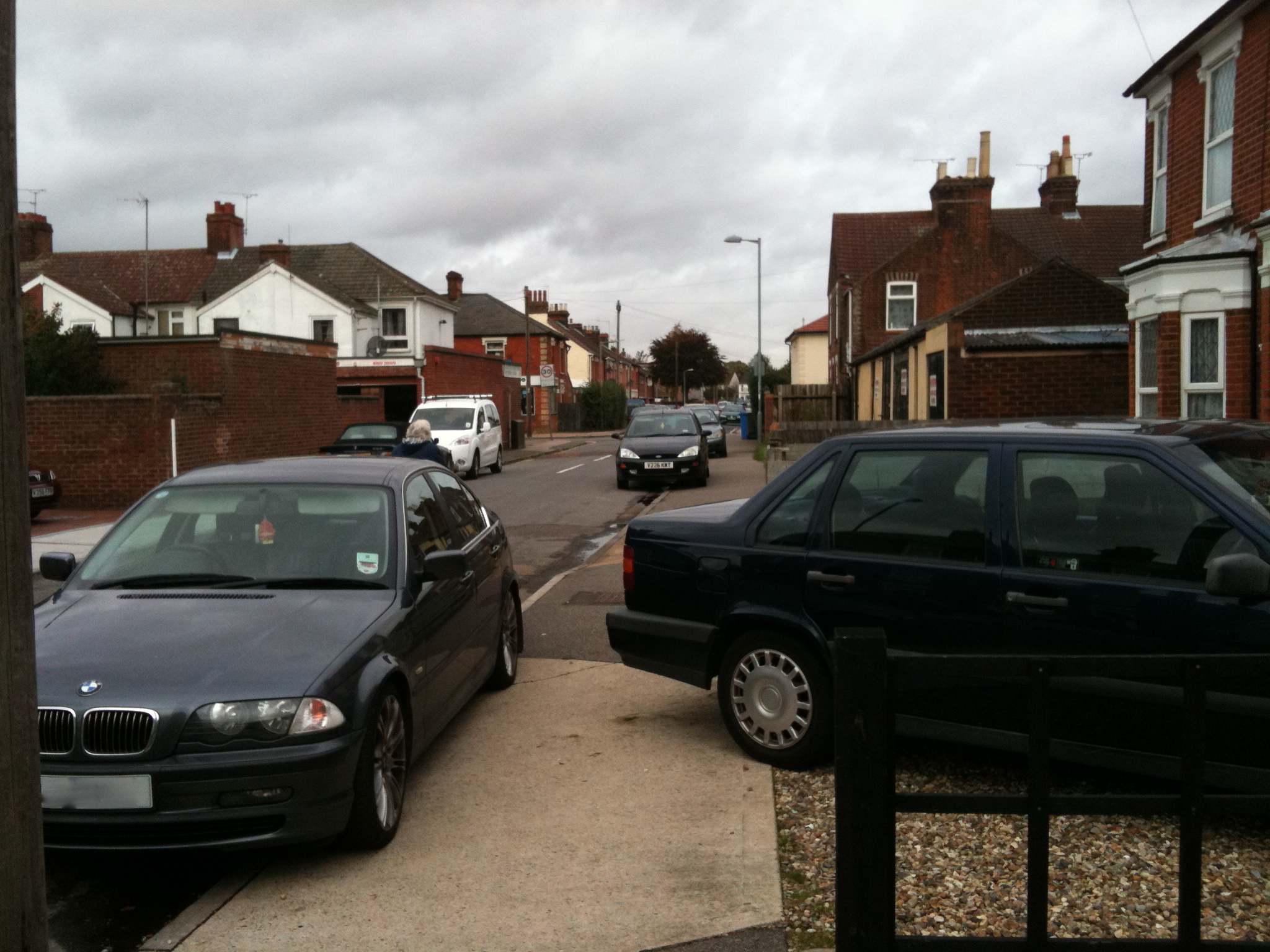
The phrase when I was young was ‘you have eyes bigger than your stomach’. In this case the phrase might be ‘your have aspirations longer than your parking space’. Possibly car dealers should provide free tape-measures prior to purchase…  Mentioning arses, I notice that Renault were recently reprimanded for their ‘I see you baby, shaking that ass’ adverts and indeed seem to have created a whole string of offensive adverts.

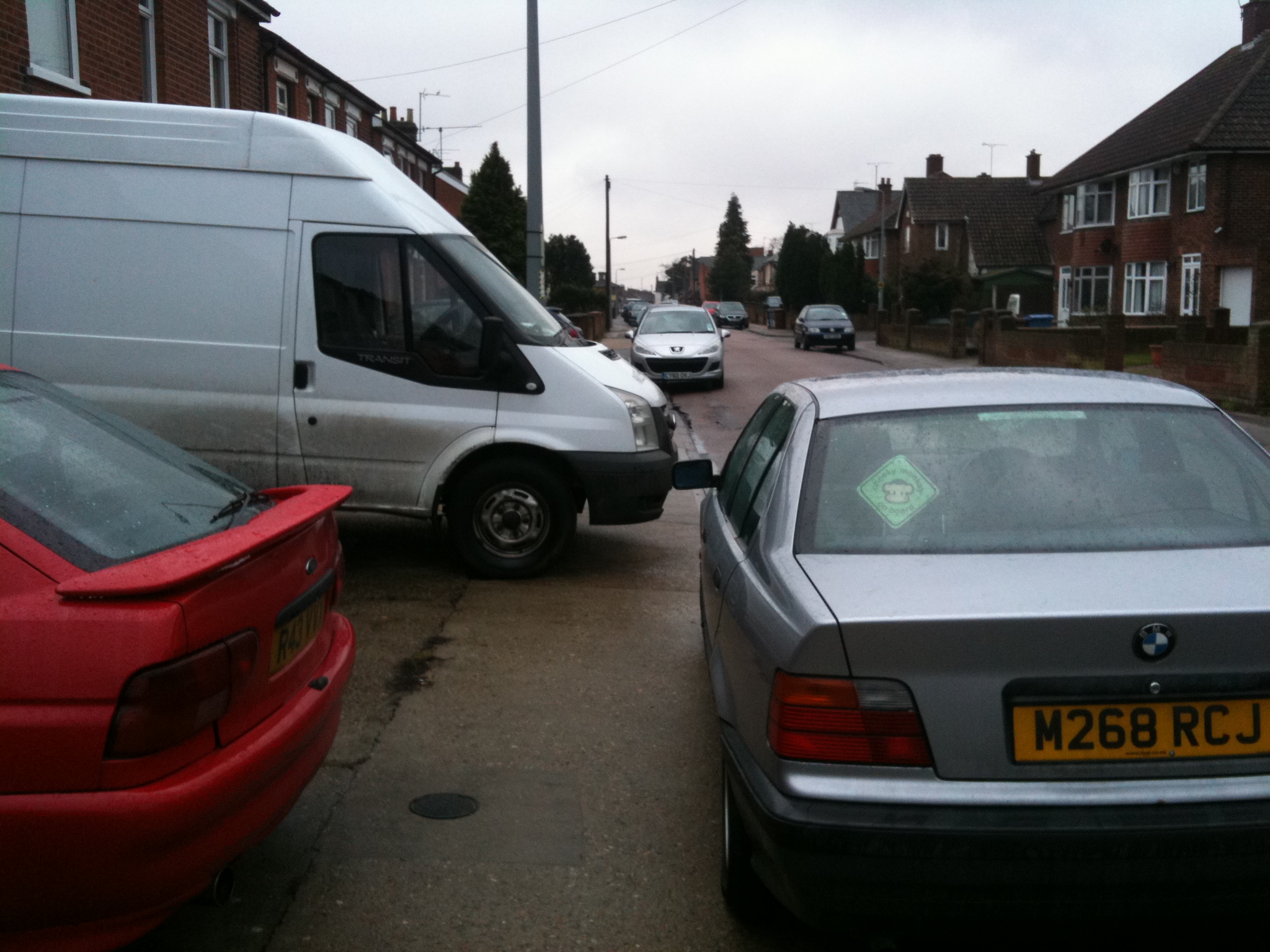
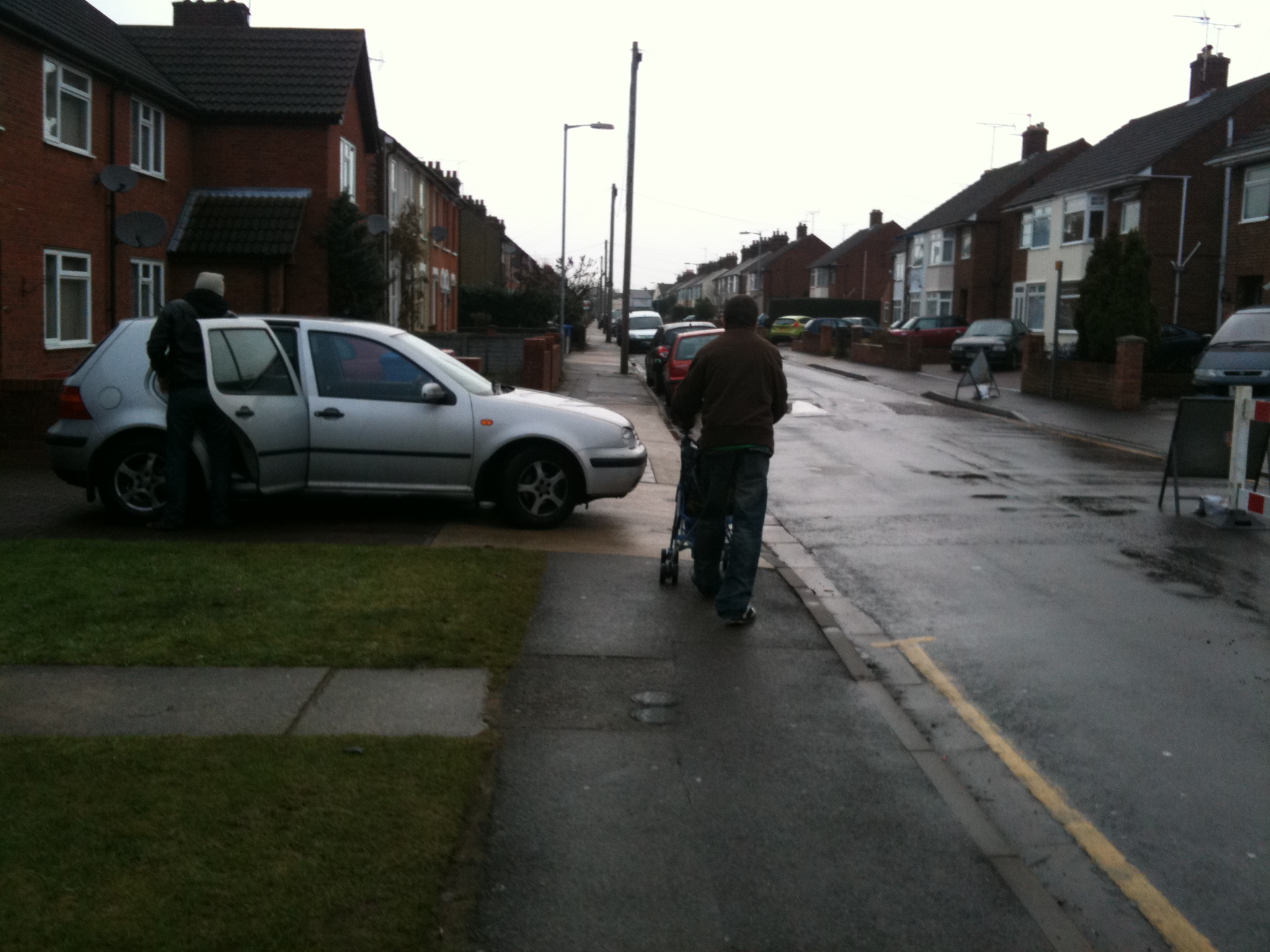
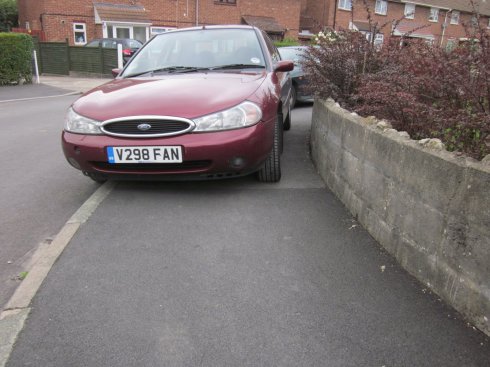
Here are some examples of protruding arses and noses near where I live. I was encouraged that the Volvo owner in the first picture, who was very unhelpful with me when I first challenged her, has since parked much more considerately. Also that the owner of the BMW in the same photo moved her car immediately after I pointed out the issue and she hasn’t parked back there since then to my knowledge. We are storing up problems by not sending out cleared signals to car owners that they really should buy a car that actually fits in the space they have available. A clear message should be sent out to people who install dropped kerbs for off-road parking that overhanging vehicles will be penalised. However… to achieve that legislation will be required.

Long Volvo

This one has a nice tow hook to catch ankles!

Snookered by a Parcelforce van

Just go back a little further please

Long Mercedes

I can see you!


Pavement parking bay consultation

29 Dec

In London where pavement parking is theoretically illegal everywhere unless allowed the councils seem to be trying to regularise parking arrangements, either by enforcing the ban on exiting ban on pavement parking or by allowing parking through legislation and white dotted lines along the pavement. I was pleased to see that when Houslow recently consulted on allowing parking officially on Gould Road that they made it a requirement that 1.5 meters should be retained for pedestrians.

Gould Road, Houslow

Bays have been created in other places with considerably smaller space left for pedestrians. I was trying to find an example, in Waltham Forest I seem to remember, where there was only 700mm left of pedestrians which is less than the width of a doorway! I will update this post if someone can give me a link to the post.

Incidentally, according to the current law as it applies in most of the country outside London a car is only causing an ‘obstruction’ if someone is actually being obstructed. And then even if it is impossible for that person to get past on the pavement the police may determine that they can simply use the carriageway instead as was the case in Bristol in this example which the police said was ‘not obstructing the highway’!

Not obstruction!

60,000 exciting new electric vehicles to get in the way!

14 Dec

The government is subsidising the purchase of 60,000 electric vehicles by private individuals in the UK between now and 2015 at a cost to the general taxpayer of £300m. It is also spending £20m installing charging sockets in a number of cities so that these new vehicles can be recharged.

The Secretary of State for Transport said that it was an ‘exciting green revolution’ and that ‘the british public has in the past shown it’s ready to embrace new technology and take practical steps to adopt a lifestyle kinder to the environment’.

The cynic in me things that this will just change the power source of the vehicle that is blocking the pavement. The production and disposal of the vehicles will continue to push huge pressure on resources and the environment. In addition the government and businesses will continue to have to build new roads and parking places for these vehicles which currently pay no vehicle excise duty or fuel duty. The whole car based transport system of which this is just the latest twist has humorously been described as a massive Ponzie scheme.

As far as I can see a much more profound change is the one from ‘ownership’ to ‘access’. This is what the information age is about and it is what car club operators are responding to. If you own a vehicle then there is a big temptation to use it for trips like the school run. If a potential driver has to pay the full cost for each trip then they will be much less likely to use it and walk to school! The car club model uses vehicles far more efficiently and results is far fewer being parked at any one time and this is what the car manufacturers are so scared of.

As such it is a battle between these:

EV parking bay

And these:

Car club bay

Follow the money

10 Dec

During the initial investigation of the Watergate scandal the ‘deep throat’ told reporters at the Washington Post to ‘follow the money’. It is certainly interesting to follow the money from parking fines.

Fines given out by the police appear to go into general Treasury funds, ie the money is treated just like most other taxation. Given that police funding is being cut and that for every police officer dealing with parking offenses there is one less police officer dealing with other crimes I suggest that the level of enforcement we will see will decrease over time as they concentrate on more urgent issues.

Fines handed out by the councils using civil enforcement powers on the other hand are retained by the council. In most councils this is ring-fenced and can only be used for enforcement purposes with any surplus available for highway or environmental schemes. Road Traffic Regulation Act 1984 (Section 55) The AA do say that it would be a breech of the Secretary of State’s guidelines if a council viewed civil parking enforcement as a way of raising revenue, however others have argued that the level of fines should be raised to ensure that fines need to be higher to act as a sufficient deterrent in areas where official parking charges are high.

A total of 328m was paid out by motorists in parking fines in 2008-2009 which works out at £6.14 per head. Westminster Council raised a whopping £42m. If the number of registered vehicles in the UK continues its relentless climb the temptation to park illegally will only increase and fine incomes will probably also climb.

What this means is that as long as the cost of collection is lower than the amount of income raise then there should be no risk of parking enforcement for civil offenses (such as yellow lines) falling due to reduced council revenue. As such I suggest that we press councils on enforcement for which they are responsible, for example in Arras Square that I reported on a few days ago. Check the map in The Law section to see if your areas has opted for civil enforcement.

Welcome to another 52,000 vehicles!

29 Nov

By the end of 2009 there were 52,000 more vehicles on GB roads than at the end of 2008 and this is despite a big down-turn in car sales, and government money in a scrappage scheme to encourage sales until the end of March 2010. The scrappage scheme did at least take one old car of the road for each qualifying new car.

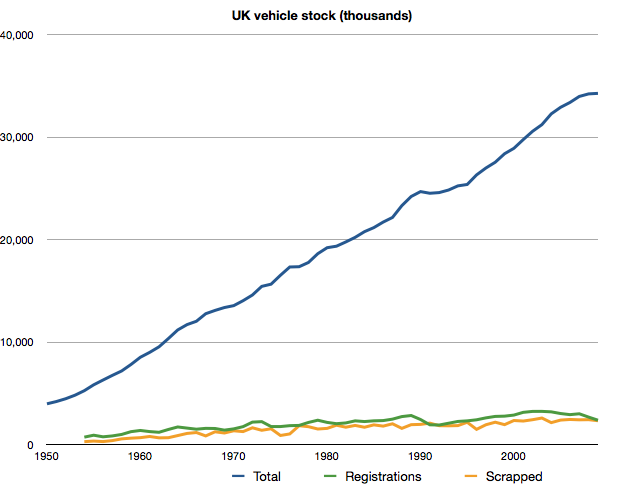
Between 1997 and the end of 2009 (roughly the period Labour’s term of office) the number of cars on GB roads increased by over 7 million or 27%! Clearly the purchasers of these additional vehicles plan to leave them somewhere when they are not in use. This may be outside some new house on a shiny new driveway or somewhere else out of the way however I am sure many front gardens were dug up with associated dropped kerbs, creating their own problems for pedestrians. Many will of course have been squeezed onto the highway where-ever possible, across pavements, on verges etc etc. Here is a graph showing the relentless increase in vehicle numbers in Great Britain since 1950.

GB vehicle stock 1950-2009

And here is the graph showing just the registrations and scrappages each year for 1960 onwards. The bumps and lumps in the curve generally fit with the state of the economy.

GB vehicle registrations and scrappages

The lack of sales and relatively low increase in the vehicle stock is in general treated as a problem by government because of the lack of ‘growth’ which is in their view always a good thing. In human beings uncontrolled growth is known to a huge problem (we call it cancer!) and if the pet hamster we had as a kid hadn’t stopped growing at the right moment then results would have been disastrous as pointing out in this wonderful little animation.

There are however also encouraging signs that we may be approaching a peak in vehicle numbers and that they could drop significantly in the coming years. Car clubs are growing fast, cycling is growing fast, rail travel is growing fast and mileage in cars per head of population has actually been on its way down for some time now. In addition the iPhone, blackberry and other smart phones can only be used when someone else is driving. Personally I think it is the mobile communications devices that will encourage most people out of their cars so that they can work while traveling. That is the subject for one of more later post though!

motorists – 2nd class citizens?!

27 Nov

Mr Herron from Sunderland has spent more than £100,000 of his own money campaigning to improve the status of motorists who he said had been treated as “second-class citizens” but didn’t convince the judge I am pleased to say.

He lost a court case where he claimed that the controlled parking zone in Sunderland city centre were too large and confusing for drivers and wanted the 39 penalty charge notices issued against him for parking on single yellow lines within the zone to be ruled unenforceable! 39 times? The markings must be very confusing or is this another case of willful ignorance? He also complained about “petty little bureaucrats”, “stealth taxes” and said he only wanted “fair enforcement” etc etc. He said that prohibitions in a controlled parking zone should only be enforced if every part of every road within the zone had been marked with either parking places, a single or double yellow lines.

Commenting on the Heron case, Paul Watters, head of transport policy at the AA said: “There is a need for greater clarity in the implementation of parking restrictions by councils across the country”. Paul Watters also recently suggested that every single dropped kerb should be marked with white paint to warn motorists not to park across them! For course the AA recently complained that fines for illegal parking should only cover the associated enforcement costs. Are the AA suggesting that fines should be massively increased to cover the cost of marking every dropped kerb and controlled parking zone in the country or is he expecting that cost to be also share out between motorists who already know the law and by non-motorists! I think I know the answer already.

Talking about democracy and fairness. I recently posted about how 88% of the ‘traffic’, ie the pedestrians, dropping kids of at a local primary school where on foot but only got 18% of the highway to use. Now that is 2nd class in by my recogning.

Highway robbery?

25 Nov

Local Authorities have written to the Department for Transport asking for the maximum fine for illegal parking to be raised from £70 to £120 (still subject to an early payment 50% discount) giving a maximum cost of £60 for someone who pays quickly. This request is for maximum fines outside London to be able to be as high as in London. While researching this just now I came across a long rant about the injustice of it all in the Independent in 2006 titled Highway Robbery.

The AA say that it was a ‘clear breach’ of the government’s rules because “The guidelines state that local authorities should not view civil parking enforcement as a way of raising revenue”.

Lets examine that claim.

Firstly, surely the purpose of a penalty for breaking the law should be sufficient to encourage compliance? If parking legally costs £20+ (as it does in Cambridge and some other places) then the fine needs to be considerably higher than that should it not?

Secondly. What is the cost of illegal parking? The total national fines were £330m last year. What does the AA think that should cover? Just the salaries of the parking wardens and police? What about the legislation regarding the creation of yellow lines (£1,500 a time), installation of all the bollard sand fences needed to physically stop drivers parking on the pavement, the costs of repair cracked pavements and verges turned to mud as in the following picture.

Ruined verge

Personally, I think that the AA keeping are keeping their blinkers well and truly fixed on the narrow enforcement costs. Is it not the motorists who are doing the ‘highway robbery’ by claiming all of the highway and then taking a chunk of the pavement as well. In addition they then use every trick in the book to make enforcement difficult?

People may be interested in seeing the fuss and denial over the years about speed cameras which raise £110m per year all of which was used for road safety work until this year when the new government ‘raided’ 40% of it. Check out the Wikipedia articles on UK speed limits and UK speed limit enforcement but if you really want to see it ‘warts and all’ then look at the associated talk pages and history. The encouraging thing is that the RAC Foundation and the AA are now supporting speed cameras.

I will take a look into what the costs are and do a post about it soon. It was, of course, only because the parking enforcement was so broken in the first place that I started this blog.

Disaster car parking

9 Nov

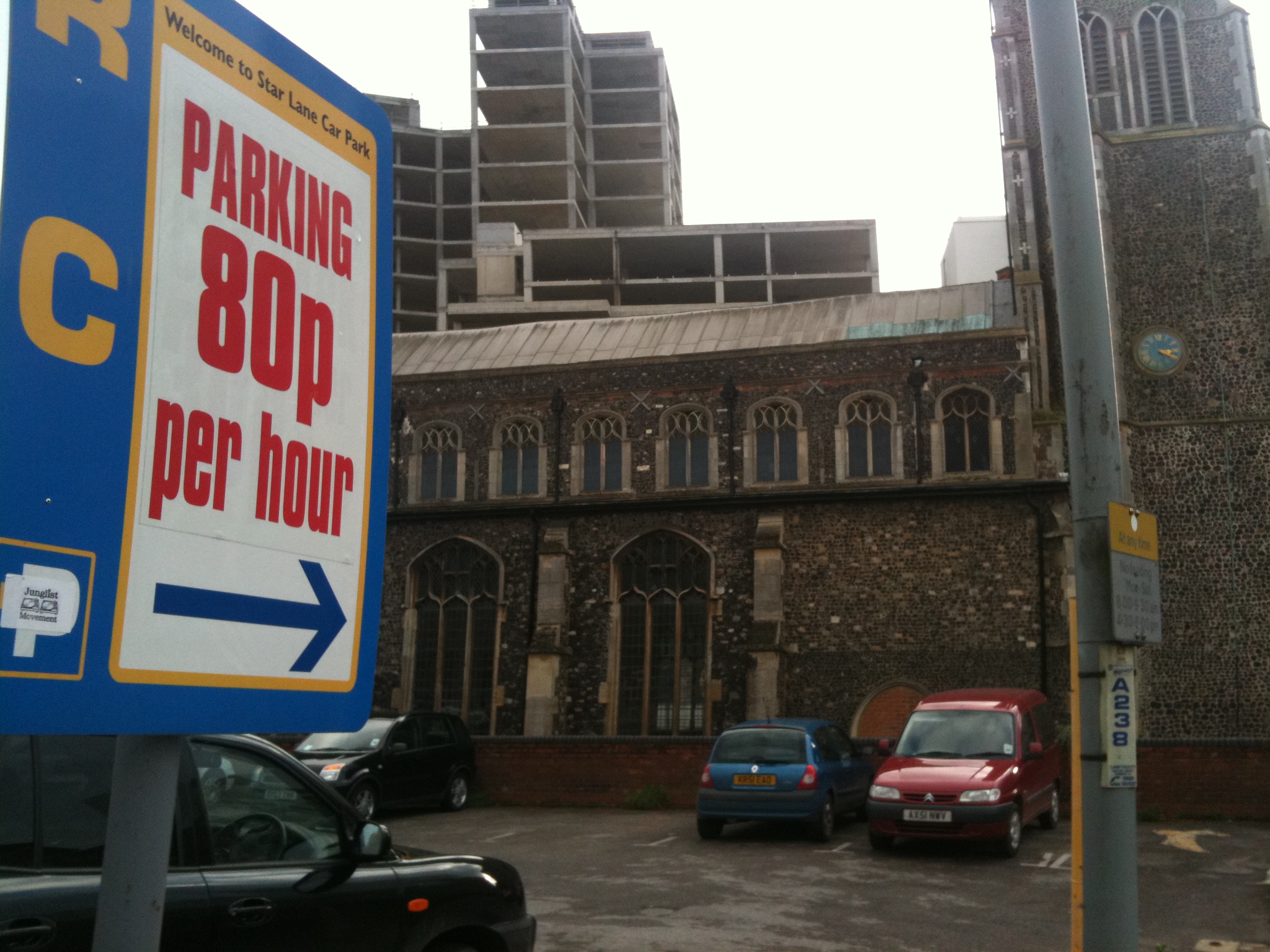
These car parks created close to our beautiful waterfront are a disgrace. Why are they given permission? They can’t make a lot of money and create a terrible impression. They are in the middle of a dual-carrageway gyratory, known as the Star Lane gyratory and the council has been advised to reduce car parking and convert one lane to pedestrian, cyclist and public transport use. However.. it is still two lanes, breaks EU air quality rules and every scrap of land is turned into a car park of the lowest quality. Yes, I know that there re great plans for the area, but why can’t we have something better in the mean time!

The fencing has been down for weeks on this one.

Disaster car park 1

The church is closed but the parking in cheap!

Nice church, 80p per hour

The irony of this next image is that the Tudor building in the middle of this car park is owned by, and is used as the head-quarters of Total Car Parks – a car park company with sites all round the country.

Car park plus Tudor building

And when it comes to creating a good first impression…

Notice the quality and attention to detail here!

Of course the most ironic car park is this one in Detroit. The massive 4000 seat Michigan Theatre was build in central Detroit in 1926 at a cost of $5 million on the site of the garage where Henry Ford built his first car. The theatre closed in 1976 because there was no parking nearby and everyone had left for the suburbs by then and was dependent on the car. And since then …. yup, the theatre has been used as a car park for the office building next door – and they even built a concrete multi-story car park within the theatre to increase capacity. So that is the journey from inventing the car, to culture and finally a car park.

Michigan Theatre in Detroit

Or Is it is final? Actually Detroit is reinventing itself at this very moment into a cycling city and ‘grow-town‘.