Archive | policy RSS feed for this section

A bit of honesty from the government??

24 Oct

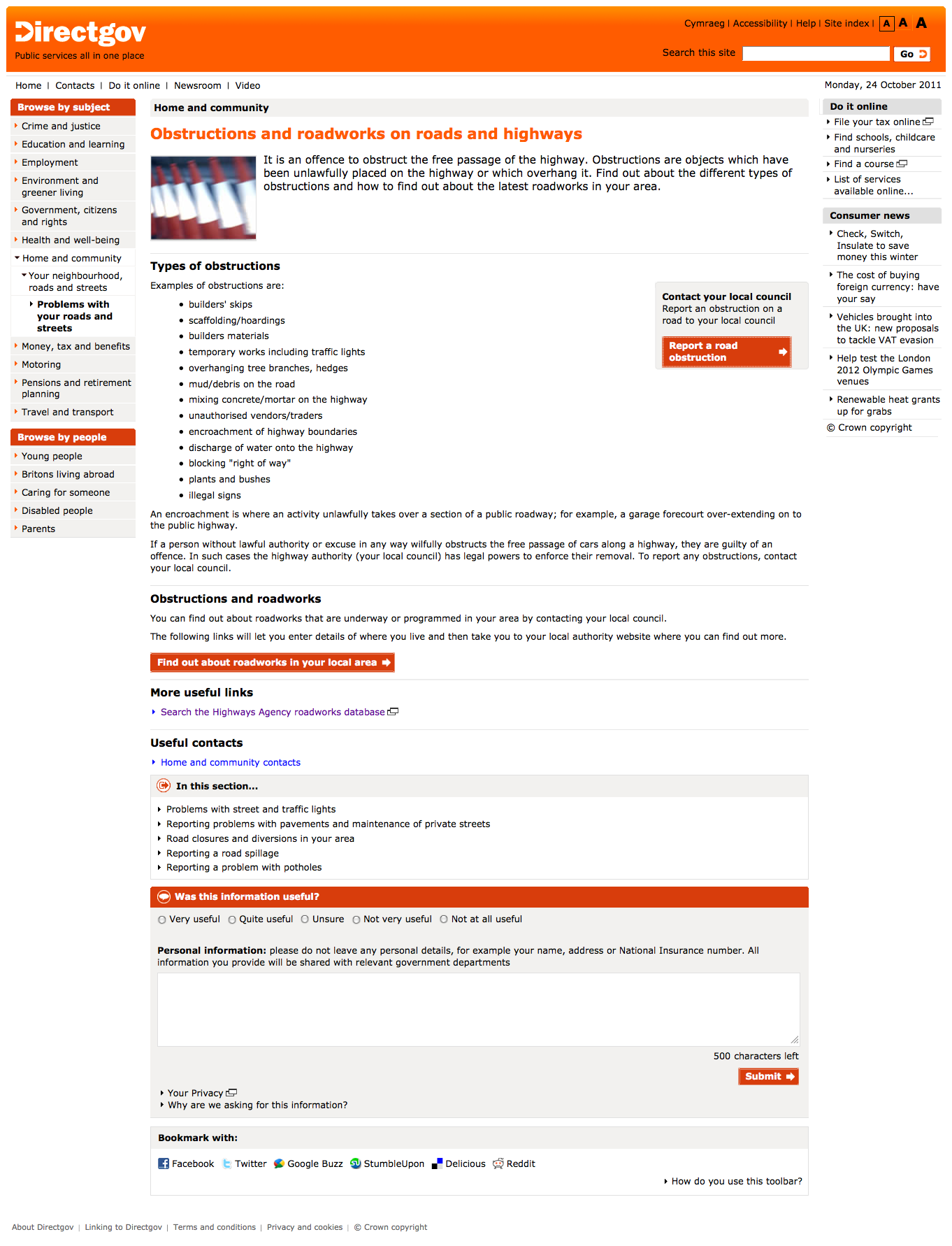
I was poking around some government websites over the weekend relating to ‘encroachment’ when I came across this delightful example of how discrimination against pedestrians (and indeed cyclists, motorcyclists and lorry drivers in this case) works. It comes from the ‘Homes and Communities’ section of DirectGov and expresses clearly attitudes which are common but normally unspoken:

An encroachment is where an activity unlawfully takes over a section of a public roadway; for example, a garage forecourt over-extending on to the public highway. If a person without lawful authority or excuse in any way wilfully obstructs the free passage of cars along a highway, they are guilty of an offence. In such cases the highway authority (your local council) has legal powers to enforce their removal. To report any obstructions, contact your local council.

OK, so that means that it is OK to willfully obstruct the free passage of pedestrians, wheelchair users, people with buggies and cyclists! Nice! Here is a screengrab of the webpage taken this morning.

DirectGov guidance on obstruction (screen grab from 24 October 2011)

I have already used the feedback box to suggest that they change this page and make it more inclusive. Others may wish to do the same.

Don’t mention the war!

11 Sep

Mike Penning, the roads minister recently claimed that there had never been a war against the motorist in a letter to Sir Peter Tapsell MP. This is very remarkable given that in July 2010 he said that ending central funding for speed cameras “is another example of this government delivering on its pledge to end the war on the motorist”. He mentioned the war again – this time in an article about the scrapping of the M4 bus lane titled “M4 bus lane to be scrapped as Penning ends Labour war on road users” (which clarifies that this is a war on the motorist actually). Some people will also remember Philip Hammond’s rousing speech at the Conservative Party Conference in 2010 – this version, which has been dubbed and subtitled is the only version of the relevant parts of the speech available on the web that I can find (I wish that the government would publish all speeches online for people to review later). A popular blog titled ‘At war with the motorist‘ was set up immediately after this speech to challenge some of the view expressed by the minister. This clip was created by the folk behind iPayRoadTax.
[youtube.com/watch?v=F2PwwlktImU]

This recent announcement has prompted me to ensure that the past won’t be forgotten so easily in future. I am making a small start by uploading some key video clips from recent motoring history onto Vimeo. For starters, here are some clips relating to battles and skirmishes for control of our roads. Lets start with the conservatives and their ambitious Road for Prosperity white paper which was published in 1989. It outlined a massive increase in road building and then Margaret Thatcher explained that “nothing can stop the great car economy” (and certainly not “wishy washy environmentalists.”) This clip is from The Secret Life of the Motorway produced by the BBC.
http://vimeo.com/28884697

This led to massive road protests during the 1990s, including the M11 link road, Twyford Down (M3) protest and the Newbury Bypass protests. This next clip starts with a short sequence from the Reclaim the Streets protest on the road outside the National Gallery in Trafalgar Square in 1997 (which has since been pedestrianised incidentally). This is followed by a retrospective piece about the road protests of the period – do notice how wealth rural conservative voters are pushing and shoving alongside younger activists with the support of elderly local residents. Nothing ‘wishy washy’ about this lot!
http://vimeo.com/28885305

The conservative government had started backing off from their ambitious road building policy by 1994 when John Gummer denied that there ever been a ‘great car economy’ saying that it was “not one which has ever been put forward by the Conservatives“! He elaborated that “The car must become our servant rather than our master” and that we must not construct a society “which restricts freedom by not allowing people to choose a lifestyle that does not involve having a motor-car“. This new found interest in alternatives to the car didn’t however stop the  transport secretary at the time, Brian Mcwhinney, giving the go-ahead for the Newbury bypass the following year before resigning 30 minutes later!

When New Labour came to power in 1997 there was no question about the direction of transport policy. Here is John Prescott laying out their vision for transport.
http://vimeo.com/28884865

In recent years cyclists and pedestrians have been getting more confident, not something that everyone in the motoring community has appreciated. Here is a clip from Road Rage, a documentary shown recently on TV highlighting the battle raging in the UK for control of the roads between motorists and pedestrians/cyclists etc.
http://vimeo.com/28884937

Finally, as a bit of light relief, here is Jeremy Clarkson, announcing that this episode would be the ‘last ever Top Gear’ after the car came last in a race across London by various forms of transport (with Richard Hammond winning on a bicycle). There have however been many more episodes of Top Gear!
http://vimeo.com/28885769

Clearly there is something very big going on about which lots of people have strong feelings. There are no easy ‘solutions’ to our transport challenges and the car most certainly isn’t it. It will be great if the currently government can avoid falling down the same hole that the last Conservative government fell down. Possibly denial is just part of the process of change in the political world?

Rural speed limits in the UK and Holland

6 Sep

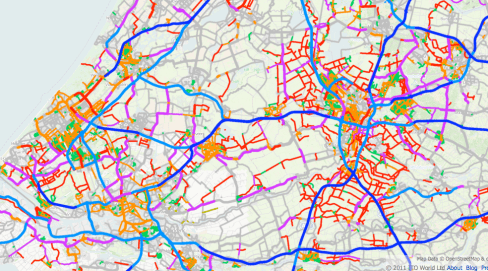
Following a discussion this blog in response to my recent ‘Safe’ routes to school – no pavements and unlit at 60 mph? blog post, here are examples of rural speed limits in Holland in the the UK. Notice that many Dutch rural roads have 50 mph speed limits (purple) and 40 mph (red) rather than 60 mph (light blue) or dark blue (70 mph). Across the North Sea on the east coast of England all rural roads are 60 mph, no 50 mph speed limits at all and very few 40mph limits. The speed data is from OpenStreetMap and has been visualised by ITO Map. The speed data is not yet complete If you are able to help please then please add information to OpenStreetMap for your area and places that you visit.

Speed limits holland (click for slippy map view)

Speed limits Tendering District, UK (click for slippy map view)

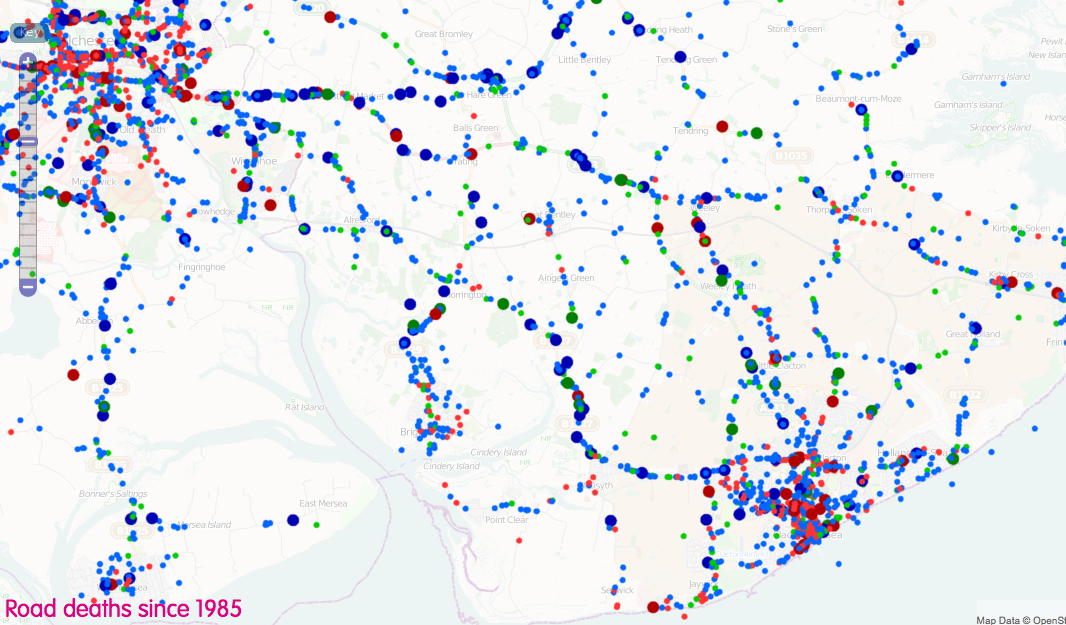
This final image shows pedestrian road casualties for Tendering District since 1986. Large blobs are deaths, small ones are serious injuries. Red for pedestrian, blue for driver, green for passenger. Most pedestrian casualties are in the towns, which is likely to be for two reasons – firstly that most pedestrians movements naturally take place in towns and secondly because pedestrians avoid rural roads knowing that they are unsafe. Casualty data from Stats19 police data. Do remember that road deaths have fallen massively since 1985 when some 5,500 people were killed in GB compared to 1,857 last year.

Road casualties – Tendering district

RIP school travel mode statistics – burying bad news?

1 Sep

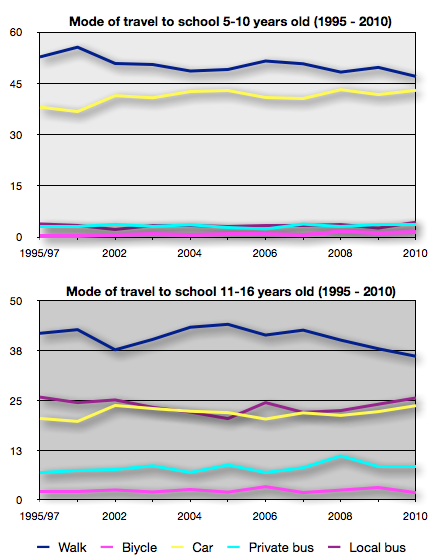
Ministers have just announced that there will be no ‘travel mode’ question in the next school census. I find this curious because the school run is a hugely challenging and emotive subject for parents and for other car commuters. Here are a couple of charts showing who how things have changed over the past 15 years during which time this information has been collected. Notice that more primary age kids will be traveling to school by car than on foot soon if current trends continue, also that the car and local bus is gaining with secondary school age kids at the expense of waking. Cycling is lost in the noise at the bottom.  I wonder if the parents at these Brentwood schools parents will start chucking rocks at traffic wardens again? Was it relevant, per-chance that these statics were first collected in 1995 just after the previous conservative government abandoned the ‘great car economy’ following an epidemic of road protests in the 1990s? (walking is dark blue and is highest for both groups, cars are in yellow and are next highest for primary school kids and have similar percentage as for local buses for secondary school kids. Local buses are in dark purple).

Travel to school by mode of transport (1995-2010)

Local council must change its bin policy

25 Aug

The official bin-collection policy of Ipswich Borough Council policy is to leave bins after collection ‘at the very back of the pavement on the curtilage of the property … not obstructing residents’ driveways, preventing usage of drop kerbs etc‘. I have asked them why they don’t return the bins to where they found them (which is normally within the curtilage of the property on a driveway) and have also reminded them of their duties to the blind/wheelchair users and other groups under disability legislation. The response was: “We have discussed your interpretation of the Equalities Act with our resident equalities expert and we are of the opinion that we are taking the best possible action in this respect“. Umm… Strange, given that the work ‘pedestrian’, ‘wheelchair’ and ‘buggy’ don’t even appear in the text.

Here is my proposed replacement text: “a) Bins MUST NOT be left in a position where they create a safety hasard. b) Bins MUST NOT be left in a position where the available footway is reduced to less than 1m and should not left in a position where the width is reduced to less than 1.5m. Bins can often be returned to a position just inside the curtilage of the property. Where this is not possible they may be left on the footway or carriageway as long as the conditions in a) and b) are satisfied. Where no viable option exists then alternative provision for the collection of waste will need to be arranged. This policy is to ensure that all road users, including pedestrians, some whom may require additional width (wheel chair users, people with buggies and shopping and those with visual impairments) are able to use the highway safely“.

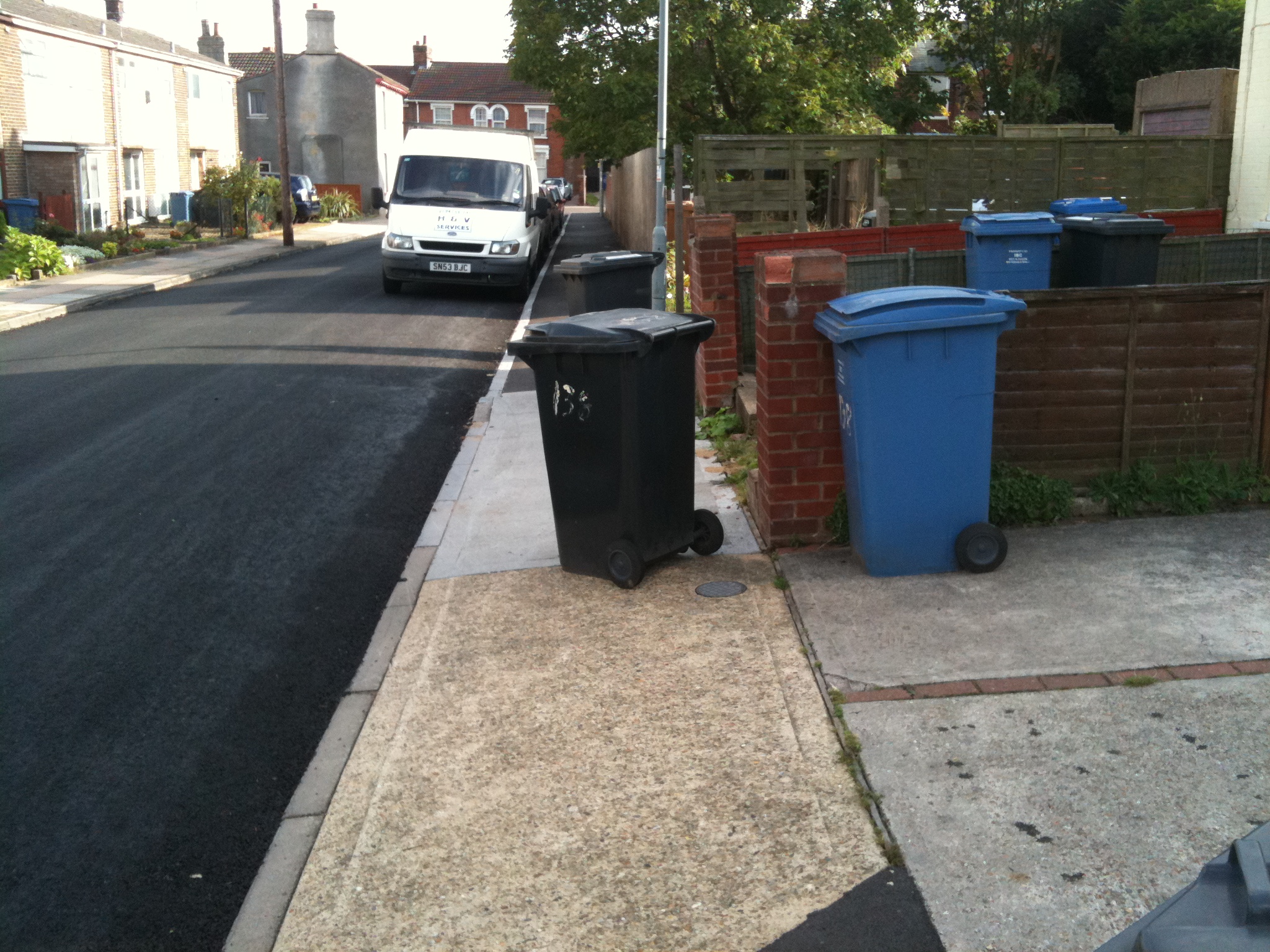
Here’s the reason why a change is needed. In these two following pictures there is no space for a wheelchair user of parent with a buggy to use the pavement when the current guidelines are following. In both cases it would however be trivial for the bins to be returned within the curtillage.

Bins left blocking the pavement after collection

Bin left on pavement with 400mm between bin and lamp-post.

The law is very clear on this. Lets start with Department for Transport guidance on the ‘Pedestrian environment and transport infrastructure’:

  • “Since October 1999 service providers have had to take reasonable steps to change practices, policies and procedures which make it impossible or unreasonably difficult for disabled people to use a service … These requirements apply to facilities and services in the pedestrian environment’.
  • “Those who are travelling with small children or are carrying luggage or heavy shopping will all benefit from an accessible environment, as will people with temporary mobility problems (e.g. a leg in plaster) and many older people. Thus, the overall objective of this guide is to provide inclusive design and through that achieve social inclusion
  • “Manual wheelchair users need sufficient space to be able to propel the chair without banging their elbows or knuckles on door frames or other obstacles. But someone who walks with sticks or crutches also needs more space than a non-disabled walker; so too does a long cane user or person carrying luggage, or a lot of shopping bags, or with small children. Thus providing adequate clear space on pavements, along passages in public buildings, through doorways etc, is of benefit to many people.

And also the DirectGov guidance re the Equalities Act 2010:

  • The Equality Act 2010 provides important rights not to be discriminated against or harassed in accessing everyday goods and services like shops, cafes, banks, cinemas and places of worship… The Equality Act 2010 gives disabled people rights not to be discriminated against or harassed in relation to the use of transport services. This also covers access to travel infrastructure such as railway stations and bus stations. You also have a right to reasonable adjustments.

And here is a helpful diagram published by the DfT showing the pavement width required by these different groups of pedestrians. Is it however unfortunate that the diagram is so hard to read which probably goes against their own guidance on legibility, but we can’t have everything!
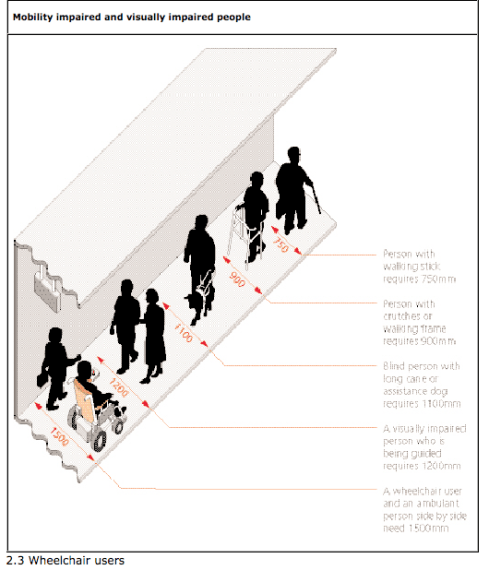
Pavement widths required by different user groups (DfT guidance)

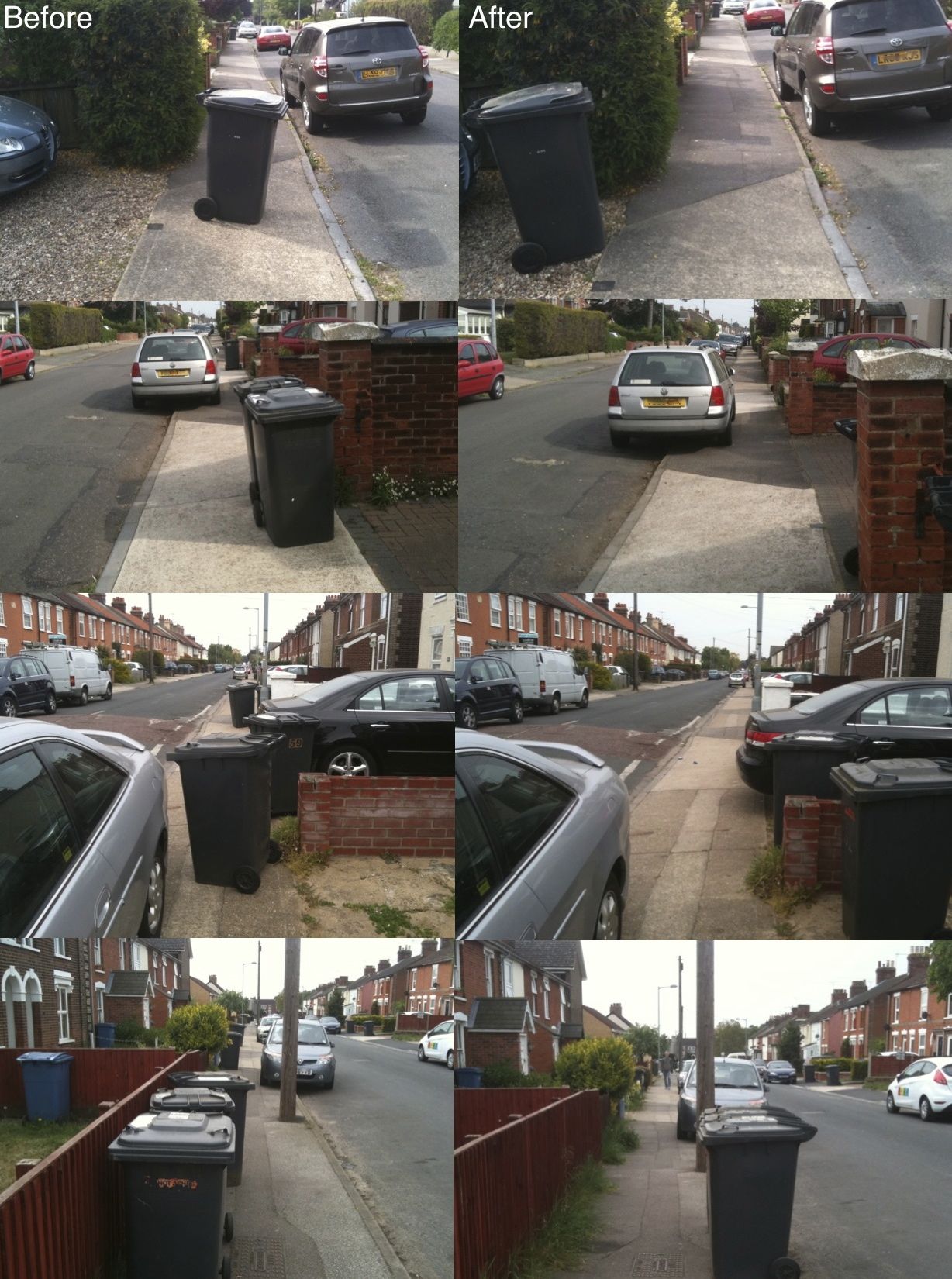
Finally, here are a set of photos illustrating the ‘reasonable adjustments’ that I am proposing to the council. The photos on the left show where the council leave bins currently and on the right you can see where I am suggesting they should be left to allow free passage (or as good as can be achieved with all the pavement parking!).
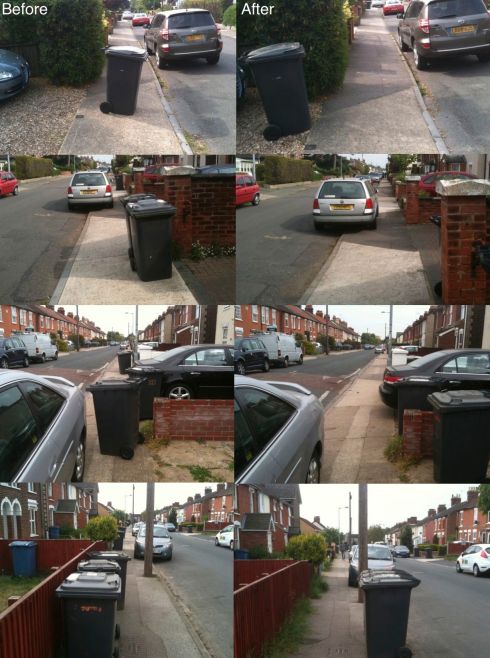
Bins after collection (as now on the left, and as proposed on the right)

I will be sending a copy of this post to the council and ask them to reconsider. If that doesn’t work then possibly the local paper would be interested in taking this on as a local issue.

Park(ing) day 2011

22 Aug

Park(ing) Day is a global grass-routes project to convert parking meter spaces into attractive social spaces for a few hours on one day each year, thereby challenging the dominance of the car in a playful and effective way. The initiative, which started in San Francisco in 2005  had already spread to 183 cities around the globe by 2010 and Parking day 2011 takes place on 16th September in a few weeks time. This could be a good day to do some stuff in our local areas. Any ideas?

In San Francisco this initiative has already inspired the city authorities to convert parking bays into pavement extensions for cafe tables, park benches, bike racks etc on a more permanent basis. Very simple, very effective and very San Francisco. Do of course remember that in North American English the ‘pavement’ is the carriageway, or more accurately the paved road surface rather than the footway. Click on the images for more information and do watch the video. Isn’t it great!

Divisadero Street Parklet (copyright image)

22nd Street Parklet (copyright image)

‘Illegal Items placed on verge’

8 Aug

Today I discovered that councils that completely ignore cars left all over the verges then get agitated when local residents use painted rocks, home-made posts or whatever to protect these very same verges. Councils refer to these rocks as ‘items left illegally on the verge’. take for example this page published by Surrey CC entitled ‘‘Protecting Grass Verges from parking‘: “Some residents may take their own measures to prevent parking (often plant-pot shaped concrete blocks or large rocks). Although these can be aesthetically pleasing, it is an offence to place unlawful items on the public highway. If seen or reported, we have the right to request that the items are removed.” Needless to say, having removed these home made defenses the council in all likelihood doesn’t then have the resources to replace them: “All methods require funding from very limited maintenance budgets. Funding may be provided specifically for verge protection but this is not always guaranteed“.

This same page also confirms that “There is no legal right to park on a road, verge or footway.” (so that makes cars ‘illegal objects’ as well doesn’t it?). So… what does the council do about these car shaped illegal objects? err.. they seem to just pretend that they are not objects after all. So there you have it, simple when you know how!

In a curious twist, verges in Surrey can be protected by a clause in one of those odd local Acts of Parliament which should have died out in Victorian times but which are evidently still being created. In this case the ‘Surrey Act 1985  (section 5) which allows the council to ban verge parking simply by placing a sign saying ‘no parking’ on the verge. Not a lot of people know that and I shouldn’t think it is that effective as a result! Not sure why it was necessary to mention horses and cattle in the 1980s? I wonder how much parliamentary time was taken debating if sheep, swine and cattle should or should not be included?

Here is the relevant section of the Surrey Act 1985:
This section applies to any of the following land in a district which, being in, adjoining or accessible from a highway, is maintained in an ornamental condition (whether by mowing or otherwise):—
(a) a grass verge,garden,lawn or green managed by a local authority; or
(b) land laid out as a public garden or used for the purpose of public recreation which is vested in a person other than a local authority.

“A local authority may by notice prohibit, either entirely or at such times or on such days as may be specified in the notice, the doing of any of the following things on land to which this section applies:—
(a) driving, riding or leaving vehicles;
(b) allowing horses or cattle to enter;
(c) using any equipment provided on such land.

“A person who, without reasonable excuse, contravenes a notice displayed under this section shall be guilty of an offence and liable on summary conviction to a fine not exceeding level 2 on the standard scale.

Summer Streets. Cities without cars

8 Aug

New York Summer Streets 2011

New York Summer Streets is back for 2011 with the first of three major street closures last Saturday on the 6th August and Paris has again installed its regular beach on a dual carriageway along the banks of a Seine. A pavement chalk festival took place in London, in Passadena and Liverpool is hosting the 3rd open International Pavement Art Competition in September when the London Sky Ride also returns to the capital. So many ways to enjoy our streets when the cars are banished!

Cars Off Pavements campaign leads to 75% reduction in pavement parking

4 Jul

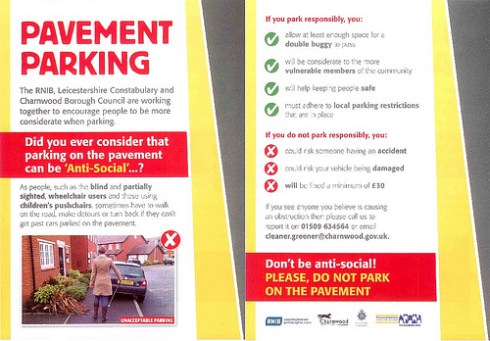
A trial ‘Cars Off Pavements campaign‘ at four parking hot-spots in Charnwood, a borough of 167,000 people in Leicestershire, led to a 75% reduction in pavement parking and is now going to be rolled out across the borough. The campaign is being run by Charnwood Borough Council, Leicestershire Police and the Royal National Institute for the Blind. Charnwood Borough Council street wardens will issue £50 Parking Charge Notices to offenders who park on pavements in contravention of the signs and lines. Police officers and PCSOs can issue fixed penalty notices to offenders who cause pavement obstructions.The local MP was out recently showing his support. Great to see such no-nonsense coordinated action on the issue!

Charnwood parking leaflet (copyright)

More cars, but less motoring

6 Jun

There has been quite a lot of interest  in the idea of ‘peak car‘ recently which proposes that we may have already reached a point of ‘peak car’ and that from here on car use may decline rather than grow further or level off. Total vehicle mileage in the UK has indeed declined since 2005 and in London since the early 1990s. Read about this in The Independent and in the New Statesman. Significantly, the government predicted back in 2003 that traffic would grow by 25% by 2025 and that vehicle ownership would grow by 30%. Both of which now seem very unrealistic and should probably be reviewed!

By contrast the number of cars on UK roads has continued its relentless rise  (growing 27% during Labour’s term in office from 1997-2010). This should mean that each cars are each traveling less distance per year and this is indeed true. Mileage per car peaked at 10,600 in 1995, and is now down to 9,200 and heading down to levels last seen in the 1960s!

Mileage per car per year

Interestingly the percentage of 21-29 year olds with driving licenses has also fallen. It is now 65%, down from a peak of 74% in 1992-1994 and a percentage which was last seen back in 1985.

Chart sources:
Vehicle mileage: ‘TRA9908 Road traffic by type of vehicle, historic in kilometres
Vehicle stock: Various sources from Vehicle licensing statistics