For our purposes the law is a muddle of confusing, ineffective and widely ignored regulations. This page attempts to cover the more useful current regulations that can be used to help clear pavements of parked vehicles and other urban clutter (road works signs on pavements, adverting boards etc) in England and Wales.
The article provides a brief historical background to how the current situation developed, followed by regulations orders by how effective they are, starting with the ones that actually have teeth and leaving the ones that are generally too vague to be of any use until later. The unenforceable ‘should nots’ and ‘DO NOTs’ from the Highway Code are not included as these have no legal weight at all and are mainly a distraction. The final section gives a map showing which places have adopted civil enforcement powers.
Definitions
highway: “shall be understood to mean all roads, bridges . . . , carriageways, cartways, horseways, bridleways, footways, causeways, churchways, and pavements“. Highways Act 1835 (Section 5)
road “in relation to England and Wales, means any highway and any other road to which the public has access, and includes bridges over which a road passes“. Road Traffic Act 1988 (Section 192) make it clear that this including private roads, private car parks and driveways used by the public (such as supermarket car parks, campsites etc where the laws of the road still apply).
footway is the modern legal term for ‘that part of the highway set aside for pedestrians’, commonly referred to as the pavement, and ‘footpath’ is the modern legal term for other pedestrain thoroughfares. Notice however that back in 1835 and 1847 when some current legislation was passed the term ‘footpath’ was used more generally. I will use the more common term ‘pavement’ in this article.
Background
Remarkably, there is apparently no legal right in law to leave a vehicle, or any other private property on the highway. The DfT website is silent on the matter, however Suffolk County Council is clearer stating that “There is no legal right for anyone to park on a public road or outside their property“. Similarly, Surrey County Council states that “in common law, drivers have the right to pass and re-pass along the road. There is no legal right to park on a road, verge or footway“.
It is also illegal to drive on or across the pavement other than to gain legal access to a property, and has been since before cars were invented! Section 72 of the Highways Act 1835, which is still in force, states that an offence is caused by: “driving on any footpath or causeway by the side of any road made or set apart for the use or accommodation of foot passengers“, which covers driving of a ‘horse, ass, sheep, mule, swine, or cattle or carriage of any description, or any truck or sledge‘. The definition of carriage was extended to cover the new-fangled velocipedes and bicycles in Section 85 of the Local Government Act 1888. Case law or whatever no-doubt extended this to cover road locomotives and motorcars as they arrived in this country.
Section 72 of the Highways Act 1835 makes it illegal to ‘tether any horse, ass, mule, swine, or cattle, on any highway‘. Regrettably this clause failed to include ‘carriage of any description’ in the list. It is therefore illegal to ‘park’ a horse, cow or any other swine on the pavement, but not a motorcar or indeed a bicycle!
Back in 1926 the AA Members Handbook warned drivers not to leave their vehicle unattended on the highway (page 74,196 etc). The 1931 version of the Highway Code stated that “No vehicle should be left standing on the highway for a longer time than is reasonable in the circumstances.” The Road Traffic Act 1930 and Road Traffic Act 1960 included detailed instructions about how authorities could create legal on-street parking bays (with the implication that parking elsewhere was ‘obstruction’ and therefore would not be allowed). These parking restrictions were however widely ignored and were repealed in 1972.
The Road Traffic Act 1974 attempted to place pavement parking more firmly into legislation and included a clause that would have banned all parking on pavements (Section 7). The act even received Royal Assent, however a succession of transport ministers failed to enable this part of the Act and gave excuses in parliament for its non-implementation for 37 years and then repealed it in 1988 (see my post ‘The sorry tail of the Road Traffic Act 1974’). Pavement parking was however successfully banned in London in 1974 by the Greater London Council (General Powers) Act 1974 (section 15) and has been illegal in the city ever since.
The Highways Act 1980 (section 66) included an obligation on councils to “provide in or by the side of a highway … a proper and sufficient footway as part of the highway in any case where they consider the provision of a footway as necessary or desirable for the safety or accommodation of pedestrians.”
In December 1986 the Department of Transport published a discussion paper, ‘Pavement Parking – Curbing an Abuse’. It received 450 comments but then nothing happened! (other than the repeal of the neglected 1974 act two years later as already mentioned).
In 2001 a parliamentary select committee on ‘walking in towns’ reported that “In contrast to the changes made to every town and city to ease motor transport, walking has been made ever more unpleasant. Pedestrians have been treated with contempt. In a myriad of ways when we walk we are treated with less respect than when we drive.”
A ban on parking in mandatory cycle lanes was included in the Traffic Management Act 2004 (schedule 7 part 1 4(2)h) which has never been enabled. In 2010 Lord Adonis explained in parliament that the DfT was still ‘liaising with the Local Government Association‘ on the matter. This particular delay is much more of a problem for cyclists than for pedestrians, but it indicates that the DfT and transport ministers are still failing to act even when it is given the powers to do so by parliament.
In 2006 The Parliamentary select committee on ‘parking and enforcement’ reported that ‘Parking on the pavement is likely to cause a grave danger to pedestrians. In particular, it creates hazards for people with disabilities and visual impairments, older people, and those with prams or pushchairs … We accept that the problem of vehicles obstructing footpaths country-wide is a large one and a major effort would be required to enforce the law. But the ‘do- nothing’ response of the Department is no longer a credible option. To periodically examine what is widely accepted as a problem and then fail to take any positive measures is not the quality of response that the general public has a right to expect from the Department‘.
In 2009 Parliament published a useful parliamentary briefing paper on the subject of pavement parking from which I have been quoting above.
Civil or police enforcement – who is in charge?
Given that there is no clear blanket ban on pavement parking it is necessary to rely on a patchwork of regulations that can be applied in certain circumstances. To make things more complicated, some of these regulations are always the responsibility of the police, but others are more normally the responsibility of the council where they have taken on ‘Civil enforcement powers’. See below for a map detailing those authorities.
Civil Enforcement is encouraged because it allows the police to concentrate on more serious issues and gives the authority control of an important part of its traffic management remit. The main disadvantage of civil enforcement is that you need to have the right person for each situation. That being said, there are situations where both parties will be able to respond because their is both a civil offence and obstruction. Obstruction is very hard and expensive to prove so lets deal with that one last. Here are some of the more useful bits of legislation:
Parking on a pedestrian crossing
It is an offence to stop or park on pedestrian crossing, including the area marked by the zig-zag lines. Zebra, Pelican and Puffin Pedestrian Crossings Regulations and General Directions 1997′ (Section 18 and schedule 4), also Highway Code (rule 240). The police can enforce these even in Civil Enforcement areas by the Civil Enforcement of Parking Contraventions (England) General Regulations 2007 (Section 7.1). The importance of this regulation seems to be well understood. Take video evidence if you can and submit it to the police.
Parking wholly of partly on a share-use path
The Road Traffic Act 1988 makes it an immediate offence to park ‘wholly or partly’ on a ‘cycle track’ (Section 21). The definition of a cycle track is given in the Highways Act 1980 as a being a share use path usable be cyclists and possibly also pedestrians but not motorised vehicles (Section 329). Highway Code “You MUST NOT stop or park on … a cycle track“. (rule 240). This regulation is very clear, but the police/council may not actually be aware of it. Take photos and talk to them about it. I am not clear a present if this is a police of council matter.
Stopping within a ‘School keep clear’ zone
The Highway Code says “You MUST NOT wait or park, or stop to set down and pick up passengers, on school entrance markings when upright signs indicate a prohibition of stopping (see ‘Road markings’). (highway code rule 238).
Notice the highlighted text ‘when upright signs indicate a prohibition of stopping’, which is actually a way of saying that the yellow paint can be ignored by motorists in places where there aren’t any parking restrictions indicated on any ‘upright signs’. And… before a council can install the signs they need to go through a reasonably expensive legal process for each school, and in my town the council saved money by not doing so!
Needless to say.. some parents seem to think that the school zone is being kept clear for them to drop of their kids for school or alternatively attack the police with missiles! Where it is illegal, the ‘Communities’ Secretary Eric Pickles wants to ban councils from using the more efficient CCTV vans to enforce these regulations.
Parking on the pavement or verge alongside yellow lines
It is an offence for vehicles to be parked wholly or partly on the pavement if the highway at that point is marked with yellow lines that are in force at the time. The only exception is if the vehicle is actually parked on private property the far side of the pavement. Private property is normally indicated by a change in surface.
Highway Code Rule 238: “You MUST NOT wait or park on yellow lines during the times of operation shown on nearby time plates (or zone entry signs if in a Controlled Parking Zone)“. Yellow lines can only be enforced by Civil Enforcement Officers in areas where Civil Enforcement is in place and not by the police (The Civil Enforcement of Parking Contraventions (England) General Regulations 2007 – Section 7.1) The police can enforce yellow lines in other area.
Unfortunately motorists often plead, sometimes successfully, that parking on the pavement or verge beside yellow lines in a particular area is an established practice. Councils will then have to expend significant effort to regularise the position of pavement parking beside yellow lines uniformly to be successful. Take notes about where parking on pavements beside yellow lines has become ‘normalised’ and take it up with your councillor or the council. Take photos and raise the issue with you local paper and see if they will run a story or a campaign.
Parking on a section of highway marked with double-white lines
It is illegal to park on a section of highway marked with double white lines. (Highway Code rule 240, The Traffic Signs Regulations and General Directions 2002 section 26). It is my understanding that this restriction includes the pavements and verges as well as the carriageway. This regulation is potentially very useful in places with double white lines but seems to often be ignored at present.
Obstructing the pavement with road works signage
The official guidance which states that “in no circumstances must the width of the footway be reduced to less than 1m, preferably not less than 1.5m” (Traffic Signs Manual, chapter 8 clause D4.4.1 pdf). An impressive percentage of signs on the street fail the 1 meter test.
Carry a tape measure and a camera ideally and complain about any signs that leave less than 1 metre on FixMyStreet or directly to the relevant council or contractor. In time the authorities and contractors will learn that they have to be more careful.
Parking across a dropped-kerb
This would be useful if one knew if it was in force in any particular area however it seems to be impossible to find out where it is in force. To explain…
Councils and police can ticket vehicles that blocked dropped kerb used to “assist pedestrians crossing the road” and also in places where the carriageway “has been raised to meet the level of the pavement” under the Traffic Management Act 2004 (section 86), but only in the area has asked for and been granted ‘Special Enforcement Area’ status.
Unfortunately it seems to be impossible to find a map or list on the web showing which parts of the country have this status and which haven’t. I can’t even find out if my own town is a ‘special enforcement area’ or not and have had to ask them by email! The Highway Code Rule 243 still only says ‘Do not’ rather than ‘You must not’ because it is not universally applied.
Leaving ‘things’ (including advertising boards) on the highway
According to the Highways Act 1980 ( Section 148 and Section 149) it is an offence if ‘a person deposits any thing whatsoever on a highway to the interruption of any user of the highway without lawful authority or excuse or if the thing “constitutes a nuisance” ‘ or constitutes a “danger to users of the highway (including a danger caused by obstructing the view)” then they they can remove it without delay and recover the cost of removal from the owner. This can be used by councils (sometimes) to removed advertising boards.
Unfortunately, this clause is however used far more by councils to make local residents remove posts and painted rocks placed on the verge to stop vehicles parking on them than to remove the cars which I believe could also be covered by the regulation. With A-frames most councils seem to have pretty much given up – one can even find companies selling ‘pavement signs’ openly on the web.
Take photos and send them to the council or put them on Fixmystreet.
Leaving ‘structures’ on the highway
Section 143 of the Highways Act 1980 gives authorities powers to remove any “structure [that] has been erected or set up on a highway“, including “any machine, pump, post or other object of such a nature as to be capable of causing obstruction notwithstanding that it is on wheels”. This is interesting. This covers things that ‘are capable of causing an obstruction’ with no requirement to prove that it was an ‘unnecessary obstruction’ and a ‘willful obstruction’ and that anyone was actual obstructed all of which make other obstruction regulations pretty much useless. Does the phrase ‘any other object of such a nature as to be capable of causing obstruction notwithstanding that it is on wheels‘ include motorcars, caravans, motor-homes etc I wonder. I have written a blog post on this one.
Leaving wheelie-bins on the pavement
It is apparently illegal to leave wheelie bins permanently on the pavment under (Environmental Protection Act 1990 section 46(1)). However, the wording of the relevant section seems unclear to me. What is clear is that council have authority to fine people or confiscate bins from people who leave their bins out permanently.
Heavy good vehicles – additional restrictions
Heavy goods vehicles (ie, goods vehicles with a gross weight of over 7.5 tonnes) are banned from parking on the pavement or verge by the Road Traffic Act 1988 (Section 19 and 20) except for unloading in situations where the vehicle is not creating a danger and not creating an obstruction and is at no time left unattended. There only exceptions are to save a life and other similar but unlikely situations. I have yet to discover how one knows if a particular HGV (which include all vehicles over 3.5 tonnes and all have the letters HGV on their tax disks) is over 7.5 tonnes.
Night time – additional restrictions
There are a lot of regulations relating to parking at night, most of which appear to be completely ignored at present where I live. This is what the regulations say:
- At night vehicles MUST NOT be parked facing against the direction of the traffic flow. (Highway Code rule 248, Road Vehicles Construction and Use Regulations 1986 Section 101, Road Vehicles Lighting Regulations 1989 section 24)
- Vehicles MUST display parking lights when parked on a road or a lay-by on a road with a speed limit greater than 30 mph or within 10 meters of a junction. (Highway code rule 249-250, Road Vehicles Lighting Regulations 1989 section 24)
- Goods vehicles with an unladen weight (or kerb weight) of more than 1525 kg [which includes Ford Transit vans and the like] must always display parking lights at night regardless of the speed limit. (Highway code rule 250, Road Vehicles Lighting Regulations 1989 section 24)
Take notes and forward details to the police. Use this as part of a general awareness raising campaign about the law even if it doesn’t make a lot of difference to a pedestrian if the vehicle on the pavement has lights on or is point this or that direction.
Selling vehicles on the highway as part of a business.
Businesses can’t sell vehicles from the side of the road. The Clean Neighbourhoods and Environment Act 2005 (Section 3). “A person is guilty of an offence if at any time he leaves two or more motor vehicles parked within 500 metres of each other on a road or roads where they are exposed or advertised for sale“.
Take photos and put them on fixmystreet and if nothing happens complain to your local council.
Driving on the pavement
The offence of ‘driving on the pavement’ is potentially the most powerful weapon in the book and could immediately be used to great effect if the police wished to and had broad support in doing so. This offence was introduced way back in time by the Highways Act 1835 (section 72) which states that is an offence is caused by: “driving on any footpath or causeway by the side of any road made or set apart for the use or accommodation of foot passengers“. You may be interested to know that it covers any ‘horse, ass, sheep, mule, swine, or cattle or carriage of any description, or any truck or sledge‘ – it is the ‘carriage of any description’ which is useful even though cars had not been invented at the time. Highway Code Rule 145 states: “You MUST NOT drive on or over a pavement, footpath or bridleway except to gain lawful access to property, or in the case of an emergency“. Since January 1999 a fixed penalty notice can be issued which is handy because it makes if much simpler for the police to action. The offender get issued with a ticket with fine and points attached unless they appeal in which case it goes to court. This regulation cannot be used if the police don’t see the offence because they don’t have the power to insist that the keeper of a vehicle tells them who was driving at any particular time in relation to driving on the pavement (which they do in relation to speeding offences).
Unfortunately this powerful comprehensive regulation and very simple efficient process appears to be little used at present and I believe it won’t be until the general population consider pavement parking to be socially unacceptable in the same way they most people now consider smoking in a restaurant or letting your dog mess the pavement to be unacceptable. Only then will the police feel confident that they have public support for acting. It would be interesting to see parents hanging around outside a school with their kids waiting for the police officer to disappear before getting into their cars to drive off.
Leaving a vehicle in a position where it may cause a ‘danger of injury’
The Road Traffic Act 1988 (Section 22) says that it is an offence “if a person in charge of a vehicle causes or permits the vehicle or a trailer drawn by it to remain at rest on a road in such a position or in such condition or in such circumstances as to involve a danger of injury to other persons using the road.”
Unfortunately these regulations seem to be ignored at present as it is hard to prove that a particular situation is dangerous enough to be worth prosecuting and risking have the court decide against the prosecution. Councils and police have wildly different views on what might be a cause a danger and what might not be.
Using a Vehicle in a manner causing alarm, distress or annoyance to a member of the public
Section 59 of the Police Reform Act 2002 provides that if someone drives a motor vehicle in a manner which “is causing, or is likely to cause, alarm, distress or annoyance to members of the public”. I am not clear if this could be used for a stationary car, but I have on a number of occasions been threatened by motorists in moving vehicles.
Parking partly on a pavement beside a cycle lane
The Road Traffic Regulation Act 1984 makes it illegal to stop or park a car in a cycle lane (being a lane marked out in the carriageway with a solid white line for the use of cyclists. The Highway Code says “You MUST NOT stop or park on… cycle lane” (rule 240) and a cycle lane is defined as being a ‘lane marked out by painted lines within the carriageway‘.
Provision was made in the Traffic Management Act 2004 (schedule 7 part 1 4(2)h) to allow civil enforcement of this offence, however it ha never been brought into force. In 2010 Lord Adonis said that the DfT was still ‘liaising with the Local Government Association‘ on the matter (six years after the Act was passed!). It is still not in place in 2013. Without this being enabled the only people able to enforce this are the police, who tend to be more interested in other matters.
Equality legislation
According to the DfT councils are required to “take reasonable steps to change practices, policies and procedures which make it impossible or unreasonably difficult for disabled people to use a service” and that “These requirements apply to facilities and services in the pedestrian environment”.
They remind councils that “Manual wheelchair users need sufficient space to be able to propel the chair without banging their elbows or knuckles on door frames or other obstacles. But someone who walks with sticks or crutches also needs more space than a non-disabled walker; so too does a long cane user or person carrying luggage, or a lot of shopping bags, or with small children.”
They also say that “The Equality Act 2010 provides important rights for people with disabilities not to be discriminated against or harassed in accessing everyday goods and services like shops, cafes, banks, cinemas and places of worship… including the right not to be discriminated against or harassed in relation to the use of transport services which includes access to travel infrastructure such as railway stations and bus stations. You also have a right to reasonable adjustments”.
These are of could very general regulations may be difficult to apply in an particular situation but could be used to bring a general case against a council for failing in its duties.
Reference 1:Department for Transport guidance on the ‘Pedestrian environment and transport infrastructure’
Reference 2: Disabled people’s rights in everyday life
Street works – Avoidance of unnecessary delay or obstruction
Street Works contractors are are required by the New Roads and Street Works Act 1991 to not “create an obstruction in a street to a greater extent or for a longer period than is reasonably necessary, the street authority may by notice require him to take such reasonable steps as are specified in the notice to mitigate or discontinue the obstruction“. (section 66) The above covers areas outside London – for London the legislation is apparently covered by the Greater London Authority Act 1999.
Obstruction
This comes last because it seems to be very ineffective. The police can deal with obstruction very simply by issuing a fixed penalty notice. The problem is proving that the obstruction was unnecessary and willful it seems. It is generally agreed that a pavement is obstructed if someone entitled to use the pavement is not able to do so because of an obstruction. If two people have to walk one in front of each other then this is apparently not obstruction. If it is not possible to pass with a double-buggy or in a wheelchair then it is only obstruction if you have a double buggy or a wheelchair and are not able to use it. If as a result of extreme pavement parking no one even bothers to try and us it then there is apparently no obstruction. However… of course, as soon a someone does try to use one then there may be obstruction but nothing will be done unless the police are there and deemed it to be obstruction – they may however say it isn’t because a pedestrians could walk in the carriageway.
Do press for effective the creation of effective guidelines by the local police. If there aren’t any then see if the local newspaper will start a campaign or at least run a story. With a change of heart by the police and courts this legislation could actually be useful!
Obstruction is covered by:
- Town Police Clauses Act 1847 (Section 28) “every person who, by means of any cart, carriage, sledge, truck, or barrow, or any animal, or other means, wilfully interrupts any public crossing, or wilfully causes any obstruction in any public footpath or other public thoroughfare“
- Highways Act 1980 (Section 137). “If a person, without lawful authority or excuse, in any way wilfully obstructs the free passage along a highway he is guilty of an offence“
- Road Vehicles (Construction and Use) Regulations 1986 (Regulation 103) “No person in charge of a motor vehicle or trailer shall cause or permit the vehicle to stand on a road so as to cause any unnecessary obstruction of the road.”
- Road Traffic Act 1988 (section 22) “Cause vehicle to be left in a dangerous position. £60 endorsable“
- Road Traffic Act 1988 (section 42) “Cause unnecessary obstruction by motor vehicle /trailer £30 non endorsable” – also Road Traffic Offenders Act 1988 (schedule 2)
- Road Traffic Act 1988 (section 22A) “A person is guilty of an offence if he intentionally and without lawful authority or reasonable cause—(a)causes anything to be on or over a road … in such circumstances that it would be obvious to a reasonable person that to do so would be dangerous.”
Case law:
“It appears that for an obstruction to be “unnecessary”, there must be an unreasonable user of the road; and the question whether a user is unreasonable involves consideration of all the circumstances, including the length of time the obstruction continues, the place where it occurs, the purpose for which it is done and whether it does in fact cause an actual as opposed to a potential obstruction: Evans v. Barker (1971) Parliamentary briefing 2010 (PB2010)
“Where a car was parked in a bus bay for five minutes but no bus was actually obstructed, it was held that there was no evidence to justify a conviction under this regulation“:Brown v. Cardle, 1983 S.L.T 218; 1982 S.C.C.R. 495 PB2010
“A vehicle left on a road for an unreasonable time may constitute an unnecessary obstruction” Solomon v. Durbridge (1956) But.. “If the vehicle is left only for a reasonable time, then even if it amounts to an obstruction the defendant is not to be convicted of an offence under this regulation”: Evans v. Barker, supra (car parked in Oswestry on market day between 2.45 p.m. and 4.00 p.m., 20 foot width of road left clear).PB2010
“To constitute an offence there must be proof of an unreasonable user of the highway: Gill v. Canon and Nield [1917] 2 K.B. 674. Nagy v. Weston [1965] 1 W.L.R. 280; [1965]” PB2010
Police should act with fairness, integrity and impartiality
Police Act 1996 (as amended by the Police Reform Act 2002) and now reads ‘with fairness, integrity, diligence and impartiality.‘ (section 29 and schedule 4). It was suggested to a recent Select Committee on walking in towns that the manner in which the police tolerate the law-breaking by motorists goes against this promise of fairness.
Odd-ball local Acts of Parliament
Believe it or not, a number of places apparently have had their own Acts of Parliament banning pavement parking. The parliamentary briefing paper of 2006 mentions Exeter, Hereford and Worcester as well as London. In addition to these Act I have also discovered that Surrey has it own curiosity. Personally this just reinforces my view that this whole legal area is a mess. How are people expected to know how to law varies in these random places?
- Exeter: Pavement parking is banned by the Exeter City Council Act 1987 (section 30).
- Hereford: The city actually makes no mention of any such Act in their 2010 Parking Enforcement Annual review and I have been unable to discover what Act the parliamentary briefing was referring to.
- London: Parking on pavements, verges etc is banned by Greater London Council (General Powers) Act 1974 (section 15)
- Surrey: They doesn’t have a blanket ban of pavement parking, but the Surrey Act 1985 (section 5) makes it possible to make parking on verges is illegal simply by placing an appropriate sign on a particular verge saying ‘no parking‘.
- Worcester: makes it clear that a vehicle ‘Parked with one or more wheels on any part of an urban road other than a carriageway (footway parking)‘ will be at risk of an immediate PCN (code 62). I have not been able to discover the title of the relevant Act.
Civil Parking Enforcement areas
There is a list on this site or you can use the map. Beware that small unitaries don’t show up on this map.
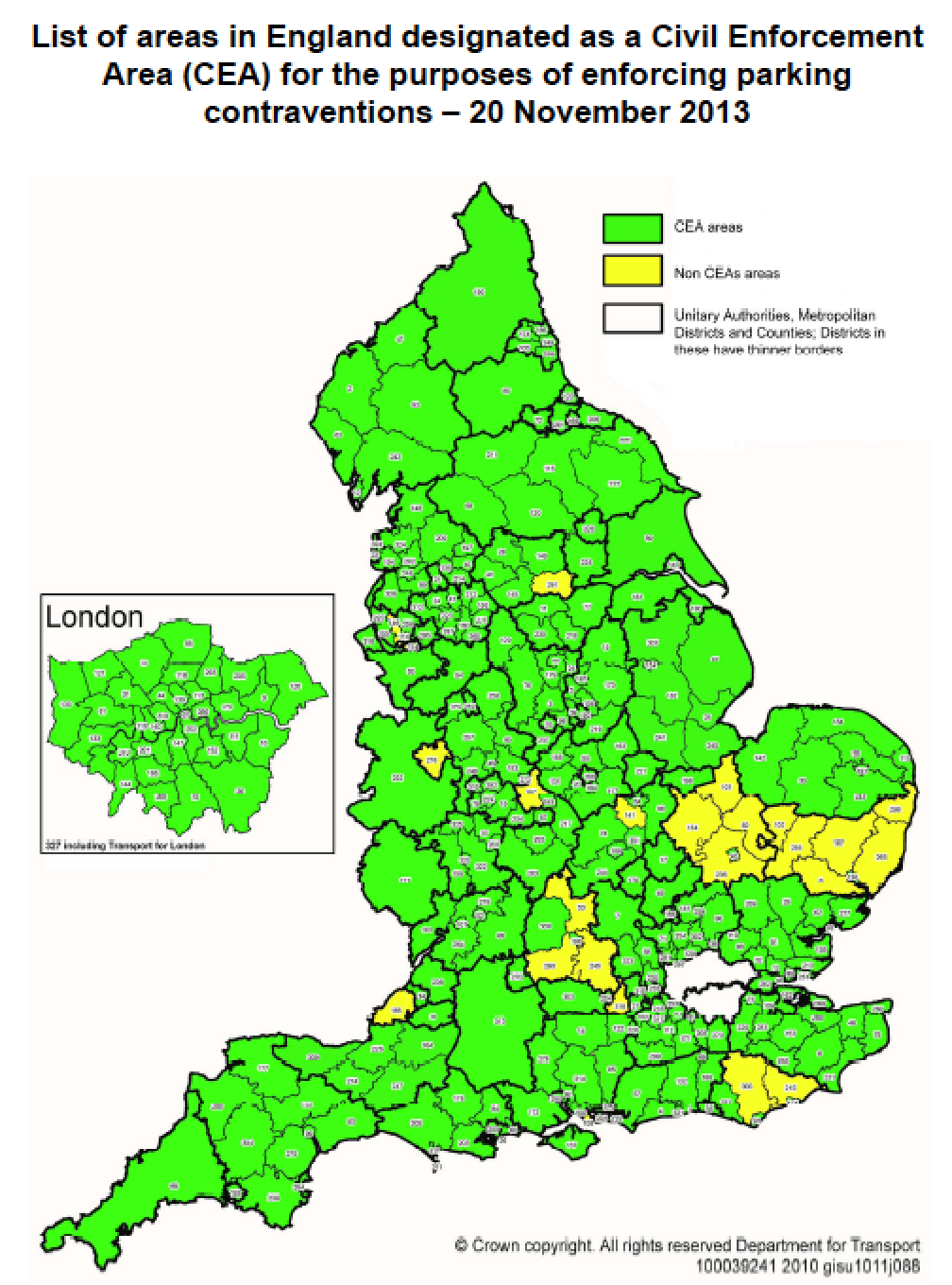
- Green means that it is enforced by the council, not the police


 Pedestrian Liberation

I have spoken to Ipswich Borough Council about the use of pavement for Thomas Cycles on Foxhall Road. YOu may use them yourself as I’m sure you’re a cyclist considering how against cars you are. Thomas Cycles took it upon themselves to block pave the pavement outside their shop and install off road parking for their customers, however, this block pave area goes from their shop to the edge of the road and when cars park on there this means that there is no place for padestrians to walk other than on the road which is an entrance to the layby at a busy round-a-bout. this area is frequented by the usual padestrian traffic – those on foot obviously, disabled/wheel chair users, parents with little ones and buggies, the blind. I am still to hear back from Ipswich Borough Council as to what action they are going to take, if any.
Thanks for the note. I had spotted that myself just a few days ago and made a mental note to go back because it was so strange to see the pavement covered with lines like that. Do please let us know what happens. It turns out that the land is actually owned by the shop who have used it for their own purposes and aren’t about to change anything. I will do a post about it some time. Thanks again.
Where can I find the correct definition of a “structure” as used in section 143 of the Highways Act 1980 I have searched the net and cannot find one although some local authorities appear to have given there own definition looking at your map I appear to live in a CPE area
Section 143 of that act defines a structure as “any machine, pump, post or other object of such a nature as to be capable of causing obstruction, and a structure may be treated for the purposes of this section as having been erected or set up notwithstanding that it is on wheels.” (which seems a very broad definition to me). I seem to remember that one of the acts contains a long list of definitions; I thought it was the 1980 Act but I can find it just now. I have mentioned structures in a couple of posts:
help required and quick our district and county council are removing 1 zebra crossing and putting a red phase vehcile crossing in its place with no pedestrian phase just the red one and then they are replacing a green man crossing with a 22m staggered junction – we are arguing they are against the equality act 2010 and they are ignoring us – do you have a quick answer please as work starts tomorrow and we need letter to tell them to stop until they give us prove they have complied with it?
Apologies about the delay in responding. Busy times here. My personal experience is that the council will be very hard to stop. My council seems to pretend that the Equalities Act doesn’t exist when it comes to emptying the bins, so I am not surprised by your experiences. Here is a post about my experiences with disability legislation.
Unfortunately it costs a load of money to challenge them legally. I was quoted £150 for a 1 hour consultation about a traffic lawyer here in Ipswich which I guess would be typical of other places (I declined!).
3 months ago I had the misfortune to fall over an A sign lying on the pavement. It had the sign removed from it weeks before. I suffered serious injuries some of which I won’t recover from completely. I wont work again. Who is responsible for this sign? Is it the contractor or the COuncil. I am trying to sue for this but the Council stated that it’s not their responsibility. Any help?
Are you talking about a road works sign or an advertising sign? The council has many general duties to keep the highway usable and advertising A-frames in illegal. There are plenty of rules about road-works signs and how they can be used. Sounds to me as though you should contact one of those no-fee-no-win claim outfits and see if they think you have a case and against whom. Needless to say the everyone will claim it is not their responsibility! What pedestrians need is the equivalent of the Cyclist Defence Fund http://www.cyclistsdefencefund.org.uk/advice-cyclists Do keep in touch with developments.
I found your site to be of great value to, it also contains lots of indications of how to make those who could act, should act. Thank you a for most interesting experiance.
I have concerns about a footpath that is on my land, regarding the safety of the general public using this footpath, along with that of my family and visitors to my property.
The footpath runs alongside a narrow, single track private road for about 120 metres from the main road, and terminates at a cottage situated behind my property, the owners of which have a right of way over the road.
The local authority (Amber Valley District Council) send a refuse lorry, at the occupant’s request, to this cottage, which is too large a vehicle for the road and is often driven at inappropriate, dangerous speeds.
Other heavy goods vehicles and agricultural vehicles are also invited along the road by the owners of the cottage, and these too are often driven at dangerous speeds.
When any of these vehicles travel along the private road, there is no room left available for pedestrians using the footpath, and naturally, these vehicles and the speed at which they are often driven are a real danger to these users.
Concerned for the well being of the public whilst on my land, as well as the welfare of my family and visitors to my property, I installed several bollards in the verges at the edge of the road, in efforts to calm the speed of this traffic, along with constructing a raised kerbed section at the side of the road at one point to provide safe harbours for pedestrians.
I have asked the council to stop sending this lorry and they refuse whilst it is requested by the cottage owners. I have since asked that they instruct the driver to adhere to a 5mph speed limit, which I have indicated, and they say 10mph is sufficiently slow, but of course even that is not observed.
Amazingly, Derbyshire County Council served a notice on me to remove these bollards and the raised pedestrian area, saying that they obstruct pedestrian access.
They maintained that the public now have a right over all of the road way (which I do not object to or contest)
Although the Government Ombudsman has found the order to be illegal and the council have since withdrawn it, the owners of the cottage are now taking me to court in attempts to get these safety features removed.
If this happens, there is almost certain to be accidents involving this heavy traffic and the public.
I am amazed and distressed that the local authority do not appear to have any concern for the welfare and safety of pedestrians using this footpath, and understood that it was an offence for HGVs to travel along public footpaths without the owner’s consent.
I am unable to secure legal advice, can you help or provide any information or advice?
Philip Boles.
I recognise very well the sort of issues you are dealing with but really don’t think I can be of any help other than to note that issues about vehicles and parking seem to cause no end of problems between neighbours. Also that currently attitudes tend to side with the motorist and their rights over and above those of pedestrians in ways that seem very unjust.
Oxfordshire County Council is shortly introducing a Controlled Parking Zone in our area. Several of the streets are quite narrow, and in order to accommodate the desired number of parking spaces for residents, they intend allowing pavement parking and will mark the pavements accordingly. Please can you give me some guidance about the rules governing this? I understand that 1m pavement width must be left clear for pedestrians, but does the invasion of wing mirrors, and overhanging hedges have to be taken into account or can be ignored?
Here is a summary of some very useful information I received recently from Living Streets that might be useful to you, some of which I should definitely include in the law section.
Highways Act 1980 Section 41(1) “To maintain highways that are maintainable at public expense
Highways Act 1980 Section 41(1A) “To ensure that safe passage is not endangered by snow and ice
Highways Act 1980 Section 66(1) “To provide a footway by the side of a highway maintainable at public expense
Highways Act 1980 Section 130(1) “To assert and protect the rights of the public to the use and enjoyment of the highway
Department for Transport guidance sets out clear minimum widths to allow access – http://www.dft.gov.uk/transportforyou/access/peti/inclusivemobility?page=3 which reads “A clear width of 2000mm allows two wheelchairs to pass one another comfortably. This should be regarded as the minimum under normal circumstances. Where this is not possible because of physical constraints 1500mm could be regarded as the minimum acceptable under most circumstances, giving sufficient space for a wheelchair user and a walker to pass one another. The absolute minimum, where there is an obstacle, should be 1000mm clear space. The maximum length of restricted width should be 6 metres (see also Section 8.3). If there are local restrictions or obstacles causing this sort of reduction in width they should be grouped in a logical and regular pattern to assist visually impaired people. It is also recommended that there should be minimum widths of 3000mm at bus stops and 3500mm to 4500mm by shops though it is recognized that available space will not always be sufficient to achieve these dimensions.
Manual for Streets sets more challenging suggested minimum widths: http://www.dft.gov.uk/pgr/sustainable/manforstreets/pdfmanforstreets.pdf p.68 which reads “There is no maximum width for footways. In lightly used streets (such as those with a purely residential function), the minimum unobstructed width for pedestrians should generally be 2 m. Additional width should be considered between the footway and a heavily used carriageway, or adjacent to gathering places, such as schools and shops.
Living Streets also suggest that the width of the pavement was sufficient for wheelchairs / prams etc to pass each other and note a non-statutory code of practice on disabled access which notes that pavement parking is a hazard (see http://www.accesscode.info/external/5_17.htm)
You could also take a look at my post about bins on the pavement and the Equalities Act:
With the legal nature of this website it is important that spelling and grammar are totally correct. An example is offense – correct spelling in ENGLISH is offence. Spelling mistakes can be avoided by ensuring that the spell check is set to UK English and not US English.
Thanks James, now fixed and sorry for any offence caused 🙂
Hello Peter, may i request your advice on my recent PCN which was issued because i stopped on the side of the road whilst 2 wheels of my car were on the dropped kerb. I stopped to collect something for 3minutes. I didnt get out of my car. I positioned myself with 2 wheels on the dropped kerb with the intention to drive into the drive and to avoid obstructing traffic. The vehicle already on the drive was about to leave but they had to then wait for someone. So i drove off. PCN was then issued from a cctv. I stopped on the kerb without causing any obstruction to pedestrians or vehicles with the intention of driving into the drive. Do i have a case?
I find it strange that you are coming here for assistance. This blog aims to support pedestrians. Motorists have a great deal of support structures in place already, not to mention a legal system which pretty much always gives the motorist the benefit of the doubt! I suggest you contact one of the motoring support groups
Hi
I’m hoping someone can help me, my car over heated while driving so I pulled over not realising I stopped on the white line to a pedestrian crossing now I’ve been fined 105 for the privilege, I didn’t leave the car at any point and was there for about 10 mins is there anything mentioned in the highways act as I’ve not been.able to find anything
This site is here to help pedestrians get pavements available for their use. If you want advice about how to get off a motoring offense then you are in the wrong place 😉
In my case the County Council has made a public footpath right across my front garden WITHOUT complying with the leglislation of the Wildlife and Countyside Act 1981, is the path legal or illegal that is what I ask you Sir?
FACTS:
• The County Council failed to “Duly Serve the Notices” as required by the legislation of the Wildlife and Countryside Act 1981
• The County Council failed to take ”Reasonable Steps” to trace and locate other occupiers, and lessees of the land that would be grossly and adversely affected by the order.
• The County Council falsely stated and confirmed that “they had served the notices” on ALL and EVERYONE as required by Paragraph 3 of Schedule 15 to the Act, when indeed you had not.
• The County Council has NOT followed “Due Process” of the Law in accordance with Legislation of the Act. A fundamental, constitutional guarantee that all legal proceedings will be fair and that one will be given notice of the proceedings and an opportunity to be heard before the government acts to take away one’s life, liberty, or property.
Yet the County Council has admitted to me that they did NOT follow the law and that they missed us off the list of people to be served notices, and they also missed off another person who lives at the Annex of this land yet they say the footpath is legal, I say it is illegal as the Order was invalidly granted, please help???
Debbie
I am not a lawyer and the primary purpose of this blog is to highlight the plight of pedestrians in the face of motorists and authorities who seem to ignore both politeness and sometimes also the law and we just don’t have the resources of knowledge to answer other questions.
“Highways Act 1835 (section 72) which states that is an offence is caused by: “driving on any footpath or causeway by the side of any road made or set apart for the use or accommodation of foot passengers“. You may be interested to know that it covers any ‘horse, ass, sheep, mule, swine, or cattle or carriage of any description, or any truck or sledge‘”
Would you say that this includes wheelchairs and prams or buggies?
Very well set out and useful reference page; well done. Just a nit-picky point on official legal terms, as it causes me confusing reading this page, and I’m speaking as a highways engineer. In the ‘highway’ the pedestrian bit is a ‘footway’ and not footpath (which is a pedestrian right of way across private land) nor is it ‘the pavement’ .Pavement is a very commonly used term for the footway but mistakenly so, as within the highway ‘pavement’ technically means any highway paved area. The ‘carriageway’ is part of the pavement as well as say the ‘footway’ and ‘cycletrack’ or ‘shared use surface’ (wierdly ‘cycletrack’ instead of ‘cycleway’ is the offical term I believe …much to many engineer’s confusion, including mine!). Generally the only bit that isn’t pavement in the highway in the grass verge (which is also technically highway). It’s worth noting that any parking conditions (i.e. yellow lines etc) refer across the whole highway (i.e. carriageway, footway, cycletrack and verge). Hope that’s helpful.
Many thanks. I am now aware of the difference and will review the article again.
I live in west Lancashire. A work van is a repeated offender in my street. It parks partly or wholly on the footpath. It is impossible for me to fit my pram through, meaning I have to walk out onto a blind bend at a junction, with my pram and small child. I have knocked at the house and politely asked him to move his van, he refused to accept he was causing a problem and slammed the door in my face. Do you think this is a council or police issue? Both have yet to get back to me.
My experience is that no one will help you. The police and authorities seem to hope that they can just hide and ignore it. Our job is to make that harder for them to get away with. Do not however underestimate the risks of challenging motorists as some can get very violent.
Keep writing to the police, write to your MP, write to your police chief to the head of transport at the council, write to the local paper, get local disability groups involved and so on. Expect to receive words but no action. Do also widen your complaint to issues on neighbouring streets and to rest of the town to avoid it appearing as a vendetta against one person.
Wow – someone has built a site with my exact thoughts – nice one!
On the topic of Stopping within a ‘School keep clear’ zone to people with common sense (not parents it seems) I feel the purpose of these zones is to give plenty of visibility and time to see school kids running into the road. Jam packing these ‘School keep clear’ zones with 4x4s to cocoon there little darlings inside on the 2 minute journey home makes it impossible to ensure safety and in these more security consious days a designated teacher/parent used to be able to see from one end of the zone to the other anything dodgy going on.
Of course for general rules of the highway code relying on the public to do the correct thing used to be enforsed by someonr in a police car or even police on a bike or dare I say on foot – but of course walking is delving into the unknown…
Also as a postman with some driving duties you may be pleased to hear that there is at least one out there that is law abiding and considerate even if I do actually have to get out of my van and walk 10 yards to empty post boxes!
Good “to the point” website – Keep it up…
Our local Council are now insisting, contrary to their original policy that the black recycling bins (1 metre x 0.5metre x 0.5metre) we use are placed at the end of our road not on the edge of our property as before at 0700hrs on the day of collection. This is an 80 metre round trip. I am concerned that if all 13 houses do so (as many as 16 boxes) then we will be blocking a substantial part of the pavement for circa 4 hours every fortnight. I have read various websites and wonder if this is considered as ‘reasonable’ or not by others. it will clearly be a wilful obstruction, but I understand it has to be un-reasonable as well. I consider it to be so and would therefore suggest the Council are complicit in this obstruction but unless we comply they will not collect the recycling. i understand there is an offer pending for the elderly to have their bins collected which still leaves 10 properties left. i have seen the lorry reverse down our street a few weeks ago so I know it can be done. Of note, the usual refuse bins can be left where they have always been left at the edge of our property.
I have not heard of that one before. Out of interest, why are they no longer wanting to bring the lorries up your road? Is it anything to do with the challenge in doing this due to the number of cars parked on the road?
You may like to raise this question on our facebook group.
Thanks for the swift reply! Nothing to do with parked cars though as all our cars are parked on our drives. They do manage to bring the refuse lorry down so am a little perplexed all round. I’m not on Facebook so can’t go to the group. thanks again, Nick.
Un-funnily enough, I have just been informed that our local Council in Wales considers putting out a fully-laden wheelie bin at the end of a foot passage that our back gate opens onto (20m round trip) is also illegal! The argument is nothing to do with obstruction, but seems to be to do with restrictions on where exactly the owner of the property is entitled to place receptacles containing waste for collection. (I think the previous elderly owners had some sort of deal with the binmen who came into the back garden but those days are over.) Can Peter throw any light on this – I am a pedestrian with an obstructive wheelie bin in tow!
PS what a fascinating website – thank you, most illuminating
Are mini-scooters and skateboarding allowed to rife on pavements They are a nuisance and are dangerous to pedestrians.
According to this old article on the BBC (http://news.bbc.co.uk/1/hi/magazine/5271874.stm)
“Unpowered scooters and skateboards cannot legally be used on pavements, footpaths or cycle tracks as they have no right of way, but the DfT admits it is not very practical trying to enforcement the law. Local bye-laws can be created banning them.
Thank you Peter The police used to say the same thing about pavement cyclists, “that nothing can be done about it”. But, whilst the police are on the beat, stopping skateboards and mini scooters, takes up no extra time or work. They are supposed to enforce law and “order”! Denise
________________________________
I am also finding pavement parking and other obstructions massively on the increase in Manchester in recent years. On parking, the 1835 Highways Act makes the offence one of driving, but since it is impossible to park on a pavement without driving on to it, and since parking is neither an emergency nor access to property (for the vehicle), parking is still de facto evidence of an offence. The issue was brought before parliament in 1961 and this principle was confirmed, along with the definition of “driving” as including any means of moving a vehicle, not just having a motor running. The 1835 Act does have exceptions for hand-propelled carriages, such as wheelchars and pushchairs. As for wheelie-bins, the 1847 Town Police Clauses Act specifically makes an offence of leaving rubbish bins in the street, but says nothing about ‘permanently’, so technically they not not be left there at all, presumably. That is why Victorian housing had back entries or alleyways, primarily for the delivery of fuel and removal of waste. The “bin men” collected and returned bins from/to your property, right up to the 1970s. Councils all over the country have been busily gating alleyways off, while expecting householders to leave bins out in the street – wrong way to go!
Nice comment. Totally agree.
Also, another commenter has just left a note on another post noting that clause 28 of the 1847 Act makes it illegal to leave a vehicle on the road for longer than is required to load or unload! http://www.legislation.gov.uk/ukpga/Vict/10-11/89/section/28.
His comment on https://pedestrianliberation.org/2011/01/19/damage-to-vehicles-left-on-the-pavement/ reads:
“No-one should be prosecuted for this – any vehicle left unattended on a public highway has, technically, been abandoned (1847 Town Police Clauses Act – you are only permitted to stop a vehicle to load or unload) and is therefore left entirely at the owner’s risk. Such a vehicle is not covered by insurance and police have the powers to remove it – this was common knowledge up to the 1980s – many firms, for instance, would not allow employees to take company vehicles home unless they could show they had secure, off-street parking. What has changed? The law still exists, but everyone, including the police and unsurers, seem to have forgotten all about it…”
My mothers neighbour takes his car of his drive and parks it I front of her house every morning then moves it back down his drive about 6-7 pm. When we politely asked him not to do this as family were having to park in front of other peoples houses when they visited he told us ” the council owned the pavement not us and he could do it if he wanted n we couldn’t do anything about it ” he has another car parked constantly outside his house as he and his son buy them from auction and sell them on.. The last house owner let him do this but my mum put her car there when we moved in and since they got rid of the car he has started this. Can you help ?
So you’re objecting to someone obstructing a pavement but happy to do it yourself? or objecting to someone parking in front of your house, legally on the road? Bit confused.
Assuming you mean the latter, if he wishes to park on the road outside your house for whatever reason, if he’s legally parked, taxed, MOTd insured, it’s the Queen’s highway and it’s not actually within your power or rights to do anything. Sorry.
But. Is he declaring his income on the cars he buys and sells? Sounds like a business to me? So he should be doing so…
I tried to get a large motor home moved (is this classed as a Transit type van for the purpose of the law) off the pavement which was causing an obstruction. I tried to use the grounds of Obstruction (You had to walk side ways to get between the van and the hedge) and mounting the kirb. After a lot of phone calls to the police using the same crime number they did send a police woman. Her response was, she could walk between the van and hedge, and it any case, if anyone else couldn’t, whether it be a pram, wheel chair or disability buggy, they could cross the road and use the other footpath to get buy. I also explained that the owner would regularly have mains electric hooked up to the van and cables running across the footpath which causes a tripping hazard as well as a shock hazard, and her response was, “that’s what motor home and caravan owners do”. So it would appear that in Leeds, if it’s what people do, The Law doesn’t count a jot.
We have a dropped curb for access to our property and a neighbour continually parks a long wheel base high transit van right next to the first dropped curb, it obstructs our vision to the left when exiting our drive . Can this be a legal act?
Hello..
Im curious if anyone can offer some advice.
Behind where i live is an access/service road which is used for us to gain access to the gardens at the rear of our houses, and to put our waste bags out on ‘bin-day’.
A local person who does not live here has started parking 2 sometimes 3 cars in the access road everyday. This also causes a nausance to pedestrians as the service road is only a cars width wide.
I dont want to confront him as he has a bad reputation and also sells cars from the side roads.
Who do I report this to ?.. and is he actually doing anything technically wrong ?
Many thanks
M.
Who is the access/service road owned by?
is it legal for me to talk to someone outside a cafe inside the barriers not sitting down or touching the table and chairs
Hi,
Great website, with some very useful info.
I am not sure if this is a little off topic, but hopefully someone can help.
We live on a single carriage trunk road (60mph).
It has a narrow pavement that is made even more dangerous to walk down due to the fact the hedges are rarely cut back and the natural debris from the hedges and field partially cover the pavement.
It is very dangerous to walk down the pavement, does anyone know the laws on what the council/ highways agency are legally obliged to do? Should they keep the pavement completely clear and the hedges cut right back? If so how frequently?
A postcode of the road is CH665PN, if you look at google maps street view walking north on welsh road, you see an image from a while ago.
Many thanks,
Rob.
Councils certainly have powers to require property owners to cut hedges that are ‘encroaching’ on the highway and can cut them themselves if the owner doesn’t and then send a bill to the owner. The councils (and police) may however say that it is actually fine for people to walk in the road and that the footway is an optional extra! There is a huge gap between what the law says and what the authorities choose to respond to.
please can you edit the above post and remove my email address.
No problem. I have just removed your email address as requested.
Is there any law prohibiting the driving of a HGV, along a public footpath ?
Sorry, I would have clicked on the notify me of follow up comments via email” box, re the above question about HGV’s if I’d noticed it before posting
I believe that has been the law since 1835. See reference to Highways Act 1835 Section 72 above.
Very interesting site. Thanks.
I would like to know, please, what the legal position is with regard to queues outside nightclubs and the barricades used to control them.
I frequently walk in Oxford from the bus station westward, in the late evening pulling wheeled luggage. On the only two streets I can use the pavements are obstructed by barriers, reduced to a width of 2 ft. One new venue closes the footpath altogether. So I take to the roadway
Many thanks
The following acts would appear to be relevant should the authorities be interested in doing something about it:
Highways Act 1980 (Section 148 and Section 149), it is an offence if ‘a person deposits any thing whatsoever on a highway to the interruption of any user of the highway without lawful authority or excuse or if the thing “constitutes a nuisance” ‘ or constitutes a “danger to users of the highway.
Also, Town Police Clauses Act 1847 (Section 28) “every person who, by means of any cart, carriage, sledge, truck, or barrow, or any animal, or other means, wilfully interrupts any public crossing, or wilfully causes any obstruction in any public footpath or other public thoroughfare“
I am hoping some one may be able to assist me here. We moved into a village in the South Hams last year, where just outside our front door there are is a space for up to 6 cars. This bay has been outside these house for around 200 years to allow farm animals, vehicles and now modern vehicles to be ‘off’ the main highway. Over ten years ago the highways agency deemed it necessary to place a zebra crossing just by this bay. The white jig zag lines run along the bay’s white block lines for around 3 cars length. This has been fine for all this time, yet last year a child who ran into the road was knocked from his feet. This morning the residents received a letter saying that it was now illegal to park across these jig zags and that they were to correct the parking and reduce the space available. Parking is a premium in a village and one placed on the main road. I was wondering how they managed to place the zebra crossing here in the first place, without noticing that what THEY have done so blocking the parking bays with the zig zag lines, why the parking spaces are being made illegal when to me surely they should have relocated the crossing as not to block the parking bays. Any advice, information or wording of the law would be very much appreciated.
Hi, my home was the original gatehouse of a mansion. The gatehouse is at the start of a narrow pathway which leads up to the main house which is now a residential home. The single track pathway is used by pedestrians and cars which has no road markings on it at all and only has space for single line traffic which causes problems as currently cars use my driveway as a passing space. My front door leads directly out to this pathway where there is no pavement therefore safety is an issue.
The residential home has invited me to discuss proposed plans to extend the home by increasing a further 14 residents by building a double storey unit.
My concern is for the increased transport which will now use this pathway (residents, visitors, dog walkers, delivery vans etc) and in particular the safety of my family as the danger will increase when leaving/entering the house as well as for pedestrians who use this pathway.
Are you able to give any advice about single tracks used by cars and pedestrians?
Many thanks.
Hi Catherine I have a similar problem to house built in 1800’s in of which use to have its own gated pathway to its front door that steps onto the carriageway. This carriageway now serves the rear entrance of a tower block built in 1964 with its garages.The gate has long since been removed and the tower block insists there has never been a pathway to my house and are free to invite H.G.V. over the cellar that runs under the road and for divers to include the pathway as an extension to the width of the road.
I would be happy to learn how you have resolved this problem and give you my knowledge.
I am so glad that I found your site, thank you.
My mother lives on a street where all the whellie bins have to be parked on the pavement as the council have made no other facility for the bins. I have visited and written to my local MP who has replied that there is nothing else that can be done, despite me recommending two areas within the street which could be used for whellie bins. This prevents wheelchairs from accessing the street without it being an obstacle course for them, not to mention it being unsightly and smellie. After reading an article on your blog which states that it is illegal to permanently keep bins on the pavement, are you able to advise how I am best to tackle this again with the appropriate authorities? Thank you.
We also have this problem in my home town. I am not clear if councils are permitted to allow bins to be permanently stored on the pavement. Will check.
Is it against the law to park a car fully on a path with all 4 wheels in Gateshead? People can get past but only just. If it is who do you ring to complain to. Counsel or police or warden? Thanks.
No one wants to know unfortunately. If there are no yellow lines then it is probably the police and ‘obstruction’ or ‘driving on the pavement’ but I would fall off my chair if they did anything. Do however complain to your MP, local police commissioner and councillors and see if you can get movement.
I had a good one from Tendring District council. Parking was pay and display, but I couldn’t display on the dashboard as I was on a motor-cycle and had no dashboard.
Enquiry to TDC asking what the devil I was supposed to do in this case resulted in my receiving a letter saying that where there was no motorcycle specific parking, I could simply park for free ‘in areas where [my bike does] not affect other vehicles or pedestrians adversely’.
Given that ANYWHERE my bike were parked would only have an adverse effect, (unless, I suppose, you were a pedestrian who particularly liked motorcycles), and given that we were discussing a roadside pay and display, I read this to mean that I could stick the bike anywhere it didn’t prevent people getting past. In the specific context, I felt I was being told to park on the pavement! I never actually had to do so… it seemed a bit of a weird idea to me!
But I kept the letter, just in case.
Priceless!
Approx. 40 yrs ago I parked with 2 wheels on the pavement and received a ‘producer’ for driving on the pavement. When I went to the police and said ‘what do you mean driving on the pavement?’ the response was ‘well did you pick the car up and put it there?’ – no answer to that! I received a caution. I therefore conclude that if it is illegal to drive on the pavement then it is also illegal to park – the car must have been driven there to park it so is there really a grey area?
Thank you for that nugget. Very interesting. As you suggest, it was illegal to drive on the pavement then, and still is now. The only difference is that now the authorities pretend it doesn’t happen!
i have a neighbough across the road from my house and we all have driveways with drop kerbs and along the front of are gardens is a grass footpaths and then goes into tarmac drives ways with drop kerbs my nieghbough has put big plant pots along the footpath and across there driveway and drop kerb they are now building a carport which is on a drop kerb. i dont know if they own the footpath and drop kerb but if they do are they still allowed to do this
Probably worth asking them or asking your planning dept. You might consider alerting planning anonymously though to avoid more problems with neighbours than necessary!
at present fife council in scotland allow cars to park on the pavement in areas where the roadway is marked as a bus stop area , apparently although double yellow lined no parking regulations nearby apply to the pavement as well as the roadway the broad yellow single lined no parking regulations only apply to the area where the bus stops meaning that the pavement used by the public for boarding buses can be used by cars for parking on.
Not sure I understand. Yellows lines apply across the full width of the highway (including pavements and verges as well as the carriageway/roadway).
East Sussex county council are planning to build a new school with a pedestrian access opposite my property at the end of a cul de sac. There is no turning point and vehicles will be forced to turn using the dropped kerbs/pavements and private driveways twice daily.
This I feel is putting children at risk as well as a disturbance to home owners. Is there anything I can do?
put lockable post on your land notice video proof of driving on pavement to police as its an offence.
For one, do avoid the words ‘being forced’, which I think only apply when a motorist has someone pointing a gun at them, being threatened with physical violence or where their children have been taken hostage!
All you probably do is add your voice to the debate and persist if the problem develops as you fear. I know that MPs are hearing our complaints. One day, and this will come sooner if we keep up the pressure, they will act.
Video evidence is powerful. Do collect evidence and show it to your MP, the local police and local papers as appropriate.
I was just wondering what are the law against parking slightly on the pavement where there are no signes or lines.
All that we know is included in this article. My understanding is that driving with two wheels on the pavement is ‘driving on the pavement’.
I understand that around 1815 that a precondition of a carriageway (10ft width) a pavement /footway/pathway was a prerequisite of 3ft access, can anyone confirm.
Sky-scpaper building install gated property to rear access of property on own land of which a right of access exists thereover. The vehicle Gate access with pedestrian side gate is to private land services garages and rear access to properties.
Should consideration be given for wheelchair access if so what is the minimum size. The gate is 40ft from the highway off a 10ft carriageway.
I live in a cul-de-sac in a modern development in south glos bristol. Properties built 1998. We have raised paved road with grass verges between road and footpath. “Dropped kerbs” all the way along the road as verge and road are same height. Class c4 carriageway.
Grass verge parking a persistent issue dMage occurring and muddy during the winter. Is the verge part of the road or part of the footpath. I’ve just requested copy of site plan from hm land registry to establish if covenants apply that householders have to comply with. Any Idea what the position with covenants once the local authority (south glos) had adopted the road verges and pathways
To be clear about terminology and legal status first. The ‘highway’ includes the ‘carriageway’, ‘verges’ and ‘footways’ up to the ‘curtilage’ of the properties. See ‘The Law’ section for which regulations apply to the whole width of the highway and which more specifically.
Unfortunately councils and the police are very reluctant to do anything about parking and the law is weak on it anyway. There are many laws that could be used, and in some cases councils have threatened ASBOs for people how park on verges ruining them.
All I can suggest is that you add your voice persistently to the debate – email your MP, you police commissioner, your council and your local police force and then keep it up every few months until one day police makers will realise that it would be better if they acted! Thanks for the comment. Do please also support Guide Dogs on their campaign.
Can I ask for clarification of the law as regard to parking on the pavement which causes obstrcution of access through a front doorway two feet away. According to South Wales Police, this is not obstruction.
According to the police almost nothing involving a carbis obstruction! Raise it with your MP, the paper and you local police comissioner if you want to help build pressure for something to happen!
If a HGV overhangs the foot path but its wheels are still on the road as it passes would this still be classed as driving on the foot path?
I would guess not, but obstruction, nuisance and danger could all be cited, but only my enforcers with more conviction than any I know! See ‘The Law’ page for all the laws which could be used in relation to parking.
There is a car park (modern) and the single entrance is located on the other side of a footpath. The road and footpath run parallel and a car to enter the car park must make a right hand turn crossing the path. The footpath normally would be broken. however in this case it is not and the road rises to meet the footpath i.e. there is a slight rise.
From what I read above
1. Pedestrian has right of way at all times
2. It is technically illegal for the cars to access the footpath.
On google maps
https://www.google.com/maps/place/Swansea,+UK/@51.621236,-3.933553,42m/data=!3m1!1e3!4m2!3m1!1s0x486e45555a4e97b1:0x3d77128e2fe7cb74
This is a superb website. I have now written 7 pages of notes in order to write to my MP, Councillors, Council and Police.
However, I could do with picking your brains. I live in a new development. (5years old so far and it is a crescent. In order to access the crescent you turn left off of an old road 40yrs plus. On this old road, there are double yellow lines right up to the give way junction. These double yellows stop there and its a raised kerb on that side of the road and into our Crescent. Vehicles park half on the road and half on the pavement. Maximum 3 vehicles before the next set of double yellow lines, which contines all around the Cresent.
However on my side, there are 4 townhouses in 2 sets of semi detached blocks. Each with their own drives and dropped kerbs. Between the 2 sets of terraced houses is a raised kerb. Vehicles are now parking on this raised piece and also into the dropped kerb. This side, they are obstructing the pavement, my footpath and driveway which means I am struggling to walk, cycle or even drive into my property. This is also obstructing dog walkers walking their dogs to the field across the way and also obstructing any emergency vehicles as the parked vehicles are on both sides.
Where the Cresent comes back around on to the original old road, that section has double yellows and permit parking. The council say its unadopted and have no jurisdiction and the police are not interested.
Thoughts or suggestions?
Kind regards
Lee
Can anyone advise me please on the position where cars mount the pavement close to a school,and then drive along with two wheels on the pavement and two on the road. The purpose seems to be to park at the end of the road on a junction for a speedy departure. Children who are walking and turning into the road are at risk of being hit by a car moving on the pavement. Drivers are abusive when asked to stop doing this, I guess since their own children are still in their car so not at risk!
Driving on the pavement is illegal. See rule 145 Highway Code. Same law that makes it illegal it ride a bike on the pavement. It is a police matter. Take number plates and times and report them. Take a log of each occurrence. If the police won’t respond then talk to the local paper, mp and councillors. We would be very interested to hear how you get on. Keep good records of all communications which will be useful for an article in the paper.
Peter, as in order to park on the pavement, one must drive onto and then off the pavement, why is this not illegal ?
In the past the police have said they can’t prove who was driving. Now, with video evidence available,?they say they chose not to do anything!
I have a problem with a neighbours visitor who insists on parking his estate car and horse box on the pavement outside my window and as I have no front garden it is only five foot from my window and blocks out my view and light. I have asked politely if he would move to the other side of the road and park it outside the house, or in the empty double drive of the person he is visiting but he said that he can park wherever he liked. I phoned the police and they sent a young girl community officer who seemed to imply I was an old (68) grouch. Firstly whatever happened to consideration and courtesy to others and secondly is there really nothing I can do but grin and bear it?
Thank you for posting this. Do please add a photo to our Flickr group if you are able to do that. Do also contact your MP. This is something that needs politicians to act and they won’t do that until they feel the heat.
Hi. Thank you for a very constructive website.
Unfortunately I am facing some difficulty with our neighbours Tesco, as they are blocking our pavement with their delivery shutters and trolley. I was hoping if you can advice me further.
Many Thanks
I suggest you join our Facebook group and post some details and photos and see what suggestions people give you back.
I live on a corner plot and the pavement around my whole house is used by neighbours and their visitors on a daily basis for parking their cars. Up until 6 years ago there was a grass verge around my house and I maintained it as it was part of my property as outlined in my deeds. Then the avenue was extended and 10 houses were built. Planning laws required that, becasue there was to be increased pedestrian traffic, my grass verge had to be hard surfaced for which the builder required my permission. I agreed to this (I now wish I hadn’t but it’s a long story) but the pavement is still within my property boundary. Would I be within my rights to put signs up saying that it is privately owned property and reserved exclusively for pedestrians and threaten civil legal action for anybody parking a vehicle on it?
Can anyone help please with my query, my neighbours do not leave there refuse and recycling bins(3) directly in front of my dining room window, on the road. I leave mine in my drive. They are doing this on purpose as at the corner of my property there is space for bins, however they have their own drive so shouldn’t they put it on their own boundary. Often they out the bins out anywhere from 13.00 hrs. Hope this is the right p,ave but the Council want me to talk to them, sadly they are not nice and have abused my other neighbours so I will not do this. Many thanks, any help gratefully appreciated
Here in Enugu State of Nigerian and other environments, a motorist will just drove up to someones business premises frontages both in the streets etc and not the users vehicle and will get the vehicle parked for hours blocking the business owners from salling his good in only to says that he paid roadworthness or tax to make the use of the road the way he likes. what should law says about it becouse the business people do also pays capitation rates and taxes both states and federal?. is there any appropriate authourities one should report of such intimidations and treats?
Thanks. Seems like an extreme version of the attitudes that we see here in the uk. Unfortunately I can’t help you regarding Nigerian law!
Is it illegal for my neighbour to park over the footpath to my home, obstructing access to my door? There is no public footpath, just paving slabs from my door to the road. I have a low fence I can climb over to get out but at just over 9 months pregnant do not feel up to walking over muddy grass and clambouring over a 1m high trellis fence. Also, once I give birth will need access with a buggy. Have left polite notes with neighbour but as space is at a premium in our cul-de-sac and his son has just passed his test my home’s entrance is currently favoured by the father. Sorry, feeling grumpy and hormonal about this!
If a car is parked partly on a driveway in front of their house, but significantly overhangs the pavement, AND there are double yellow lines across the dropped curb; is this a civil enforcing offence? It’s in a resident parking permit area and I’m sure the enforcement officer must have to skirt onto the road to get around this vehicle so I’m not sure why it isn’t ticketed.
An interesting edge case. Will pass to a some kind legal people who are looking at the whole issue of the law as it relates to pedestrians. Personally I think it is a parking offence re yellow lines and obstruction. Try complaining to your council re non-enforcement of yellow lines and see what they say.
do the white zig zag line markings at a pedestrian crossing apply to the pavement beside the zig zag markings at the crossing as well.
It is my understanding that they do, yes.
Hi
Please can you confirm that the details under ‘Driving on the Pavement’ as follows are still current:
‘It is also illegal to drive on or across the pavement other than to gain legal access to a property, and has been since before cars were invented! Section 72 of the Highways Act 1835, which is still in force, states that an offence is caused by: “driving on any footpath or causeway by the side of any road made or set apart for the use or accommodation of foot passengers“, which covers driving of a ‘horse, ass, sheep, mule, swine, or cattle or carriage of any description, or any truck or sledge‘.’?
Has this been replaced or reiterated in any of the subsequent versions of the Highways Act?
Many thanks
Shelley
It is my understanding that this is still the legislation in force today. It might be informative to speculate why it hasn’t been updated, might that be because the ruling is necessary but contentious?
Hi
My wife recently became confined to a wheelchair and I asked that the council put a single line no parking marker in front of our front gate to ensure she has access and egress at all times.
They flat out refused, even though the wheelchair lady two doors along from us has one, this however is to allow her to get her car in and out unhindered and has nothing to do with her wheelchair. NO car, NO help.
However what was more worrying was that the the lady I spoke to at environmental health and public nuisance assured me in no uncertain terms that the Highways act is not a law, but a guideline.
Obviously this is utter rubbish, but shows the attitude the councils have.
She also assured me that someone parking their car in the road in a road such as mine would constitute an obstruction, but parking on the pavement DOES NOT.
I’ll admit to being furious about this and came here to rant, but I am all for helping anyway I can to get this ludicrous situation reversed..
Go straight to your local councillor by email, copy in your local MP.
Do it like this:
Dear xxx,
My wife recently became confined to a wheelchair and I asked that the Council put a single line no parking marker in front of our front gate to ensure she has access and egress at all times.
The council’s response so far has been inadequate (etc)
Please escalate my complaint and give me a reference number (ensures paper trail)
I expect a response within
otherwise I will escalate the complaint further, in accordance with your complaints process.
Hi all – I have just been assaulted for the second time by a resident who insisted on his right to store his wheelie bins and other rubbish on the pavement. I called the police at the same time as him, the police officers were entirely ignorant of both the Highways Act and Environmental Protection Act 1990.
They took his side throughout, accused me of anti-social behaviour, and pointed to all the other bins on pavement with the brilliant logic that “if the council don’t enforce the law then it’s alright”.
The Police Officer then encouraged him to store the bin back on the pavement where it was before.
I have now complained about the landlord who assaulted me to my MP, local councillor, and Environment department of the council. However, when I was assaulted the first time I also made the same complaints, which were responded to initially, but then ignored – no enforcement action was taken by any authority. I have also made a complaint to the Met Police about the ignorant police officer.
Any advice as to how best to pursue the complaints – what is the best way to make an MP, a councillor, and the police actually carry out their duties which we as taxpayers pay them for?
Hi i am having some issues with my local council, Sunderland, I have been complaining for 2 years about a puddle on the public footpath outside of my property. When it is there it completely blocks the access to the front of mine and next-doors house. I can take a large step over it at its narrowest point most of the time. But my daughter has to be lifted over. And it is a nuisance. Also in the winter it often freezes and is dangerous. I have some photos I could send. They class it as low priority as it doesn’t flood my house. They wouldn’t do anything about it last year. And have already told me that they won’t do anything about it this year either. Just wondering if there is any clauses about access to properties. Thanks Charlene
If on the left side you can park the car and two cars can’t both fit on the road at the same time can a car go on the pavement to give way
No, driving on the pavement is illegal, just as it is for bicycles, even for short distances. See Highway Code rule 145
No, it is illegal to drive on the pavement, even for a short distance.
İf it is illegal to drive on the pavement even for very short distances then how is parking on the pavement not deemed to be illegal unless the owner has physically picked up the car and planted it on the pavement
I have been trying to get answers from my local council Wealden District Council on parking on Pavements and parking on double yellow lines.
The answers are as follows:
1. Decriminalisation of On Street Parking
The current position within Wealden District Council is that On Street Parking has not been decriminalised and responsibility currently lies with the Police – having spoken/emailed Anthony Wakefield (Inspector CW050, Wealden Neighbourhood Policing Team) the official stance is – due to prioritising workloads Sussex Police will only respond to parking issues when there is an obvious and present danger.
2. Parking on Pavements, Double Yellow Lines and Pedestrian Crossings
Wealden District Council are not the Traffic Authority, the Traffic Authority is East Sussex County Council and it is their responsibility to pass any byelaws on parking on pavements and yellow lines. It is then down to the Police to deal with the issues, but as detailed above by Anthony Wakefield they will only respond where there is an obvious and present danger.
As you can see the answer at present lies with the County Council passing the bye laws and in this area the Police to enforce them. But it is not a priority with the Police due to cost cutting and the only uniform officers you see are PCSO who do not have the power to deal with the problems.
Has anyone proof read this yet? I have noticed a few errors in the first quarter. I have a few friends who would be happy to help
I should do that across the piece. Thanks for the offer.
I’m disgusted about the cars parked on the pavement on the way to pick my son up I’ve got photos and number plates
What happens if you don’t have a drive way, you’re in a maisonettes so the whole street have to park their cars in the street and the wheelie bins have to be permanently on the street? I’m getting threatening notices on my car advising my car is an obstruction for the bin collectors. The cost is £50 but it’s been hand written. I’ve lived here 8 years with my car outside and never had an issue before. I move my car every week and no matter where I put it I get a notice. I’m not in London, there no enforcement by law, there’s no restriction markings, this is illegal to hand write fines it’s not even an official notice. They now hurl abuse at me. I’ve complained to local authority but nothing done. Who do i turn to?
You must realise that people are being driven nuts by cars and buns blocking pavements. The authorities are going to have to do something and there is no more reason why people should have any a right to leave cars on the highway than sheds or stalls or any other item of private property. In Tokyo you are only allowed to own a car if you can demonstrate that you have a legal off road place to park it. That said, if you are receiving threats or bogus requests for payment then speak to you MP or the local paper.
At a cross road regulated by a trafic light, if a car or truck as engage itself to turn right but is stop by road traffic; can the car behind the truck go over part of the pavement if the car or truck in front is Causing a delay or an obstruction to the car which is going straight?
In a word, no. The law is clear on that, the pavement is not to be used by ‘carriages of any description’, except to gain legal access to private property. This is not well understood by the authorities. This rule applies even for a very short distance.
what are the laws about putting pavement signs out on a town centre pavement, assuming they do not obstruct pedestrians or disabled persons
See relevant text in this article relating to ‘pavement signs’.
The owner of a field next to our cul de sac has taken down our boundary joint fence and installed a gate so he can now use this as an entrance to his field. In order to enter the field he has to cross our burdened pathway that serves the houses in the cul de sac. He has no legal access. Police and council have been most unhelpful. Will highways Act section 72 help us.
Not qualified to advise unfortunately. I note however that Section 72 allows ‘legal access to property’.
i have been refused a crossover , my application for dropped kerb is to near a tree. can i drive over pavement to my property without a dropped kerb.
My neighbour parks his van over the steps which give access to the road, from the public footpath. It makes it difficult to get down to the roadside, either to get in our car, or a taxi. Also when wheelie bins have to be taken down onto the road. To each side of the steps there is a steep grass verge. There are elderly & and disabled people who need access to these steps. He has been politely asked not to do this. What can we do?
My parents live along a single track road which has been adopted by the highways authority. A local bus driver continually parks his mini bus either directly oposite or just below the junction on the other side of the road. This makes it virtually impossible for anything other than a car to turn the corner. Bin wagon, tractor and trailer, fire truck and delivery wagons have little chance. I have asked the driver very politely to park slightly further away but withno success. He only does school runs so his mini bus is there for about 21 hours of the day! What can be done about this?? Kind regards.
I would like to know if a garage can use a public road as a queuing system for vehicles coming in to the repair bays, the parking on the street where live is monopolised by the garage and there are vans day and night obstructing the light into my house?
I am disabled, I need a stick to walk, but unable to walk far. There is no disabled slot outside my house, the nearest place is four hundred yards away, to far for me to carry shopping etc. I park outside my house on the grass, I can not park my car there for any length of time. Houses should be built with disabled people in mind, there are eight million people with mobile dissabilities
I am constantly having to squeeze between cars / van / lorries and walls or hedges.
I’m disabled with walking difficulties; I have Diabetes and try to walk as much as possible in spite of my disabilities; I find it difficult to walk in a straight line and have been accused of deliberately walking into car mirrors that have been parked on the pavement. Grass verges near where I live have been curned up by the cars and lorries parked on them.
Very interesting. Thanks. I have a situation as I will explain. A public pavement reaches a garage ‘forecourt’ that parks two cars. The two cars are in front of the garage door windows reception. Once the cars are parked they protrude into the public pavement area which means pushchairs, wheelchairs mobility scooters now have to go in the road to pass the parked cars. The garage owner says this section where the cars are parked belongs to him and he first have to remove the cars/obstruction. He is unwilling to accept the danger. The public pavement reaches his garage and then becomes garage propert if around 20 feet. The public pavement then starts again, apparently. The police are not interested but the council as they say it’s a police issue. This 20 foot space means that mothers with push chairs, prams, mobility shooters, wheelchairs, electric wheel chairs and visually impaired are all put into a busy road which creates a significant danger due to the narrowness of the road itself.
I’m unsure as to how to approach this to get a successful solution for the endangered groups I have mentioned. Any help would be appreciated.
Thanks,
Dave.
davidabirdsall@gmail.com
What can I do about a motor home parked fully on a pavement resulting in no safe use of that pavement plus it’s also an accident waiting to happen for other road users due to the nature of the bend in the road it obstructs other drivers view of the road when turning up this road
seeking advice please. A friend works for a Taxi firm in Lowestoft and finishes work often in the early hours of the morning he drives a 8 seater and 16 seater bus.The vehicles are taxed and insured.A neighbour is complaining about the vehicles parking in the street.There are no parking restrictions in the street and no obstruction to driveways or footpaths.Can these vehicles legally park in the street.Aware of weight restrictions etc and none of these apply.
Hi, excellent information presented about this never ending nightmare. I am blind and use a white cane, we get visits from friends and colleagues who say that the road that we live in is one of the worst they have come across for pavement parking.
A local councillor and Surrey Police arranged for a white line to be put down to try and keep the pavement clear so that I could access the road. Great but still some mindless, anti social idiots ignore it, the Police suggest reporting it through their True Vision reporting system because it is a form of, harassment. To their credit Surrey Police have spoken to several offenders.
However, as a number of people have already said, cars are meant for the road, pavements are for pedestrians. Those who park on the pavement should be photographed and these sent to the local council who should enforce a penalty which goes toward the repair of the pavements that those vehicles are damaging.
Great work.
KP
Please does anyone know how long after an illegally installed gate is built, over 4 metres wide and almost 2 metres high, (in a cul de sac allowing traffic over the pavement through a boundary fence) will it be deemed legal simply because of the passing of time?
Thank you for this article. Within an hour I was on the phone to press and an article is being produced. I along with millions of other people have had enough. They would rather block footpaths than walk another 20 feet to a free car park whilst blind and disabled walk in road on dangerous bends.
I share a pathway with my neighbour we live in terraced houses with a passageway through the middle of our homes, (my sons room goes over the passageway) he stores 3 motorbikes and I am unable to use to access my back garden, the best part he starts his motorbike in the passageway and rides up the path onto the road, I had to pay for a drive and dropped kerb, and when someone parks across the entrance of the footpath he zooms over my garden out of my drive ruining my grass edging, I have now complained to our council after persistently asking him not to, there response it’s a work in progress to get him to move it, he is belligerent and screams and shout when he is told what he cannot do so the council pussy foot around him unfortunately them kind of people who thinks the world owes him everything yet he does nothing at all just a drug addict aggressive waste of space, in at my wits end living next to him, surely the council have rights to make him stop driving on our shared path and to store combustion engines under a passageway when I can smell petrol in my sons room? Why do I feel like I am asking for so much but if he rides his bike out and knocks someone over I have to check before I walk out and carbon monoxide slowly poisoning my son, if a fire started in this passage way my son wouldn’t have a chance, can someone please help me give me something, the one time I asked him to move his motorbikes as was having a new back door he was going mad saying I’ve just woke him up and he not moving them! This was 10am in the morning and he doesn’t even work.
Hello, I live in Surrey and my title deed states that I have a right to pass and repass to get into my house with or without vehicles obstructing. SCC are telling people to park there and I cannot do anything about it. That surely has to be wrong and it has caused me to have a serious fall. Help and advice would be appreciated.