Or possibly the title should be ‘how to talk about something for 37 years and achieve very little!
This long story starts with Section 7 of the Road Traffic Act 1974 which should have make pavement parking illegal across the country. It was intended to achieve by a further amendment to section 36 of Road Traffic Act 1972 which had already been amended in 1973 to ban on the parking heavily commercial vehicles on pavements by the Heavy Commercial Vehicles (Controls and Regulations) Act 1973.
The new change added the following clause to the 1972 Act: “a person who parks a vehicle, other than a heavy commercial vehicle, within the meaning of section 36A of this Act, wholly or partly— (a) on the verge of an urban road, or (b) on any land which is situated between two carriageways of an urban road and which is not a footway, or (c) on a footway comprised in an urban road,shall be guilty of an offence“.
A pavement parking was however successfully introduced and enabled in 1974 by the Greater London Council (General Powers) Act 1974 (Section 15).
So what happened to this national ban? Firstly, one needs to be aware that each section of an Act of Parliament needs to be ‘enabled’ and in some cases (like this one) they never are! The excuses have changed over the intervening 37 years but no new meaningful powers to get cars off general pavements have been introduced. Notice how the excuses for non implementation morph over this period when the number of vehicles on the GB roads has more than doubled.
The bill received Royal Assent in July 1974.
By January 1975 the government was being asked when this section would be brought into operation. The response was: “Time must be allowed for authorities to survey their areas and prepare exemption orders under subsection (5). My Department is consulting the local authority associations on the length of time required before fixing the date of commencement.
In April 1975 it was: “The Department is consulting the local authority associations over the commencement date for this provision.”
In May 1975: “I refer the hon. Member to the answer given by my hon. Friend the Under-Secretary of State—Mr. Neil Carmichael—to the hon. Member for Hampstead (Mr. Finsberg) on 10th April,—[Vol. 889, c. 463–4.]
In June 1975 it was more encouraging: “I intend in the near future to make a decision on the commencement date for Section 7 of the Road Traffic Act 1974. ”
October 1975: “Local authorities must survey their areas, prepare exemption orders and signs before Section 7 may be implemented in full. Since this must be done within existing resources some delay is unavoidable, but I hope it will be kept to a minimum.”
By January 1976 the reponse was: “Before Section 7 of the Road Traffic Act 1974 can be fully implemented local authorities have to arrange for the exemption of roads where it would be necessary to allow footway parking. It will take some time for this work to be completed because it must be accomplished within their present resources. It is hoped to state a date for the full implementation of Section 7 after consultation with local authorities in the spring.”
In February 1976 the Secretary of state was asked twice, and both times pretty much responded with the same message: “Before Section 7 can be fully implemented local authorities must prepare orders exempting from the ban those roads where footway parking should be allowed to continue. With existing resources this is bound to take time. The local authority associations will be consulted in the spring about the prospects for implementation.”
In February 1977 the Bishop of London asked in the Lords: “what is the reason for the delay in introducing regulations to give effect to Section 7 of the Road Traffic Act 1974, and on what date such regulations will be introduced.”
Baroness STEDMAN responded and actually gave a date for implementation. She said: “My Lords, the right reverend Prelate will know that, before footway parking can be banned, work to exempt streets where such parking needs to continue must be completed. With so many pressing calls on their resources, local authorities have not hitherto been able to give this work priority. However, my right honourable friend the Secretary of State for Transport has proposed to the local authority associations that the date for making Section 7 operative should be 1st April 1980.”
The bishop pressed further: “My Lords, while thanking the noble Baroness for her Answer and for giving a set date, may I ask whether she will ensure that every pressure is brought to bear upon local authorities to see that the necessary work, which has been provided for on the Statute Book since 1974, is completed in time for the date mentioned?”.
Baroness Streadman responded firmly: “My Lords, my right honourable friend has made it very plain to all the local authority associations that there is no variance from the date. ”
But.. then there was a change in government and the tone changed.
In June 1979 the response was now vaguer: “Since section 7 of the Road Traffic Act 1974 has not been brought into effect, it is not illegal under that Act to park vehicles on footways.” He went on to mutter about yellow lines etc.
By July 1979 the decision was firming up: “In consultation with my right hon. Friend the Secretary of State for Scotland and my right hon. Friend the Home Secretary, I have decided that this additional task should not be imposed on local authorities and the police when the need to reduce public expenditure is overriding. We reached this conclusion following representations from the English and Scottish local authority associations and from the police. Local authorities already have powers to ban parking on particular stretches of footway, and yellow line waiting restrictions apply to the footway as well as the carriageway. Of course heavy commercial vehicles are also prohibited from parking on footways. Against this background we are therefore deciding to defer implementing section 7 at least for the time being.”
He was pressed on the matter again in October 1979 with similar effect.
In January 1980 Mr. Kenneth Clarke replied to yet another query on the matter and referred back to his earlier response: “Section 7 of the Road Traffic Act 1974 already makes provision for a national ban on footway parking beside urban roads, but, although we are very conscious that such parking can be a hazard to blind and disabled pedestrians, amongst others, my right hon. Friend has decided, for the reasons given in his reply to my hon. Friend the Member for Harrogate (Mr. Banks) on 27 July—[Vol. 971, c. 631–32]—that it is necessary to defer implementation of section 7.” He ended saying “We are doing what we can in the present circumstances to discourage footway parking by giving publicity to the inconvenience it causes.”
In July 1980 Mr. Kenneth Clarke answered: I disapprove of parking on pavements and verges which is inconsiderate to other people and can be dangerous to the blind and the disabled. However it would not be sensible to bring section 7 into force until local authorities and the police are in a position to implement and enforce it.
By March 1982 there was no answer, or more accurately it was ” I will answer this question shortly”. The following day the longer response was the more familiar one: “Implementation of section 7 has been deferred because representatives of local authorities and the police are not yet in a position to implement and enforce a footway parking ban. It is an offence under existing law to drive on footways, to park on footways in roads where yellow line waiting restrictions are in force, to park heavy commercial vehicles on footways, and to leave a vehicle in a dangerous or obstructive position. I deplore inconsiderate parking which endangers handicapped people. My Department will issue further publicity material to discourage it.”
And then a same response in July 1982: ” Implementation of section 7 has been deferred because representatives of local authorities and the police tell us that they are not yet in a position to undertake the work necessary to implement and enforce a footway parking ban. However, it is important to realise that it is already an offence to drive on footways, to park heavy commercial vehicles on footways, to park on154W footways in roads where yellow line waiting restrictions are in force, and to leave a vehicle in a dangerous or obstructive position.”
And also in December 1982: ” I assume the hon. Member is referring to Section 36B of the 1972 Act, as inserted by section 7 of the Road Traffic Act 1974, which will, when implimented, prohibit parking on the verges and footways of urban roads. Implementation has been deferred because local authorities and the police are not yet ready to undertake the work involved in preparing for and enforcing the ban. There are already a number of ways in which action can be taken against such parking under existing law.”
There was then silence on the matter until March 1985 when a much simpler reason for non-implementation was given: “The need to avoid new demands on public sector resources.”
The Road Traffic (Consequential Provisions) Act 1988 carried this, and other non-enacted provisions of the now repealed 1974 Act forward to the new Act (Schedule 2 paragraph 22). The Road Traffic Act 1988 did however introduce the offence of parking on a shared use path (or cycle track as it is called in the Act) (Section 21) which is useful.
In December 1990 the Secretary of State for Transport was asked to make a statement on the response to his Department’s discussion document issued to local authorities on solving the problems created by parking on pavements. The response was “Over 450 responses were received, expressing a wide range of views. We have concluded that new statutory powers are needed to allow authorities to target problem areas effectively. We are now discussing with the local authorities advice on available engineering measures to deter parking on footways and verges.”
This irritating un-enacted clause from the 1974 Act was then repealed by the Road Traffic Act 1991. Of course this didn’t stop the questions coming. The answers tend to lean more heavily back onto the police and the ineffective law of ‘obstruction’ and to also place great faith on the new powers of decriminalised parking enforcement given to Authorities as part of the 1991 Act.
In February 1991 the question got this response: “The latent power in paragraph 22 of schedule 2 to the Road Traffic (Consequential Provisions) Act 1988 which, if commenced, would introduce a new national offence of parking a vehicle, other than a heavy goods vehicle, on the verge of an urban road, or on the footway or on any land situated between two carriageways on an urban road is being repealed by the Road Traffic Bill. I refer my hon. Friend to the answer given to the hon. Member for Bradford, South (Mr. Cryer) on 11 December 1990, at column 344.”
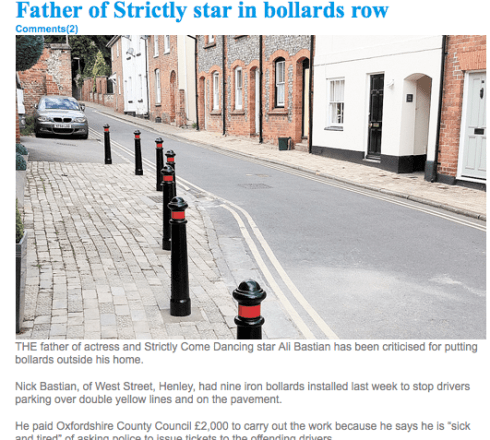
In March 1992 a question referring back to the 1974 act got a nice fluffy response “We are committed to seeking effective alternative powers to enable local authorities to deal with the problem of parking on footways when a suitable legislative opportunity arises. Meanwhile, general parking restrictions and in some cases local Act provisions, can offer a remedy. The use of high kerbs and other road engineering measures such as bollards can also prove a highly effective deterrent to footway parking, provided proper provision is made for the needs of pedestrians with disabilities”.
In November 1992 the government tried to claim that the current rules could be used effectively saying: “Under the Road Traffic Act 1991 local authorities are able to assume responsibility for all permitted parking controls throughout their areas on application to us. They can also apply to have special parking areas designated in which they will be able to enforce virtually all parking restrictions. While the police will retain powers to enforce endorsable offences such as obstruction and dangerous parking, local authorities will in practice be able to deal with the vehicle concerned if it is also parked in contravention of a parking regulation”
By 1993 the government was saying that a total ban on pavement parking would be impractical: “While there is a general ban on parking heavy goods vehicles on the pavement, parking other kinds of vehicles there is banned only where it is prohibited by a local Act of Parliament, as in London, where it contravenes a traffic order made by the local traffic authority, or if the vehicle is parked in a dangerous or obstructive position. Responses to the consultation document “Curbing an Abuse”, which we published in 1987, showed that a complete ban would not be practical. It would create severe difficulties for many local traffic authorities, and the police do not have the resources that would be necessary to enforce it effectively.” Also that “I accept that the current situation is not entirely satisfactory, but expect it to improve as local authorities take on responsibility for parking enforcement under the arrangements in the Road Traffic Act 1991.”
By 1999 answers wereall focused on the police and ‘obstruction’ and also on that gentle request in the Highway Code that drivers ‘should not’ park on the pavement: To quote: “the Highway Code (Rule 218) makes it clear that motorists should not park on the footway or pavement as it can seriously inconvenience pedestrians, people in wheelchairs, the visually impaired and people with prams and pushchairs. Enforcement is a matter for the police under the law relating to obstruction.”
The 2001 Parliamentary Select Committtee report on ‘Walking in Towns’ recommended: “extending the ban on pavement parking to towns and cities outside London and ensuring that it is enforced”. (The government response is not easily available on the web but they evidently rejected this advice – see December 2002 response below).
October 2002: “Enforcement of criminal parking offences is an operational matter for the police. The Road Traffic Act 1991 provided for the decriminalisation of most non-endorsable on-street parking offences and their enforcement by local authorities. Normally, where there is an infringement a local authority parking attendant would issue a Penalty Charge Notice (PCN) to the transgressor. It is a matter for the local authority to ensure parking attendants are doing their jobs properly. Motorists can appeal to an independent parking adjudicator if they wish to dispute the issue of a PCN.”
December 2002: “We are not in favour of a national ban on pavement parking for the reasons given in our response to recommendation [e viii] of the Walking in Towns and Cities report of the Environment, Transport and Regional Affairs Committee (Cm 5277). Parking on pavements and verges is a problem that should be tackled at local level using traffic regulation orders.”
In December 2010 Norman Baker (then in opposition) asked and got this response: “Local authorities outside London already have powers to prohibit parking on the footway where they consider this to be a problem, using Traffic Regulation Orders and appropriate traffic signs. They are also able to use physical measures such as high kerbs or bollards, which are self-enforcing and effective. There are no powers in primary legislation for the Secretary of State to make regulations that would enable local authorities to ban parking on the footway without a Traffic Regulation Order.”
In February 2011 Norman Baker (now a minister) claimed that there would be a: “nationwide blitz on motorists who selfishly force pushchair mums into the road” after it gave councils in England permission to use signs to indicate a local pavement parking ban. (only a few councils had announced plans for schemes in very small areas by August 2011 – hardly a blitz!).
Postscript
History appears to be repeating itself, but this time with regard to parking in mandatory cycle lanes (being a lane in the carriageways for cycling marked by a solid white line, and not to be confused with a shared use footway, or cycle track, which is not on the carriageway) ….
The Traffic Management Act 2004 (schedule 7 part 1 4(2)h) included a ban on parking in cycle lanes.
Since the Act received Royal Assent the section relating to the parking ban has not been enabled, meaning that it can’t be enforced. In March 2010 Lord Adonis said: “The Department for Transport is currently liaising with the Local Government Association to seek its views on the priority that its members outside London give to the introduction of the moving traffic contraventions provisions under part 6 of the Traffic Management Act 2004. A decision on the timing of implementation of these provisions will be made when these views are clear to the department.”
In 2013 the clause had evidently still not been enabled, according to the CTC who said: “However, DfT has yet to implement powers in the Traffic Management Act 2004 to enable local authorities to enforce parking in mandatory cycle lanes.”.
Judging by the fate of the 1974 Act I think cyclists are going to be in for a very long wait!









 Pedestrian Liberation